Why Trawler Galley Design Matters on Long Passages
Forty-eight hours motoring to Nova Scotia last spring with three crew members — that’s when everything fell apart. Our galley was a genuine disaster. The fridge compressor cycled every fifteen minutes because the unit sat baking in direct sun, the stove swung violently during a swell, and we couldn’t find the salt without unpacking half the cabin. By hour thirty-six, nobody wanted to cook. We lived on sandwiches and coffee. The generator ran hot, everyone was miserable, and we nearly turned back.
That’s what made me realize it: trawler galley design isn’t about luxury at all. It’s about survival and keeping morale intact on a forty-day Great Loop or a three-week coastal passage.
Poor galley layout crashes crew spirits. It burns fuel through constant generator runtime. It creates safety hazards — a flailing pot or an unsecured propane line during heavy weather matters when you’re 120 miles from the nearest anchorage. Most Great Loop cruisers inherit galleys designed for weekend trips, not extended voyages. A 32-foot Nordhavn or Grand Banks comes with maybe forty cubic feet of working galley space. That’s tighter than a food truck, honestly.
The math is simple enough. Better organization and provisioning strategy mean fewer generator hours, safer cooking conditions, and crew members willing to eat actual meals instead of energy bars at 2 a.m.
Maximizing Storage Without Sacrificing Performance
Start with vertical space. Most trawler owners waste it completely.
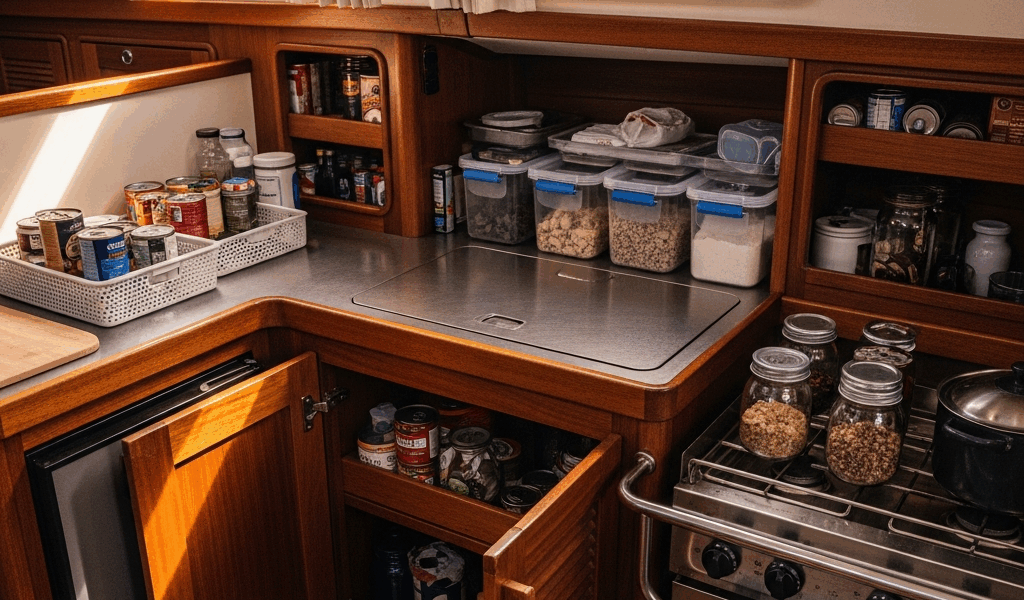
Under-counter lockers store your heaviest items — canned goods, oils, wine if you’re into that — near the boat’s centerline. This lowers the center of gravity and steadies the vessel in a seaway. I measured my boat’s galley at fifty-two inches from counter to overhead cabin liner. Most people use just the top eighteen inches effectively. Install adjustable wire shelving in overhead cabinets and you’ve tripled capacity. Add proper fiddle rails, at least one-inch high, and nothing slides during rolling seas.
Moisture control kills more fresh provisions than poor planning ever will. Your galley needs ventilation — genuine, consistent ventilation.
A dedicated dorade vent or mushroom vent above the stove keeps steam from condensing inside overhead lockers. I learned this by opening a cabinet to find two pounds of powdered milk transformed into concrete. Worse: moisture breeds mold in closed boxes. Use vacuum-seal storage for bread, pasta, and flour. Invest in fifty dollars’ worth of food-grade desiccant packets. Rotate them every two weeks without fail.
Provisioning fresh protein and produce for four-week passages requires strategy, not guesswork. Probably should have opened with this section, honestly.
Root vegetables — potatoes, carrots, onions — last four weeks when stored in mesh bags in the coolest, darkest corner of the galley, typically a lower cabinet away from the engine room bulkhead. Apples last three weeks. Citrus lasts five to six weeks. Fresh greens? Three to five days, maximum. Plan your menus backward from these timelines. Eat the spinach first, then move to hardy cabbage. Hard cheeses last eight weeks if wrapped and stored at fifty-five degrees. Fresh eggs in a cool locker? Three to four weeks if unwashed and handled carefully.
Your refrigeration system will struggle if you ask it to do too much. Most cruising trawlers run Force10 or Isotherm units pulling 8–12 amps at full compressor load. On a 48-volt house bank, that means the generator cycles just to keep milk cold. Supplement with ice-filled coolers for the first week. This buys you five to seven days where your fridge runs at thirty percent capacity instead of full load.
Stove, Oven, and Cooking Fuel Options for Cruisers
I’ve cooked on propane, electric, and alcohol stoves across thirty different boats. Each has genuine tradeoffs that matter when you’re three weeks from a marina.
Propane is reliable. It works in any sea state, heats fast, and doesn’t depend on your battery bank. The downside: propane leaks are real. A fuel-fed solenoid valve — $180 to $280 — cuts gas supply automatically if a leak is detected. This isn’t optional for extended cruising. Install the sensor in the engine room where propane would pool if your system fails. Test it monthly. Don’t skip this.
Diesel heating and cooking is standard on European trawlers like Nordhavn 40s and Symbol models. One tank feeds everything — main engine, heating, and galley. Logistically elegant. Practically? Your galley runs off 100-plus amps of battery load if you’re heating water on demand. That kills your battery bank on passage days when the engine isn’t running.
Electric induction cooktops are modern and efficient. They’re also impractical for cruising trawlers. You need 6,000–8,000 watts to run one unit. That demands a 120-amp alternator or a massive battery bank you’ll recharge exclusively. Most cruisers simply don’t have the electrical architecture to support it.
Alcohol stoves — Origo brand, around $600–$1,200 — are quiet, safe, and require no ventilation beyond normal galley air circulation. They’re slow. Very slow. A pot of water takes twenty minutes. But they consume three to four liters of denatured alcohol per month on extended cruising. At current prices ($8–$12 per liter depending on location), you’re spending thirty to fifty dollars monthly on fuel. That’s cheaper than the wear on your alternator from an induction cooktop.
For extended Great Loop passages, stick with propane as your primary stove and keep a backup alcohol burner. Propane gives you speed and confidence. The alcohol backup works when your solenoid fails.
Water and Waste Management in the Galley
Your freshwater system and galley are inseparable on long passages. You can’t separate them, really.
Most cruising trawlers carry 100–200 gallons of freshwater. A four-person crew uses roughly fifteen to twenty gallons daily for cooking, drinking, and washing. That’s five to eight days of autonomy before you need a fill-up. On a forty-day Great Loop section, you’re hitting marinas or anchorages with water access every five to seven days anyway. Plan around this constraint — it’s not negotiable.
Dishwashing is your freshwater killer. A standard faucet flows at 2.5–3.0 gallons per minute. Hand-washing eight place settings uses five gallons minimum. Multiply that by three meals daily and you’re burning fifteen gallons just on dishes. Install a low-flow aerator — 0.5 gallons per minute, roughly twelve dollars at West Marine. It cuts dishwater consumption by seventy percent without changing your behavior.
Grey-water production matters because it fills your holding tank. Your galley produces sixty to eighty percent of a cruising boat’s grey water through cooking and dishwashing. If your holding tank capacity is fifty gallons and you’re generating thirty gallons daily, you’re pumping out every other day. On the Great Loop, this means stopping at marinas, waiting in pumpout queues, and burning fuel.
Reduce grey-water production by composting food scraps — don’t pour them down the sink — using biodegradable dish soap that breaks down faster, and limiting meal prep. Pre-wash vegetables at a marina before heading out for a three-week passage. This sounds pedantic. It matters when you’re in a remote anchorage in upstate New York with no pumpout access for forty miles.
Budget-Friendly Upgrades for Older Trawler Galleys
You don’t need a $50,000 galley refit to make long passages comfortable. That’s probably the biggest misconception out there.
Start with the fridge. Most used Nordhavns and Grand Banks from the 2000s have original Isotherm units running at eighty percent efficiency. Replacing the box gasket — forty dollars, two hours of labor — and the compressor valve ($80, thirty minutes) restores performance without ripping out cabinetry. I did this on a 2008 Nordhavn 32 and cut compressor runtime from forty minutes per hour to eighteen. That’s noticeable.
Slide-out pantry drawers run $120–$200 for quality wire units. They transform deep under-counter cabinets from dead space into accessible storage. You can actually see what’s inside without crawling underneath.
Better insulation around your refrigerator cabinet costs two hundred dollars in high-quality closed-cell foam and three weekends of your time. It reduces thermal load by roughly twenty percent. Pair this with a small solar panel — 150-watt, four hundred dollars — dedicated to refrigeration compressor precharging and your generator runs fewer hours.
Hanging organizers, thirty to sixty dollars for marine-grade versions, mounted on cabin bulkheads store frequently used items — salt, spices, utensils — at eye level. Smaller boats need vertical thinking, apparently.
A quality stainless steel gimbaled stove runs $1,200–$1,800 for a Force10 or Dickinson. Replace older models prone to swinging violently. The gimbal system keeps your cooking surface level while the boat heels or pitches. This is the single upgrade that improves passage-making comfort most noticeably.
Budget three to five thousand dollars for these upgrades on a thirty-two to thirty-six-foot trawler. You’ll recover most of it in generator fuel savings and crew sanity during extended cruising.


Stay in the loop
Get the latest passage maker mag updates delivered to your inbox.