“`html
Why Fuel Quality Fails During Long Cruises
Diesel fuel doesn’t just sit in your tank like water — it’s a living chemistry experiment, and I learned this the hard way halfway through my Great Loop when the fuel polishing question became urgent rather than theoretical.
The timeline is brutal if you’re unaware. Within the first 30 days of storage, oxidation begins degrading the fuel’s cetane rating, that’s the measure of how readily diesel ignites. By day 90, you’ve lost measurable combustion efficiency. By six months — which is realistic for anyone doing extended Great Loop passages with winter layups or slow-cruising segments — your fuel has likely developed several simultaneous problems.
Water contamination starts immediately. Your fuel tank breathes. Every temperature cycle, day heating and night cooling, creates condensation inside the tank. In humid anchorages, this happens faster. I’ve pulled fuel samples from tanks that looked clean to the eye but contained 500+ parts per million of water. That’s dangerous territory.
Then microbial bloom happens. Bacteria and fungi thrive at the fuel-water interface, the bottom of your tank where water naturally settles. They multiply rapidly in warm anchorages — think Gulf Coast summers or the Florida Keys in July. These microbes create a sludgy biofilm that clogs filters and produces organic acids that corrode fuel system components from the inside out.
Probably should have opened with this section, honestly. Most cruisers don’t realize fuel degradation is cumulative and accelerating. A system that prevents these problems saves thousands in injector repairs and emergency tows.
Fuel Polishing System Types for Trawlers
There are three categories of fuel polishing systems, and the choice depends on your tank configuration and cruising timeline.
Standalone Cart Systems
These mobile units — brands like Fuel Manager and Aqua-Pure make solid 12-volt models around $2,500 to $4,500 — connect via temporary hoses to your fuel tank’s filler and return. You park them in the engine room or on deck and run them during layups. Flow rates typically run 10 to 20 gallons per hour, which works for trawlers with 300 to 1,200 gallon tanks if you’re patient and running them 8 to 12 hours daily.
The advantage is flexibility. Removed it from a previous boat? Install it on the new one. No permanent modifications needed. The disadvantage is you have to remember to run it, store it between cruises, and deal with hose routing every single time you set up.
Engine-Mounted Systems
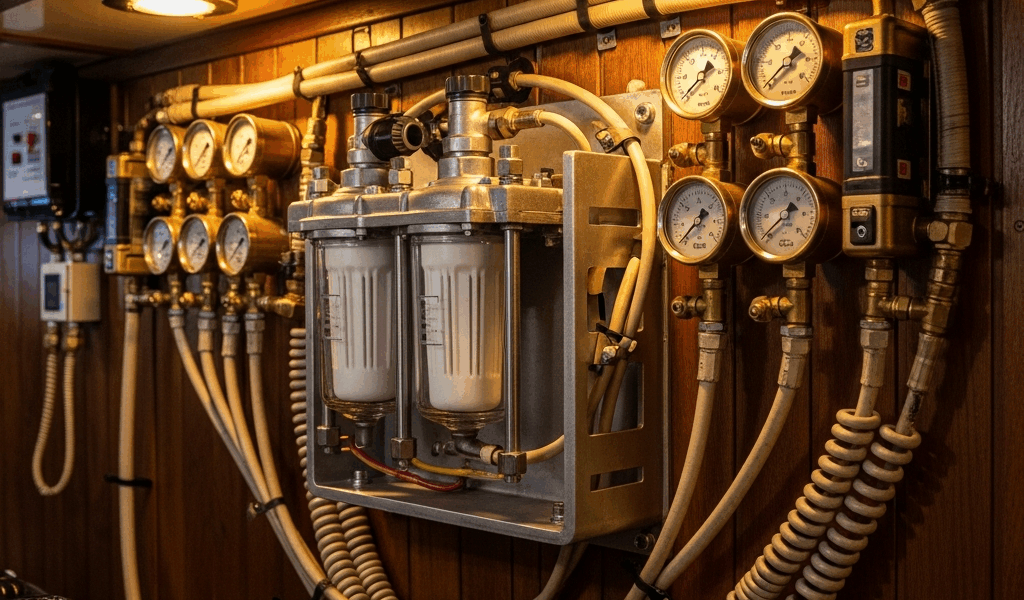
Fuel polishing kits that integrate into your existing fuel system — brands like Water Armor and Separ make these — sit between your main tank and engine. They use engine-driven vacuum or a dedicated 12-volt pump to continuously circulate and filter fuel while running. Flow rates of 30 to 60 gallons per hour are typical.
I’ve seen these on several Nordhavn and Kadey-Krogen trawlers. The appeal is passive operation — you run the system every time you fire up the engine, which for Great Loop cruisers happens regularly anyway. Installation requires cutting into fuel lines and adding filter cartridges you’ll change every 300 to 500 hours of engine operation.
There’s a catch though: if your engine isn’t running, the system isn’t working. During extended layups, you’re not polishing fuel.
Integrated Tank Systems
Some newer trawlers — and retrofit kits for existing boats — feature internal pickup tubes, integrated sumps, and dedicated 24-volt circulation pumps. These are permanent installations that cost $8,000 to $18,000 but give you the best performance. Flow rates of 50 to 100+ gallons per hour are achievable, and they run independent of engine operation.
For serious long-distance cruisers, this is the ideal setup. But not everyone wants to drop that kind of money.
For most passage makers, I recommend the engine-mounted system as the middle ground. It’s far cheaper than integrated tanks, more reliable than remembering to run a standalone unit, and effective enough for 6 to 12 month cruises with reasonable fuel storage discipline.
Installation Steps for Existing Fuel Systems
Here’s where theory meets reality with a wrench in your hand.
Assess Your Tank Access
First priority: can you physically access your fuel tank’s return and suction lines? Open your engine compartment and trace where fuel enters your engine. Follow that line backward. You’ll find either a single through-hull fitting on your tank — return fuel goes overboard or into the tank — or a dual-line setup with suction and return.
For Nordhavn 40 to 52 models, the fuel suction and return lines are typically located on the aft end of the tank. Access is tight but achievable. Smaller boats might have fuel tanks mounted vertically with limited working space. Measure your available room before ordering equipment.
Plan Your Routing
The suction line pulls fuel from the tank bottom — that’s critical, because that’s where water and sludge collect. The return line should enter the tank near the top. Never install a return line with its intake at the bottom or you’ll just re-circulate contamination.
Route new fuel lines away from engine heat. Use braided stainless steel hose rated for diesel, minimum 5/16-inch ID for engine-mounted systems. I used Aeroquip hose at $3.50 per foot on my system and had zero issues with diesel compatibility. Avoid rubber hoses if possible — diesel degrades them over time.
Plan for at least one in-tank filter bowl with a visual indicator. This catches debris before it hits your fuel polishing cartridge.
Install the Filter Housing and Pump
Mount the fuel polishing filter head in an accessible location — usually on the engine block or nearby fuel line. Use vibration-damping mounts. I made the mistake of bolting mine directly to the engine on my first attempt. During heavy weather in the Gulf, the vibration created air pockets in the fuel lines. Switched to rubber isolators, about $45 for a set of four, and never had the problem again.
If your system uses a 12-volt pump, mount it away from the exhaust manifold. Diesel fuel boils at roughly 355°F, but you don’t want to test that. Wire the pump to its own 20-amp circuit breaker, not the house batteries’ main busbar.
Bleed the System
This is non-negotiable. Air in fuel lines causes cavitation — the pump loses prime and sucks a vacuum instead of fuel. Your fuel polishing system won’t work, and you risk engine damage if the main fuel supply gets starved.
After connecting all hoses, manually bleed the return line by loosening its fitting at the tank and running the pump until fuel drips out with no bubbles. Do the same at the suction line if accessible. Then tighten everything and run the engine at idle for 10 minutes before taking it to sea.
Watch your fuel pressure gauge. Normal diesel engine fuel pressure is 45 to 60 PSI. If you see drop-offs during acceleration, you still have air in the lines.
Operation Protocol for Great Loop Passages
Installation is one thing. Using the system correctly is another.
For engine-mounted systems, run them every time you operate the engine — that’s automatic if you’re cruising. For standalone systems, run them daily during layups, minimum 8 hours. This cleans roughly 80 to 160 gallons per day depending on flow rate, which for a 500-gallon tank means a complete turnover every 3 to 6 days.
Monitor fuel water content monthly. A fuel water detection kit costs $25 to $50 and takes five minutes. Pull a sample from the tank’s lowest point. Anything over 100 PPM warrants aggressive polishing. Over 500 PPM and you’re in contamination crisis mode.
Change filter cartridges every 300 hours of polishing operation, or when the bypass valve starts indicating pressure buildup — usually a visual indicator on the filter head turns yellow or red. Don’t ignore this. A clogged filter forces fuel around the bypass valve unfiltered.
Before departure from any extended layup, run your polishing system for 24 hours straight to achieve a final fuel cleaning cycle. This catches microbial growth that built up during anchoring.
Common Fuel Polishing Failures and Fixes
Not everything goes smoothly.
Clogged Filters in Weeks Instead of Months
This means your intake is sucking from contaminated tank bottom. Check your suction line position. Is it actually at the lowest point of the tank, or did it get blocked by tank structure? Reposition if possible. Also — change your intake filter bowl cartridge. If it’s already dirty after 50 hours, your tank is worse than you thought. This isn’t a polishing system failure, it’s a tank condition revelation.
No Flow Despite Pump Running
Check for air in the lines. A pump running against air produces noise but no fuel movement. Re-bleed the return line. If that doesn’t work, verify the suction line isn’t kinked or collapsed. Fuel systems can’t suck fuel upward more than about 18 inches against atmospheric pressure. If your tank is higher than your pump, you need engine vacuum assist or a different routing strategy.
System Cavitation During Heavy Weather
The boat is rolling, fuel sloshes in the tank, and suddenly the pump starts cavitating — making a grinding noise and losing prime. This happened to me in Gulf Stream conditions. The fix: install a surge tank, basically a small 5 to 10 gallon tank with baffles, that feeds the polishing pump. This damps fuel surface movement and maintains constant suction pressure.
Moisture Trap Saturation After One Week
Your fuel contamination is severe. Change the water-absorbing cartridge. Also check for a fuel leak you haven’t noticed — water can be entering the tank through a crack in a through-hull fitting or a failing fuel cap seal. I found mine was condensation combined with a failed filler cap gasket. Replaced the cap for $120 and the problem disappeared.
Fuel polishing systems work. But they only work if your tank condition isn’t already catastrophic and if you use them consistently. For Great Loop cruisers doing extended passages, a properly installed system is the difference between comfortable fuel management and expensive injector rebuilds.
“`

Stay in the loop
Get the latest passage maker mag updates delivered to your inbox.