Why Trawlers Overheat Transmissions on Long Passages
As someone who’s spent the last three seasons helping passage makers troubleshoot engine room temperatures from the Eastern Shore to the Gulf Coast, I learned everything there is to know about why displacement-speed cruising destroys transmissions that handle weekend boating just fine.
The math is brutal. A typical Great Loop cruiser runs 8 to 10 hours daily at 1,200 to 1,400 RPM—call it 7 to 9 knots. That’s sustained. No throttle-backs. No cool-down periods. A weekend boater might hit similar RPM during an afternoon harbor run, but they’re talking 2 hours maximum. The transmission fluid in their boat cycles through the cooler with regular gaps between trips. Yours doesn’t.
Over 200 cumulative hours a month, a trawler transmission sits in continuous thermal stress. It’s relentless.
Then add the auxiliary electrical load that cruisers depend on. The genset runs 6 to 8 hours daily. Hydraulic systems for bow thrusters, windlasses, stabilizers—they push fluid through their own heat exchangers too. Modern refrigeration systems, critical for extended passages, dump waste heat into the engine room. All of this raises ambient temperature around the transmission cooler itself. Raw-water cooling systems ingest whatever temperature profile exists at your intake: 85°F Gulf water feels different than 72°F Atlantic water, and that affects cooler efficiency downstream.
The problem isn’t one failure point. It’s cumulative thermal load colliding with inadequate cooling capacity that was sized for occasional use.
Early Warning Signs Before Catastrophic Failure
Probably should have opened with this section, honestly—because I’ve watched cruisers miss every single warning sign until the transmission simply stops responding to throttle input 40 miles from the nearest haul-out.
Start with your senses before instruments fail. Transmission fluid smells distinctly acrid when overheated—not the familiar burnt-oil smell of normal operation, but sharp, almost chemical. If you catch this smell in the engine room after 6 hours of cruising, your cooler is undersized. The odor itself is fluid degradation happening in real time.
Performance lag comes next. The transmission responds half a second slower to throttle inputs. Upshift delay increases. This happens because overheated fluid loses viscosity; internal clutch packs slip microscopically. You’ll notice it as a slight hesitation before the boat settles into its cruising speed. That hesitation—that’s your transmission telling you it’s working too hard.
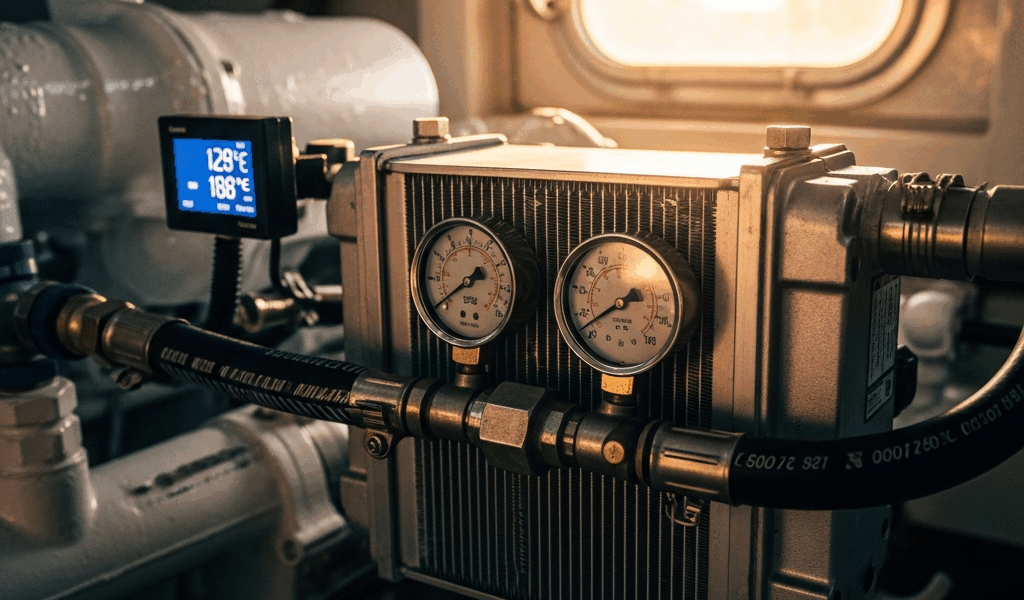
Temperature gauge readings matter — if you have them. Allison transmissions in common trawler applications (5000 series, 4000 series) flag warnings at 200°F and go into limp-home mode around 210°F. ZF transmissions operate similarly, with safe continuous operating range between 140°F and 190°F. If your gauge shows 195°F at the 6-hour mark of an 8-hour passage, you’re in danger territory by hour eight.
Many older cruising boats don’t have transmission temperature monitoring. Install one before your next long passage. A simple electric sender running to a programmable gauge—Teleflex Premium, Standard Horizon, or Garmin all make marine versions—costs $180 to $320 installed. It pays for itself the moment it prevents a $6,000 transmission replacement in an unfamiliar port.
Transmission slipping—that undefined, mushy feel when you apply throttle and RPM climbs without corresponding speed increase—means fluid breakdown is accelerating. Shear forces have already damaged viscosity improvers in the fluid. Keep cruising and you’re operating on borrowed time. Very borrowed time.
Transmission Cooler Upgrades for Continuous Cruising
Sizing a replacement cooler requires honest assessment of your duty cycle. The baseline calculation multiplies engine horsepower by 0.5 to 0.7 to estimate transmission heat rejection in BTU per hour during cruise.
A 150-horse diesel cruising 8 hours daily generates roughly 75,000 to 105,000 BTU/hour of transmission heat load. Your factory cooler—typically a tube-and-fin aluminum unit roughly 12 inches long by 6 inches tall by 4 inches deep—was engineered for 3-hour summer cruises. That unit handles about 35,000 BTU/hour effectively. The math breaks, plain and simple.
Plate-frame coolers versus tube-and-fin represents your core decision. Plate-frame units (Hydro-Tec, Standard Motor Products, or Wolverine models in the 16-plate to 30-plate range) offer superior heat transfer efficiency in confined spaces. A 20-plate stainless unit measures roughly 10 inches by 8 inches by 4 inches but dissipates 95,000+ BTU/hour depending on flow rate and raw-water temperature. You’re looking at $480 to $700.
Tube-and-fin coolers require larger physical footprint but cost less upfront—$250 to $400 for equivalent capacity. If you have the engine room volume, a 30-inch long tube-and-fin unit handles comparable thermal load to a 20-plate frame. More weight, more real estate, though.
Raw-water versus fresh-water cooler configuration matters for passage makers. Raw-water systems (cooler connected directly to through-hull intake) reject heat faster but require zinc-anode maintenance and biofouling management. Fresh-water loops (cooler between transmission and engine’s fresh-water circuit) reduce maintenance but add complexity and slight thermal inefficiency—typically 8 to 12 percent depending on circulation pump capacity.
Flow rate requirements: manufacturers specify minimum and maximum GPM through the transmission. Allison units typically require 8 to 15 GPM depending on model. Check your specific transmission manual before selecting a cooler. Under-spec’d flow starves the cooler of circulation. Over-spec’d pressure (more than 50 PSI) damages internal seals. The cooler itself should handle 100+ PSI working pressure for marine safety margin.
Most cruisers upgrade both cooler capacity and circulation pump simultaneously. Original pump might move 6 GPM at cruise RPM. A replacement pump—Jabsco 18590, $340—delivers consistent 12 to 15 GPM regardless of engine RPM variance. Combined cooler-pump upgrade costs $800 to $1,100 installed and extends transmission lifespan 6 to 10 years for full-time cruisers.
Monitoring and Maintenance During Extended Passages
Daily temperature logging sounds obsessive until you realize it catches cooling system deterioration three weeks before catastrophic failure.
Establish your baseline: record transmission temperature, water intake temperature, and ambient engine room temperature at the same time each cruising day for two weeks. Plot these on a simple spreadsheet. Your baseline tells you what’s normal for your boat’s cooling system, water conditions, and operational pattern.
Watch for upward drift. When transmission temperature climbs 5°F week-over-week despite identical cruising hours and water temperatures, your cooler is fouling. Raw-water systems develop zebra mussel blockages. Mineral deposits coat tube interiors. Fresh-water loops accumulate rust particles and coolant breakdown products. This drift is your 200-hour warning.
Set alert thresholds conservatively. For 8-hour passage days, treat 185°F as your “plan an anchorage for tomorrow” temperature. At 195°F, reduce speed or stop and address the cooling system. Don’t push to 205°F thinking you’ll make the next waypoint. You won’t—the transmission goes into limp-home mode and you’re idling at 3 knots anyway.
Routine maintenance during extended seasons: check transmission fluid level every 40 hours of operation, not monthly. A low level introduces aeration and accelerates temperature rise. Filter changes every 150 to 200 hours for passage makers (versus factory spec of 500 hours for typical owners). The extra fluid changes cost $60 to $80 per service but catch particle contamination before it damages clutch material.
Inspect cooler lines monthly for weeping, cracks, or pinhole leaks. A leaking transmission cooler line under pressure dumps fluid silently into the bilge while reducing flow through the cooler. You won’t notice until temperature spikes 20°F in one hour. Hose replacement runs $150 to $250 depending on routing.
When to Upgrade vs. Repair on a Long-Range Cruising Schedule
The decision splits on two factors: remaining transmission life and your cruising schedule intensity.
If your transmission has fewer than 5,000 hours and temperature control is your only symptom, upgrade the cooler system. Cost $800 to $1,100, execution 3 to 4 days in a boatyard with crane service. You’re buying 6 to 10 additional years of transmission life. Transmission replacement—$5,500 to $8,500 depending on model and labor rates—plus 2 to 3 weeks downtime that might consume your entire cruising season. That math favors the cooler.
Transmissions over 7,000 hours show internal wear independent of temperature. Seals harden. Clutch material thins. A cooler upgrade extends remaining life only if overheating was the primary failure driver. If you’re already seeing slight slipping or sluggish upshifts, a cooler fixes the symptom, not the underlying mechanical degradation. In this scenario, budget for transmission replacement within 2 years anyway. Assess whether a $900 cooler upgrade delays the inevitable $7,000 rebuild by 18 months—often not worthwhile if you’re already planning to haul out.
Seasonal passage makers (3 to 4 months annually, 250 to 400 cruising hours per year) justify cooler investment immediately. Full-time cruisers (500+ hours annually) should already have upgraded factory coolers before beginning multi-year passages. The downtime risk during peak season far exceeds upgrade cost.
One final thought: transmission overheating during extended passages isn’t a design flaw in your boat. It’s a cooling system engineered for different duty than what modern cruisers demand. Recognize that shift, plan accordingly, and your transmission runs cool for decades.


Stay in the loop
Get the latest passage maker mag updates delivered to your inbox.