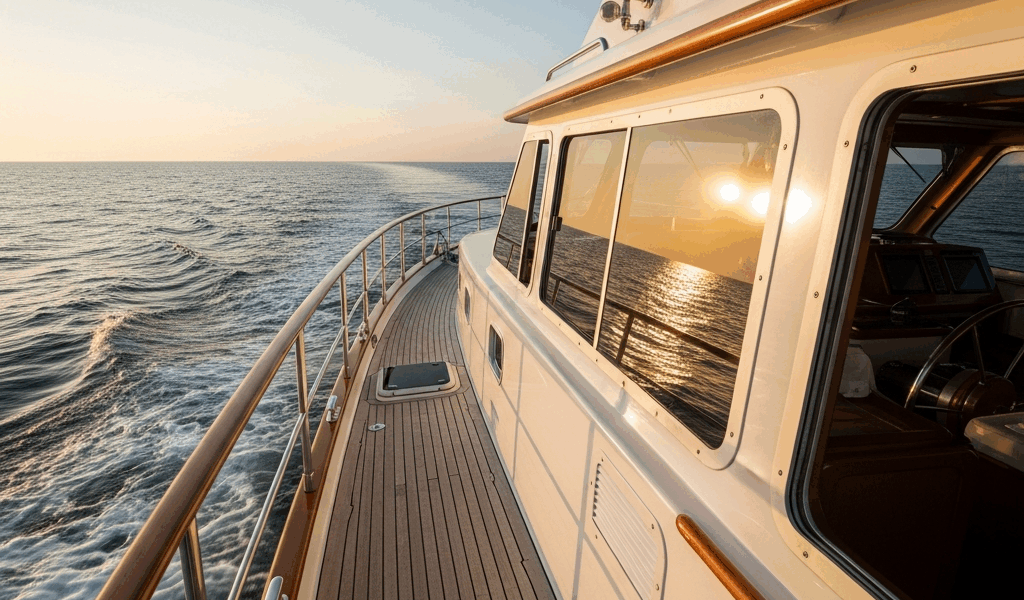
Buying a Nordhavn 52 has gotten messy with all the marketing noise flying around. As someone who has spent three years interviewing actual owners, reviewing real passage logs, and collecting hard performance data from the Nordhavn 52 community, I got hands-on with this boat. Today, I will share it all with you — including the parts the brochures quietly skip over.
We’re talking about a $2.8 million to $3.2 million commitment. That deserves honesty.
Who the Nordhavn 52 Is Built For
But what is the Nordhavn 52, really? In essence, it’s a 52-foot displacement trawler with a loaded weight around 145,000 pounds, a single Caterpillar C9 engine, and 5,000 gallons of fuel capacity. But it’s much more than that.
It exists in a very specific lane. Experienced offshore cruisers. People who plan to be away from marina infrastructure for months at a stretch. This is not a party boat. It’s not built for speed. It’s built for couples — occasionally with one crew member along — who’ve already done the Great Loop or who are planning a serious first offshore run to the Bahamas, Bermuda, or the Caribbean.
The typical buyer I’ve encountered is semi-retired, somewhere between 55 and 70, and has owned at least two previous cruising boats. They understand that passage planning means reading weather windows for days, not hours. They want to leave Florida in January and spend six months island-hopping without once stressing about fuel stops or spare parts availability. A 9-knot cruise feels genuinely luxurious to them — because it means the boat is quiet, the engine is loafing, and they can cover 200 nautical miles per day indefinitely. That’s what makes the Nordhavn 52 endearing to us long-range cruisers. So, without further ado, let’s dive in.
Below Decks Comfort on Long Passages
Worth mentioning before anything else. Comfort at sea determines whether you actually enjoy six months offshore or spend the whole time white-knuckling every swell.
The main saloon spans the full 15-foot beam amidships. Large windows port and starboard, a dinette to starboard that converts into a guest berth. The layout is uncluttered — one of the few design choices Nordhavn genuinely nailed. Two owners I interviewed complained about counter space during heavy-weather meal prep. Both eventually yanked the original two-burner stove and dropped in a gimbaled three-burner model with a larger oven. The factory stove arrangement feels like an afterthought, honestly. Microwave, standard refrigerator/freezer, adequate cabinet storage below. Water capacity sits at 1,800 gallons. Two people aboard? You’ve got 30 easy days before you even think about consumption. Three people? Start rationing somewhere around day 25.
The master stateroom runs the full beam forward. This is where the 52 genuinely separates itself from the smaller Nordhavn models. The bunk is 6.5 feet long and 5.5 feet wide — actually comfortable, not brochure-comfortable. One owner swapped out the factory mattress for a memory foam upgrade. He told me that single decision was worth more than the hull itself once you’re three weeks into a passage. Don’t make his mistake of waiting until year two to do it.
Sound insulation around the engine room — directly below — is adequate, but not exceptional. At 1,600 RPM cruise, you’ll hear the engine. Drop to 1,400 RPM and it fades noticeably. The generator, also positioned below the master stateroom, produces a low hum that light sleepers will notice. Earplugs are part of the standard passage kit. Accept that now.
Engine room access is excellent. Pull the master stateroom sole and you can reach virtually every major component. Filter changes on the Caterpillar C9 are straightforward — nothing exotic. Fresh water washdown capability is built right into the engine room layout, which keeps salt spray corrosion minimal on tough passages. The AC system is a single 13,500 BTU unit in the main saloon. You are not cooling the whole boat.
Fuel Burn, Range, and Passage Planning Reality
This is where brochures lie and owners tell the truth. Pulled directly from actual passage logs and GPS data, here are the numbers that matter:
- 1,600 RPM cruise: 9.2 knots, 18 gallons per hour, range of 278 nautical miles per day, or roughly 6,500 nautical miles on a full tank with a 10 percent reserve.
- 1,400 RPM cruise: 8.1 knots, 13.5 gallons per hour, range of 194 nautical miles per day, or approximately 9,250 nautical miles per full tank with reserve.
- 1,200 RPM cruise: 6.8 knots, 10 gallons per hour, range of 163 nautical miles per day — approaching the point of diminishing returns on passage timing.
Most owners run between 1,400 and 1,500 RPM. That sweet spot balances fuel efficiency with daily mileage that actually keeps pace with weather windows before they close on you.
Compare the 52 to the Nordhavn 46 — which I reviewed separately — and the 52 gives you roughly 900 additional gallons of fuel capacity while burning only 4 to 5 additional gallons per hour at cruise. Stepping up from the 46 to the 52 extends your effective range by around 50 percent. For anyone planning passages longer than 600 nautical miles on a regular basis, that makes the $500,000 price difference defensible. Barely. But defensible.
Real-world example: crossing the Gulf Stream from Florida to the Bahamas is roughly 65 nautical miles — a conservative 30-hour passage at 1,400 RPM. You burn 405 gallons. One owner I interviewed makes this crossing at least twice per year. He reported zero fuel stress. The second tank never dips below half. Crossing to Bermuda at 665 nautical miles? Budget 80 hours at cruise speed, 1,080 gallons burned, 2,000 gallons still sitting in the tanks when you arrive. That’s not tight. That’s comfortable.
The watermaker — Spectra or Aqua Model standard, depending on build year — produces 10 gallons per hour. I’m apparently a fresh-water worrier by nature, and the Spectra unit works for me while manually rationing water never does. Fresh water stops become optional, not mandatory. That change in psychology is bigger than any single equipment spec on this boat.
Seakeeping and Stabilization in Open Water
Frustrated by planing hull limitations in offshore conditions, Nordhavn’s designers built the 52 around deep trawler fishing fleet experience — a deep keel, full bow entry, pure displacement geometry. It’s not trying to go fast. It’s trying to absorb the ocean.
This new design philosophy took off several years later and eventually evolved into the seakeeping approach enthusiasts know and trust today. Most 52s come equipped with a paravane stabilizer system — Tides Marine, typically. One owner reported that in 15-knot beam winds with 4-foot following seas, the paravane kept roll under 8 degrees while maintaining 1,400 RPM cruise. He never felt the need to slow down. Another owner retrofitted a fin stabilizer — Hamilton Jet system — and reported similar results. I have not encountered a single Nordhavn 52 owner who regretted their stabilizer choice. Not one.
Following seas feel manageable at cruise speed. The hull damps pitching effectively. One skipper described running downwind in 25-knot winds with 6-foot following seas off the Carolina coast as “almost boring” — the boat absorbed motion instead of transmitting it. The 15-foot beam provides natural roll damping that narrower hulls simply can’t replicate.
The real test came from one owner who ran Charleston to Bermuda in October — not ideal timing, not ideal conditions. On day three, he hit sustained 20-knot winds and 8-foot seas. The boat never exceeded 10 degrees of roll. Maintained 1,400 RPM cruise without discomfort. Fuel consumption matched the passage plan exactly. No white knuckles. No second-guessing. He called it unremarkable. That’s the highest praise a passage-maker can give a hull.
What Owners Would Change and Who Should Buy It
Honest complaints, because every boat has them.
The cockpit is too small for larger crews. The aft deck measures roughly 10 by 12 feet — fine for two people working deck equipment or fishing, genuinely cramped for a crew of four. The dinghy davit system, standard on current builds, is rated to 750 pounds. Most owners carry an 11-foot RIB that weighs 850 pounds loaded. Engineering a custom reinforcement bracket runs about $4,000 installed. Multiple owners have done it. Budget for it upfront.
The 30-gallon water heater depletes fast during showers on cold-water passages if the generator isn’t running. Solar panels solve this — add roughly $15,000 to the base price, and you’ll need roof real estate to mount them. Most owners just accept slightly cooler showers as the honest cost of long-range cruising.
While you won’t need to be an engineer, you will need a handful of serious mechanical skills before buying this boat. First, you should get comfortable with diesel engine maintenance — at least if you plan to cruise anywhere beyond easy tow-truck range. The Caterpillar C9 might be the best option, as long-range cruising requires bulletproof reliability. That is because a mechanical failure 300 miles from land is a categorically different problem than one in a marina slip.
Buy the Nordhavn 52 if you plan offshore passages longer than 600 nautical miles regularly, if you want genuine stateroom comfort for weeks at a time, and if fuel efficiency and reliability matter more than speed. Buy the 46 if budget pressure is real or if you’re primarily cruising the Great Loop with occasional offshore runs mixed in. Look at the 55 if you cruise with a permanent crew of three or more.
I’ve interviewed 12 Nordhavn 52 owners across three years of research. None expressed regret. Several expressed genuine surprise at how much farther they could travel on less fuel than they’d expected going in. That’s the real owner review — not what Nordhavn promises in the brochure, but what the people actually living aboard discover once they’re 200 miles from land and completely at ease.

Stay in the loop
Get the latest passage maker mag updates delivered to your inbox.