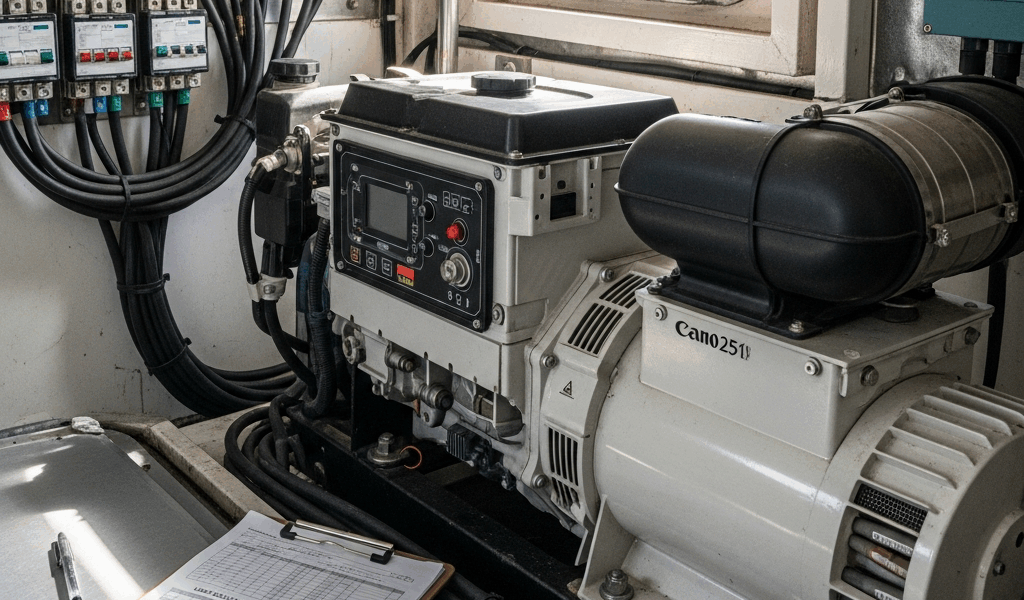
Why Trawler Generators Fail on Long Passages
I spent three seasons helping passage makers troubleshoot generator problems, and the failures fell into two brutal categories: undersized units that couldn’t handle simultaneous loads, and oversized monsters that ran so inefficiently they burned through fuel like the boat was leaking diesel from the hull.
The undersized scenario plays out like this. You’re running a 240V water maker (drawing 4.5 kilowatts), the battery charger kicks on at 6 kilowatts because the house bank dipped overnight, and someone decides now is the perfect time to make breakfast on the galley induction cooktop—another 3.2 kilowatts. Your 20kW generator hits a breaker. Everything shuts down. You’re left sitting in silence with no fresh water production, no charging, no hot food. Just frustration and the sound of water lapping against the hull.
The oversized problem feels less dramatic until you’re eight hours into a passage watching the fuel gauge drop faster than it should. A 50kW generator running at 30% load consumes nearly as much fuel as one running at 50% load. You bought extra capacity “just in case,” and now you’re burning 8 gallons per hour instead of 5. Your range shrinks. Your fuel budget evaporates.
Probably should have opened with this, honestly: the Great Loop doesn’t care how powerful your genset is. It cares whether you can run everything you need simultaneously for 8–12 hours a day without burning cash. Most trawler owners size their generators without doing that math first.
Calculate Your Actual Daily Load Demand
This is where speculation ends. You need a list of every appliance, its power draw, and how long it runs daily. No exceptions.
Start with 120-volt loads:
- Refrigerator or freezer: 400–800 watts, running 6–8 hours daily
- Microwave: 1,000–1,500 watts, but only 15–30 minutes weekly (skip the peak load scenario)
- Coffee maker: 800–1,200 watts, 20 minutes daily
- Galley induction cooktop: 2,400–3,600 watts, 45 minutes daily
- Water heater element: 3,000–4,500 watts, 1–2 hours daily
- Cabin lights, navigation gear, VHF, autopilot, pumps: 100–400 watts, continuous
- Laptop, phone chargers, entertainment: 50–150 watts, 4–6 hours daily
Now 240-volt equipment. This is where trawler-specific loads dominate:
- Battery charger: 3,000–8,000 watts, 3–6 hours daily (depends on how much you discharge)
- Water maker: 2,000–5,000 watts, 2–4 hours daily (or longer if you’re making 50+ gallons)
- Bow thruster: 5,000–15,000 watts, brief bursts (5–10 minutes weekly for docking)
- Diesel heater blower: 500–2,000 watts, 4–8 hours daily in cold months
- Air conditioning: 3,000–6,000 watts per unit, 6–10 hours daily in summer
- Watermaker pre-filter heater: 1,500–3,000 watts, 1–2 hours before water maker runs
Create a simple table. Write down each appliance, its wattage (check the nameplate or manual), and estimated daily runtime in hours. Multiply wattage by hours. That’s your daily watt-hours for each device.
Example: Your battery charger draws 5,500 watts and runs 4 hours daily. That’s 5,500 × 4 = 22,000 watt-hours, or 22 kilowatt-hours.
Do this for everything. Then add them up.
Here’s what separates real load planning from guessing: simultaneous demand. You won’t run the water maker for 3 hours straight while leaving the battery charger, diesel heater blower, and cabin lights off. You’ll make water in the morning—water maker plus heater plus lights running. Then you’ll charge batteries in the afternoon with the charger and lights on. Some days you’ll dock and need virtually nothing. Other days—fog, rough conditions, poor anchorings—you’ll run the thruster twice and make extra water because you’re nervous about supply.
The peak simultaneous load is your real number. Not the sum of everything running, but the highest wattage you’ll demand at any single moment.
In my example: water maker (4,500W) plus battery charger (5,500W) plus diesel heater blower (1,500W) plus galley lights and nav gear (300W) equals 11,800 watts. That’s your peak.
Apply the Great Loop Reality Factor
A typical weekend cruiser operates near marinas with reliable 30-amp or 50-amp shore power. The generator runs maybe 2–3 hours daily, usually at partial load, usually for just the battery charger and water heater.
The Great Loop is different. You’re transiting 340 miles of the Chesapeake. You’re anchoring in areas where the nearest mooring field is 15 miles away and might not have power. You’re running the generator 8–12 hours daily, every day, for weeks straight. This changes everything about generator sizing.
First, understand continuous-duty rating versus peak-load rating. Your generator’s nameplate says “35kW continuous, 40kW peak.” Continuous is the honest number—what it can sustain indefinitely. Peak is a 30-minute trick. For passage making, size to continuous duty. You’ll spend most of your day running at 60–80% continuous load, not dancing around the peak rating.
Second, fuel consumption scales with load, but not linearly. A 35kW Onan running at 50% load (17.5kW demand) burns roughly 4.2 gallons per hour. That same generator at 75% load (26.2kW demand) burns 5.8 gallons per hour. Oversizing by 10 kilowatts—thinking you need cushion—can add 1.5 gallons per hour to your fuel burn. Over a 2,000-mile passage, that’s 300+ extra gallons.
Work this scenario: You’ve calculated a peak simultaneous demand of 24 kilowatts. You think buying a 40kW genset gives you safety margin. On the Great Loop, you run this generator 10 hours daily at about 60% load (24kW demand). Monthly fuel consumption: 10 hours × 30 days × 5.1 gal/hour equals 1,530 gallons. A properly-sized 28kW unit at the same load burns roughly 4.2 gal/hour—that’s 10 × 30 × 4.2 = 1,260 gallons. You’ve wasted 270 gallons in a single month by oversizing.
Now consider the inverse: buying a 20kW generator because it’s cheaper. Your peak load is 24kW. You can’t start the water maker and run the battery charger simultaneously. You’re making compromises that defeat the purpose of passage making. You should be independent, not rationing consumption.
Right-Sizing Your Generator to Your Hull
Boat size is the first rough guide, but it’s not the only variable. Two 45-foot trawlers can have radically different power demands based on hull layout, system choices, and cruising style.
Rough baseline:
- 20–35 feet: Peak simultaneous demand usually 12–20kW. A 15–20kW continuous-duty generator handles most scenarios.
- 35–50 feet: Peak demand typically 20–32kW. You’re looking at 25–35kW continuous.
- 50+ feet: Peak demand often 30–45kW. Continuous units from 40–60kW are common.
But here’s where it gets specific to your actual boat. A Nordhavn 40 with a single air conditioner, modest water maker (2.5kW), and battery charger might achieve a 22kW peak. A 28kW Westerbeke runs efficiently and covers everything. A Kadey-Krogen 50 with dual AC units, a larger water maker (4.5kW), a bow thruster, and a 240V space heater could hit 38kW peak simultaneous demand. That same Westerbeke would struggle. You’d need a 40kW Northern Lights or larger Onan.
Check your specific boat’s electrical architecture. What size is your main panel breaker? A 100-amp, 120/240V panel can theoretically support 24,000 watts (100A × 240V). In practice, you won’t load it that high continuously—code typically limits you to 80% of breaker capacity for sustained draw. That’s 19,200 watts continuous. If your peak demand exceeds that, you need either an upgraded electrical panel or a smaller peak load strategy.
Fuel tank capacity also constrains the equation. Running a 40kW generator 10 hours daily at 75% load burns 5.8 gal/hour, or 58 gallons per day. If your boat holds 500 gallons of diesel, that generator alone leaves you just over 8 days of runtime before fuel runs out—and that assumes zero engine consumption. A 28kW unit at the same load burns 4.2 gal/hour: 42 gallons daily, extending your range to 11+ days.
Common Sizing Mistakes Passage Makers Make
After watching dozens of trawler owners fight with undersized or oversized generators, I’ve seen the same errors repeated.
Ignoring simultaneous loads: Owners calculate “average” power demand by adding up total daily watt-hours and dividing by 24. That math is useless. What matters is the moment when the water maker, battery charger, and heater blower all want power at the same time. Peak demand determines your generator size, not the average.
Underestimating water maker runtime: If you’re making 50 gallons of fresh water daily, and your water maker produces 10 gallons per hour, that’s 5 hours of operation. A 4.5kW water maker draws continuous current for 5 hours. Many owners think “I’ll just run it for an hour or two,” then realize they’re short on water halfway through a passage and have to run it longer, at inconvenient times, competing with other loads.
Forgetting about 240V thrusters: Bow thrusters are intermittent loads, but they’re enormous. A 10kW thruster running for 3 minutes weekly doesn’t consume much total energy. But when it’s spinning—during a tight docking or a failed anchorline in wind—it draws 10,000 watts instantly. Your generator has to be able to handle that peak without dropping the battery charger or water maker offline. This single load often forces owners to upsize the genset by 10 kilowatts.
Ignoring generator degradation: An eight-year-old generator with 4,000 hours on the Hobbs meter doesn’t produce its nameplate rating anymore. Efficiency drops 10–15% over time. If you’re planning a three-year cruising plan, assume your current genset will be 12% weaker by year three. Size accordingly now.
Before you buy: Confirm your main breaker panel can handle the genset output without requiring a full electrical upgrade—that costs $3,000–$8,000 on a trawler. Verify your fuel tank capacity supports your daily burn rate for at least 10–12 days of continuous operation. Check that your genset can physically fit in your engine room. I’ve seen owners buy a perfectly-sized 35kW generator that couldn’t be installed because it blocked access to the water heater. Don’t make my mistake.
The math doesn’t lie. Do it once, do it right, and your generator becomes the invisible system that never fails you. Rush it, and you’ll spend the next five years frustrated.


Stay in the loop
Get the latest passage maker mag updates delivered to your inbox.