Freshwater vs Saltwater Cooling Systems for Trawlers — Which Works for Your Passage?
The Great Loop or cruising from the ICW to the Bahamas has gotten complicated with all the cooling system noise flying around. I spent three seasons cruising a 42-foot Monk trawler between freshwater passages and coastal runs, and I learned everything there is to know about this decision — it changes everything about maintenance schedules, failure anxiety, and your overall cost of ownership.
Most passage makers don’t realize how fundamentally different these systems behave until they’re halfway through their planned route. That’s what makes this choice endearing to us cruisers who’ve learned the hard way.
How Freshwater Cooling Works on Long-Range Trawlers
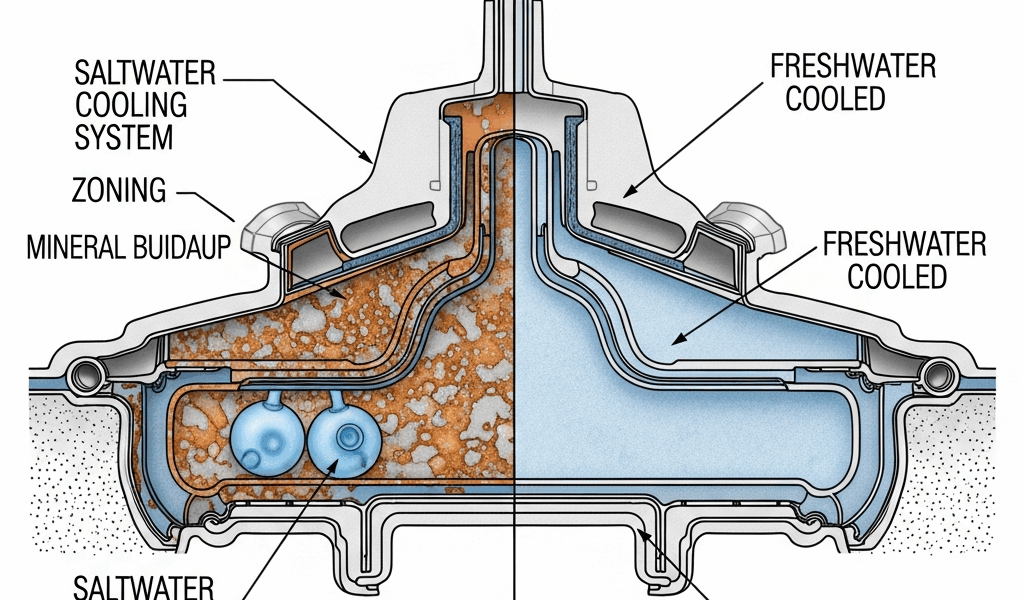
A closed-loop freshwater cooling system is, at its core, simple: engine coolant circulates through a sealed loop, absorbing heat from the diesel block. That loop runs through a heat exchanger—typically a titanium or cupronickel unit—where seawater gets drawn through a through-hull and cools the freshwater without ever touching the engine itself. Much more than that, really.
Why passage makers choose this setup comes down to one thing: corrosion prevention. River systems along the Great Loop introduce sediment, freshwater microorganisms, and mineral deposits that accumulate inside saltwater systems. I watched a friend’s raw-water impeller become a crystallized puck after three weeks on the Tennessee River — the system hadn’t seized, but the deposits had literally transformed the impeller into something unusable.
Freshwater systems eliminate that entirely. Your engine internals stay clean.
A typical closed-loop retrofit costs between $4,200 and $7,500 depending on heat exchanger size and whether you’re replacing existing through-hulls. That’s the hard part. The ongoing work? Manageable: you’re changing inhibitor annually (about $80 per gallon, and most trawlers need 2–3 gallons), flushing the heat exchanger every 18 months with citric acid or a commercial flush solution (DIY cost runs $120; dockside service hits $600–$900), and monitoring hose conditions for signs of coolant leaks.
The real advantage for Great Loop cruisers — you can run the same system through the Ohio, Mississippi, and Tennessee Rivers without fear. No saltwater corrosion eating away. No zinc anodes dissolving into powder. No seacock valves sticking from mineral buildup.
Probably should have opened with this section, honestly. The peace of mind traveling inland is worth the initial investment alone.
Saltwater Cooling Systems and Coastal Cruising Trade-offs
Raw-water cooling draws seawater directly from the ocean or bay, circulates it through the engine’s water jackets, and returns it overboard. No heat exchanger. No inhibitor. No layers of complexity.
Initial installation costs run $800–$2,000, sometimes less if your trawler already has through-hulls roughed in. Sounds simple. But here’s the thing — “simpler” in marine engineering is a contradiction.
Seawater is hostile. Corrosion happens fast. The system compensates with active management — which is industry shorthand for “constant attention.”
Zinc anodes dissolve intentionally, sacrificing themselves to protect the engine block and raw-water lines. Most passage makers replace zincs every 18–24 months at a cost of $150–$400 per set, depending on whether you DIY or hire a mechanic. The timing depends on your salinity exposure and how many hours your engine runs annually.
Impeller wear accelerates under seawater. That rubber impeller inside your raw-water pump degrades faster in salt than in freshwater — plan on replacing it every 2–3 years ($120–$280 per impeller kit, plus 2–4 hours of labor if you’re not comfortable doing it yourself). I’m apparently the type who learns the expensive way: my impeller fractured at 200 RPM in the middle of a Gulf Intracoastal passage, and I paid $850 for emergency dockside replacement in Apalachicola.
Seacocks—the through-hull valves controlling water intake—develop stiction in saltwater environments. Mineral deposits and corrosion create resistance. You’ll need to exercise them monthly (turn them open and closed) and service them annually. A full seacock rebuild runs $300–$600 dockside.
Cost Comparison Over 5 Years of Passage Making
Let’s break actual dollars for a passage maker running 400–600 engine hours annually across freshwater and coastal sections. Without further ado, here’s what you’re looking at.
Freshwater System (5-Year Ownership)
- Initial retrofit or installation: $4,200–$7,500
- Annual coolant inhibitor: $160–$240
- Heat exchanger flushing (2× annually): $240 (DIY) or $1,200–$1,800 (dockside)
- Hose replacement every 3 years: $300–$600
- Gasket replacement (one major overhaul): $400–$800
- Freeze protection winterization (if applicable): $80–$150 annually
- Five-year total: $6,580–$12,890
Saltwater System (5-Year Ownership)
- Initial installation: $800–$2,000
- Zinc anode replacement (3 sets over 5 years): $450–$1,200
- Raw-water impeller replacement (2 sets): $240–$560
- Seacock annual service and maintenance: $300–$600 annually ($1,500–$3,000 total)
- Corrosion cleanup and minor repairs: $400–$1,000
- Emergency out-of-plan replacements (impeller failure, seacock stick): $600–$1,500
- Five-year total: $4,290–$9,860
On paper, saltwater wins. Lower upfront cost, slightly lower total ownership cost. But this math breaks down if you’re traveling through rivers, lakes, and coastal zones. The freshwater system becomes economical because you avoid the contingency damage — seacock failures, impeller fractures, zinc depletion in complex water chemistry situations.
If you’re staying coastal and doing predictable saltwater cruising, raw-water cooling is cheaper and serviceable.
Great Loop and Coastal Transition Challenges
Here’s where theory meets reality. Most passage makers I know start the Great Loop with saltwater systems because they’re buying used trawlers that already have them. Then they hit the Mississippi. Water quality changes hourly. Mineral content varies wildly between regions. The system accumulates gunk it was never designed to handle.
You have three options at this transition point: run the saltwater system through freshwater sections and accept the maintenance surge; install a freshwater system partway through the loop (expensive and invasive mid-trip); or add a secondary strainer basket to your intake line (cheap at $60–$120, moderately effective).
Most cruisers I’ve spoken with retrofit to freshwater around year two of long-term passage making. Not because the saltwater system failed completely, but because the psychological burden of constant vigilance outweighed the cost savings.
A few hardy cruisers run dual systems — saltwater for engine cooling, freshwater for keel and thrusters. This costs more upfront but provides redundancy for serious blue-water passages. It’s overkill for Great Loop + coastal runs.
Which System Wins for Your Passage Plan
Choose freshwater cooling if: You’re planning to cruise the Great Loop or spend significant time in inland waterways — at least if you want reliable performance. Your budget can absorb the $4,500–$7,500 retrofit cost. You cruise seasonally or part-time and want minimal maintenance overhead. You value peace of mind over lowest dollar cost.
Choose saltwater cooling if: You’re staying primarily coastal (ICW, Florida Keys, Gulf Coast). Your trawler already has it installed. You’re mechanically inclined or have reliable dockside service access. You’re cruising for a single season and prioritizing lowest upfront cost.
Consider a retrofit mid-journey if: You started saltwater and realized you hate the maintenance schedule. You’re experiencing seacock stiction or zinc depletion faster than expected. You want to cruise the Great Loop after coastal experience.
Real passage makers I know did it differently. Mark and Susan from the Trawler Forum spent five years doing Great Loop variants with a raw-water system — they retrofitted to freshwater in year three. Tom, who cruises the ICW exclusively, has never touched his original saltwater system beyond annual zincs. Michelle bought a trawler for a single coastal season with saltwater and never looked back. Don’t make my mistake of ignoring the water chemistry differences until you’re stuck in the middle of nowhere.
Your passage plan determines your system. Know it before you commit.

Stay in the loop
Get the latest passage maker mag updates delivered to your inbox.