Fleming 55 at a Glance — The Core Stats
Buying a bluewater trawler has grown more complex with the marketing noise flying around. As someone who has spent years talking to Fleming 55 owners, surveying used examples, and riding along on actual offshore passages, I dug into the practical details of this particular boat. Today, I will share it all with you.
So, without further ado, let’s dive in — starting with the numbers, because the numbers on a Fleming 55 are not small. The boat measures 55 feet on the waterline, 58 feet overall. Beam is 16 feet. Displacement hovers around 110 tons. That last figure matters more than people expect when they first look at specs on paper. This is not a light vessel. Standard power is a Cummins QSM11 diesel — 500 horsepower at cruise — paired to a Bravo 3 or Glendinning pod drive depending on year and configuration. Fuel capacity: 4,000 gallons. Fresh water: 1,000 gallons. At a true 7-knot trawler pace, you’re looking at roughly 2,500 nautical miles on one fill. I’ll get into the real-world asterisks on that number later, because there are several.
New, a Fleming 55 runs $2.8 to $3.2 million — electronics package and engine selection move that needle considerably. Used examples from the 2000s and early 2010s land between $1.2 and $1.7 million, assuming they haven’t been rotting in a yard for half a decade. This is not an impulse purchase. One demographic buys this boat: bluewater passagemakers with actual capital, actual time, and actual intention to cross oceans. Pacific Puddle Jump. The Great Loop as a two-year expedition. If that’s your plan, the Fleming 55 was built for that mission. If you mostly want to anchor off a Caribbean beach and drink rum drinks, there are cheaper, faster, lighter boats that make more sense.
Hull Design and Offshore Seakeeping — How This Thing Actually Moves
The Fleming 55 rides on a full-displacement semi-tunnel hull. But what is a semi-tunnel hull? In essence, it’s a hull shape designed to minimize resistance at low speeds while the tunnel — a channel carved into the hull bottom — positions the engines farther aft and reduces prop wash turbulence. But it’s much more than that. The real proof is in the motion owners describe after days at sea, not what a naval architect draws on a whiteboard.
Talk to owners who’ve taken their boats across the Pacific or bashed up the ICW in a winter gale. The language is remarkably consistent. The motion is not violent. It’s deliberate. In a 4-to-6-foot beam sea, the boat doesn’t snap or jar — it rolls with a period that starts to feel almost predictable after the first few hours. The pilothouse sits forward and high, so the sensation is riding the swell rather than punching through it. Compare that to some sharper-bowed Nordhavn models, which can feel snappier but kick spray back on the cabin. The Fleming runs wetter forward, gentler overall. Your crew stops getting launched out of the galley chair somewhere around the second night.
Stabilization comes standard with paravane options or active fin systems on newer builds. Paravanes — those towed fin-like devices you stream off the boat — cut roll by a noticeable margin in beam seas. I’ve watched owners deploy them at dawn on ICW legs where the fetch had built up overnight, and the difference is real and immediate. With paravanes down, the roll period lengthens and dampens. Without them on a bouncy day, you feel every wave. Active fin systems, more common on post-2010 boats, use hydraulic actuators beneath the hull and require less deck management. Most experienced owners prefer the actives for long passages — less gear to rig at 2 a.m. in rough water, less to fail at the wrong moment.
Following seas are where the Fleming earns genuine respect. The long keel and skeg — that vertical stabilizer aft — keep the stern planted. In a 6-foot following swell, the boat surfs slightly but doesn’t slew sideways. No hobby-horsing. You can hand-steer or trust the autopilot without white-knuckling the wheel. That’s not a theoretical comfort. That’s the difference between a passage you can manage shorthanded and one that grinds you into the deck.
Range, Fuel Burn and Passage Planning Reality — The Math That Matters
Worth saying out loud. Range numbers define this boat’s entire identity, because choosing to cruise at 7 knots instead of 12 knots is a lifestyle decision — not a casual preference.
At 7 knots, the QSM11 burns roughly 11 to 13 gallons per hour. Push to 8 knots and that climbs to 14 to 16 gph. At 9 knots — which some owners run when they have a clean weather window or need to reposition — you’re burning 18 to 22 gph. That variance depends on sea state, load (full fuel tanks, provisions, fresh water, crew weight), hull fouling, and prop condition. I know owners who’ve kept detailed fuel logs for years. One skipper out of Newport kept a spreadsheet for 18 months of Pacific cruising and averaged 12.1 gph at 7.3 knots in mixed conditions. Another operator, working the Caribbean, averaged 13.8 gph at 7 knots. That two-gallon spread is real and it compounds over a long passage.
With 4,000 gallons aboard and a 10-percent reserve — industry standard — you’re working with 3,600 usable gallons. Divide by 12 gph average: roughly 300 hours of cruising time. At 7 knots, that’s 2,100 nautical miles. Add headwinds, weather detours, or faster speeds during a closing weather window and you burn through fuel faster than the spreadsheet suggests. The smartest passage planners I’ve interviewed budget an extra engine hour per day beyond the route calculator — for battery charging, for adverse conditions, for not wanting to arrive at a strange anchorage after dark.
This range profile reshapes how you think about cruising entirely. Pacific Puddle Jump legs — Galápagos to the Marquesas, Marquesas to Tuamotu — typically run 2,200 to 2,800 miles. A Fleming 55 handles those comfortably with reserves intact. The Great Loop works well too, especially the river sections, partly because fuel stops are closer and partly because the boat’s 4.5-foot draft opens up marinas that deeper vessels can’t access. What the Fleming doesn’t do is complete a 3,000-mile leg between fuel stops on a single tank without careful planning. If that’s your specific mission, you’re looking at a Nordhavn 76 or a Selene 60, or you accept that the long hops require strategic fuel caching or offshore rendezvous arrangements.
Liveaboard Layout and Passagemaker Ergonomics — Where You Actually Live
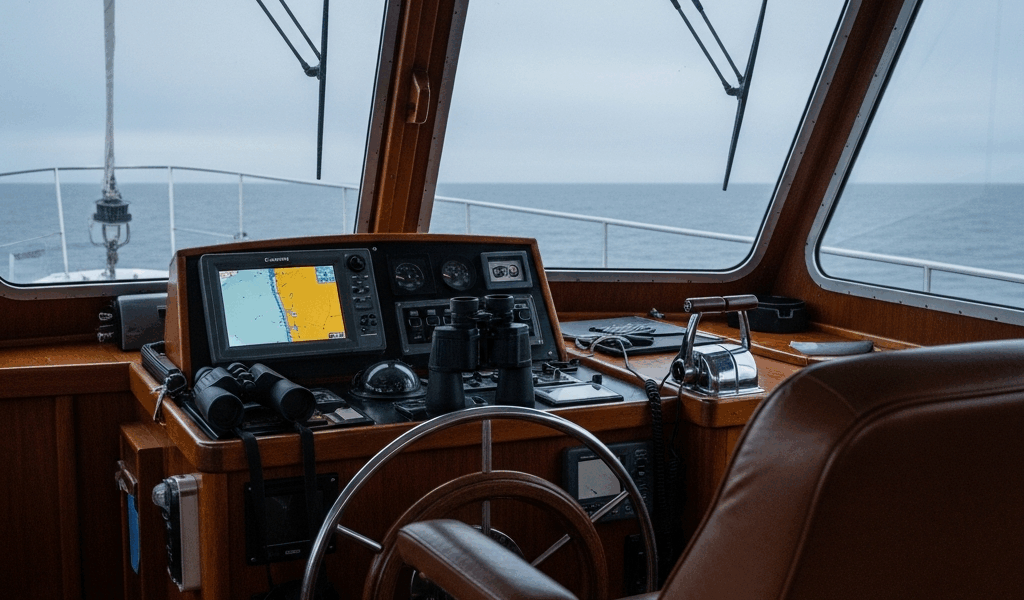
The Fleming 55 interior prioritizes function over flash. That’s what makes it endearing to us passagemaker types. The pilothouse is command central — full-width window visibility, twin helm seats with armrests, chart table to starboard, galley access just aft. You can pilot the boat, monitor three screens of electronics, and have someone hand you coffee without either of you leaving a station. Sightlines forward, port, and starboard are excellent. Aft visibility is adequate but not panoramic, which is an inherent trade-off in this style of pilothouse-forward design.
The master stateroom sits amidships. Which is noise country. The engine room is directly below, and on a passage night watch you hear the generator running, you hear prop thrust in certain sea states, and you absolutely hear the Cummins when you’re pushing hard into a headwind. Some owners install additional sound dampening — DEI 050200 Boom Mat is a common choice, around $180 for a roll. Most just adapt. The forward cabin is quieter and cooler but tighter — crew quarters or occasional guest space, not an owner’s sanctuary.
Galley access underway is straightforward. The galley sits adjacent to the salon, with the pilothouse companionway just steps away. You’re not hauling a pot of pasta through three doorways. The galley itself is adequate, not generous — three-burner stove, single oven, medium 12-volt refrigeration compressor. Cooking underway is doable but demands attention. Nothing is gimbaled, and a confused sea state will remind you of that fast. Meal prep in a seaway requires respect for what the boat is doing underneath you.
Stowage is genuinely generous. Owners consistently describe being able to pack three months of provisions without creative logistics. Spares storage — Cummins fuel filters, raw water impellers, hose sections, spare belts — organizes neatly forward in the sail locker or below the pilothouse sole. The engine room itself is walkable. Access to the Cummins, seacocks, and heat exchanger is reasonable. Maintenance is not a contortionist’s game, which matters at 2,000 miles from the nearest service yard.
Who Should Buy the Fleming 55 and Who Should Not — Direct Talk
I’m apparently the kind of person who has to test a boat in rough conditions before trusting any review, and firsthand experience works for me while secondhand marketing copy never does. Skip the misstep I made of buying a sea trial in flat water and thinking that tells the whole story.
This boat is built for couples and small crews planning genuine bluewater passages. If you’ve spent five years researching trawlers, read every Cruising World issue twice, and you have the capital and the timeline for an 18-to-36-month voyage, the Fleming 55 will deliver. It’s not flashy. The hull is workmanlike. The interior is practical. But after three weeks underway in a 20-knot blow with following seas, that practicality starts to feel like brilliance — especially when other boats are making life miserable for their crews.
The Fleming 55 is not the right boat for first-time trawler buyers or owners who primarily dock at nice marinas and take occasional 50-mile weekends offshore. You’ll overpay for features you never use. Burning fuel at 7 knots feels like punishment when you’re only covering 200 miles a week. A faster, lighter coastal cruiser makes more sense and costs considerably less.
Price-wise, the Fleming 55 slots between the Nordhavn 52 and the Selene 60. The Nordhavn is faster and shallower-drafted. The Selene is roomier and more inherently stable at anchor. The Fleming is the compromise — strong offshore motion characteristics, adequate interior volume, genuine bluewater range. That’s what makes it endearing to serious passagemakers who’ve owned other boats and know exactly what they’re trading away. A used example from a meticulous owner — full service records, documented engine hours, receipts for major systems work — represents real value. Used Flemings hold price unusually well because the owner community is small, loyal, and talks to each other constantly.
The single biggest risk with older models: outdated electronics or questionable engine maintenance histories. While you won’t need a full refit, you will need a full survey — including haul-out and prop inspection. First, you should request engine hours and service logs directly — at least if you want any honest picture of what you’re buying. A Cummins QSM11 with 4,000 hours and documented service intervals is a very different proposition than one with 4,000 hours and a seller who gets vague when you ask questions. If they’re defensive about fuel consumption data or maintenance records, walk away. There are other boats.
The Fleming 55 is a serious commitment to serious passagemaking. It will take you across oceans, keep you safe in rough water, and make the journey manageable for crew who need actual rest and actual hot food. It will not make you fast. It will not impress anyone at the fuel dock with granite countertops. It will not appeal to weekend cruisers who measure a good day by how close they can anchor to a beach bar. But if you’re reading this because you actually mean it — about crossing the Pacific, about doing the Loop properly, about living aboard for two years and earning every mile — a well-maintained Fleming 55 might be the tool you’ve been looking for.


Stay in the loop
Get the latest passage maker mag updates delivered to your inbox.