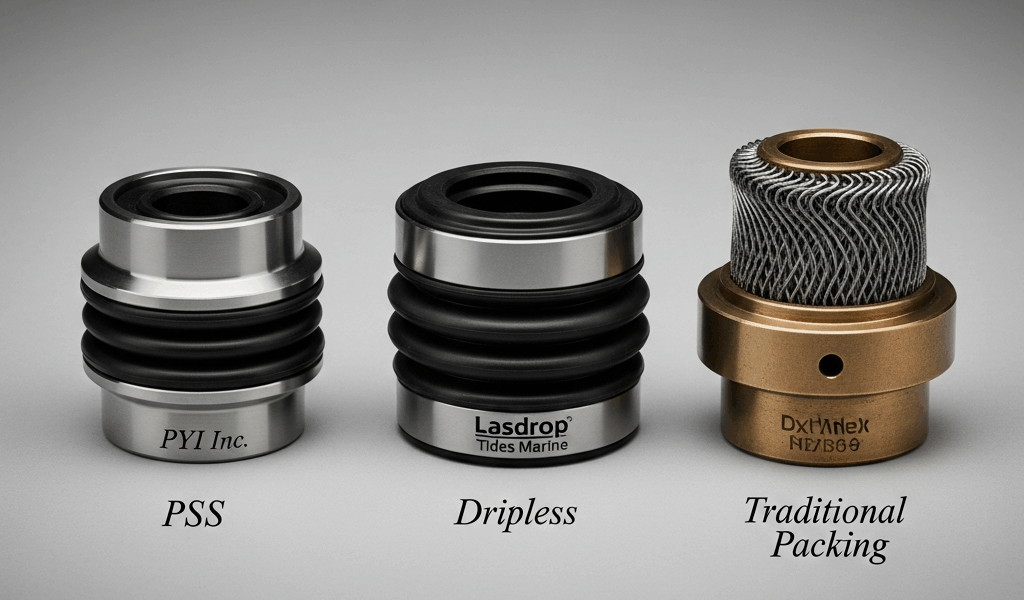
Best Propeller Shaft Seal — PSS vs Dripless vs Traditional Packing
This article includes affiliate links. We may earn a commission at no extra cost to you.
Shaft seals have changed quite a bit thanks to the marketing noise flying around. Every manufacturer claims theirs is the set-it-and-forget-it solution, the dry bilge guarantee, the one seal serious sailors trust. As someone who’s put roughly 40,000 offshore miles on various boats over the past two decades, I figured out how to handle traditional stuffing boxes, PSS face seals from PYI Inc., and dripless lip seals like the Tides Marine SureSeal. Each one has made me genuinely grateful at some point. Each one has also made me nervous at exactly the wrong moment.
Three days offshore with water coming in faster than your bilge pump can handle — that’s when a seal decision stops being minor. Here’s what I actually know.
Three Shaft Seal Types — How They Work
Before picking anything, you need to understand what each seal is actually doing mechanically. They solve the same problem — keeping seawater out where the propeller shaft passes through the hull — but the approaches are completely different animals.
Traditional Packing Gland
But what is a traditional stuffing box? In essence, it’s a bronze or Delrin housing that threads onto the stern tube, packed with rings of flax or PTFE material compressed around the rotating shaft. But it’s much more than that — it’s a mechanical philosophy. The gland nut tightens down, squeezes the packing tight, and the whole thing is supposed to drip. Three to five drops per minute at rest is the classic spec. That slight weep lubricates and cools the packing. Some old salts say one drop per revolution underway, though honestly that number shifts with shaft speed and who you’re talking to at the dock.
The physics are almost insultingly simple. Compression plus friction equals sealing. Nothing rotates against a stationary seal — the shaft turns through packing material that stays put. Low-tech in the best possible sense.
PSS Face Seal — PYI Inc.
The PSS — Packless Sealing System — from PYI Inc. works as a face seal. A stainless steel rotor clamps to the shaft and spins with it. A carbon graphite flange sits stationary against the stern tube, held there by a flexible EPDM rubber bellows. The mating faces of carbon and stainless press together at their interface. A wave spring maintains that contact pressure as the bellows flexes with shaft movement. PYI makes them in shaft diameters from 3/4 inch up to 4 inches — the 1-1/4 inch model runs about $185 retail as of 2024.
No drip. Completely dry. That’s the pitch, and in normal conditions, it’s accurate.
Dripless Lip Seal
Lip seals use a nitrile or UHMW rubber seal that wraps around the shaft and creates a wiping contact. The Tides Marine SureSeal is the most common one you’ll encounter. Unlike the PSS, there’s no spring-loaded face here — the lip material simply grips the shaft. These are often paired with a water injection fitting pulling from engine cooling water to lubricate the seal. Installation demands precise shaft alignment and a smooth shaft surface, typically 16 RMS finish or better. Rough shafts will chew through the lip material embarrassingly fast.
Quick comparison before we go deeper:
- Traditional packing — Drips by design, needs periodic adjustment, tolerates misalignment, field-repairable with basic tools
- PSS face seal — Dry, largely set-and-forget in normal use, sensitive to shaft deflection under load
- Lip seal — Dry, requires precise alignment and shaft finish, mechanically simpler than PSS
Installation and Maintenance Comparison
This is the piece to know up front. Maintenance reality is what separates these three in actual day-to-day ownership — more than specs, more than price, more than what the guy at the chandlery tells you.
Traditional Packing — The Ongoing Relationship
Installing a traditional stuffing box is straightforward enough. Thread it on, pack it with flax rings — I use GFO-style PTFE packing, Teflon-impregnated, about $12 per foot from Defender or Fisheries Supply — and work the gland nut until you get your drip rate. The trick is ongoing adjustment. Plan on checking it every time you use the boat. A quarter turn on the gland nut sometimes stops a fast drip entirely.
Left unchecked, an overtightened packing gland will score the shaft’s bronze bearing surface. I’ve made that repair on two different boats. Significant cost both times. Avoid the path I took.
Repacking takes maybe 45 minutes out of the water — a pick tool, a willingness to get wet and dirty in the bilge, and new packing rings. Do it every two seasons or when the drip rate becomes genuinely uncontrollable. Packing material costs almost nothing.
PSS — Mostly Hands-Off, With Caveats
Installing a PSS correctly takes patience. The bellows hose goes over the stern tube, clamped with two stainless hose clamps torqued to spec. The rotor slides onto the shaft and locks down with set screws — Loctite 271 on those, no exceptions, don’t skip it. PYI specifies a precise setback dimension between rotor face and carbon face so the bellows sits neither stretched nor compressed. Get that dimension wrong and you’ll either get leaks from an overstretched bellows or premature wear from over-compression. I measured mine at 5/16 inch setback using the provided template, and it’s been exactly right ever since.
Once it’s in, maintenance is mostly inspection. Check the bellows for cracking at every haulout. Check the carbon face for wear — there’s a groove wear indicator molded in. PYI recommends replacement every three to five years regardless of visible wear. Replacement carbon and stainless face kits run $90 to $120 depending on shaft size. Bellows are available separately if that’s all that needs replacing.
Lip Seals — Alignment Is Everything
The Tides Marine SureSeal installation requires the shaft to be in nearly perfect alignment with the stern tube — manufacturer spec is within 0.005 inches of runout. Many older boats don’t meet that tolerance without a dedicated shaft alignment job first. Frustrated by what felt like an unnecessary extra step, I skipped alignment verification on a 1987 ketch I bought in Ft. Lauderdale and installed a SureSeal directly. Eight months later, the lip had worn through. That’s a $220 seal plus a haulout — and frankly the lesson cost more than the part.
With proper alignment and a polished shaft, lip seals are genuinely low maintenance. Inspect the lip for wear and cracking annually. Keep the water injection line from the raw water circuit clear — a blocked line means the seal runs dry, and failure follows quickly after that.
Reliability on Long Passages
This is where opinions get loud. It’s also where I have actual offshore experience rather than theory borrowed from forums.
Traditional Packing — The Safest Failure Mode
The best thing about a traditional stuffing box is how it fails. Gradually. Manageably. It starts dripping faster than normal — you tighten the gland nut. Packing is spent — you add a half-ring of new material as a temporary measure, even underway in calm conditions. I’ve tightened a packing gland lying flat in the bilge during a 30-knot breeze with three reefs in, and had the fast drip stop in five minutes. The failure mode gives you time. That’s what makes traditional packing endearing to us offshore sailors.
PSS — Good Until It Isn’t
The PSS has a solid reputation, and PYI’s statistics support it. But the failure modes are more abrupt — that’s the honest thing to say about it. If the bellows cracks from ozone degradation or chafe, water enters immediately and at a rate that surprises people. If the set screws back out and the rotor shifts, the face seal opens. Both failures produce significant water intrusion fast — not a drip, a flow.
I watched one bellows failure happen offshore, about 180 miles east of Cape Hatteras. The bilge alarm went off within minutes, the crew stuffed the bellows area with rags, and we motored back under power. It worked. Still alarming. The other issue is shaft deflection under heavy propeller load — powering hard into steep chop, the shaft can deflect enough to cause momentary face separation. Some PSS seals develop a slow drip in those conditions that never shows up at the dock. Not a crisis, but it surprises owners who expected zero water intrusion forever.
Lip Seal Failures
Lip seal failures are also relatively abrupt once they go. A worn or torn lip admits a steady stream — not a drip. The good news is they’re simple to diagnose. You can see the lip, feel it, check it with a flashlight and two minutes of effort. The bad news is that field repair options are limited compared to packing. You can’t add more material. You’re managing the situation until the boat hauls. Carry a PSS emergency packing kit aboard if you run a lip seal offshore. Apparently some sailors skip this step. Those sailors have bad stories.
Cost Comparison — Purchase, Installation, and Lifetime
Real numbers on a typical 40-foot sloop with a 1-1/4 inch shaft.
Traditional Packing
- Stuffing box hardware — $80 to $150 depending on material, Delrin vs. bronze
- Packing material — $15 to $30 per season
- Professional adjustment — often owner-done, or $50 to $100 at a yard if needed
- 10-year cost estimate — $250 to $450 including occasional yard help and packing material
PSS Face Seal
- PSS unit at 1-1/4 inch — $185 retail
- Installation labor if not DIY — $150 to $250
- Replacement face kit every four years — roughly $95 per replacement, two over ten years
- 10-year cost estimate — $525 to $725
Lip Seal
- Tides Marine SureSeal at 1-1/4 inch — $215 retail
- Installation including shaft alignment check — $200 to $400
- Replacement unit every five to seven years — one replacement over ten years
- 10-year cost estimate — $600 to $850, more if alignment work triggers additional yard time
Traditional stuffing box wins on lifetime cost — not even close. PSS lands in the middle. Lip seals cost the most over time, largely because alignment requirements drag in additional yard work you wouldn’t otherwise pay for. None of these numbers include emergency repairs, which favor the packing gland every single time.
The Verdict — Match the Seal to the Boat
There’s no single best propeller shaft seal. The right answer depends entirely on how you use the vessel and what kind of failure you can actually handle when something goes wrong.
For a coastal cruiser — weekend day sailing, marina slip, one haulout a year — a PSS face seal might be the best option, as that use pattern requires minimal bilge intrusion with maximum convenience. That is because you’re rarely more than a few hours from a boatyard, which makes the PSS failure modes manageable rather than terrifying. Set the bellows setback correctly, Loctite the set screws, inspect it at every haulout. Years of dry bilges. Zero gland adjustments. The convenience premium is worth paying.
For an offshore passagemaker — extended passages, situations where repairs must happen at sea — traditional packing is the defensible choice. First, you should carry extra packing material and a good pick tool — at least if you’re going somewhere without a marine chandlery within easy reach. Scorned by sailors who’ve never managed a seal failure 200 miles from land, the stuffing box is the seal you can fix with what you have aboard. Nothing about its failure mode is catastrophic if you’re paying attention.
Lip seals occupy a specific niche. They make sense on boats with clean straight shafts, no significant vibration, and owners who are genuinely diligent about inspection. High-RPM powerboats sometimes suit them well. On older sailboats with any shaft alignment uncertainty, they’re a gamble that often doesn’t pay off — ask me how I know.
My personal setup on the boat I currently sail offshore — a 1987 Hallberg-Rassy 42, bought in Palma de Mallorca in 2019 — is a traditional stuffing box with GFO packing. Three drops a minute at anchor. I adjust it twice a season with a pair of wrenches and about ten minutes of lying in the bilge. Two Atlantic crossings with that seal. Never once thought about the shaft seal during either one. That’s the goal.




Stay in the loop
Get the latest passage maker mag updates delivered to your inbox.