How to Claim an Abandoned Boat — What Maritime Law Actually Allows
Claiming an abandoned boat has become harder to navigate with all the bad advice flying around. As someone who’s spent years cruising coastal waters and watching people stumble through this process, I worked through the fundamentals of abandoned vessel claims the hard way. A guy I met at a marina in Beaufort, North Carolina — sunburned, furious, $4,000 poorer — had towed a “free” boat to his slip without filing a single piece of paperwork. The federal government, state agencies, and admiralty courts all had opinions about that. None of them were good.
You Cannot Just Take an Abandoned Boat — Here Is Why
Quick note before the rest of this. Most people who stumble across a derelict vessel — floating in some forgotten cove, beached on a sandbar, listing at an empty dock — assume that because nobody’s around and the hull is growing oysters, it’s free for the taking. It isn’t. Not in almost any jurisdiction in the United States. Acting on that assumption can get you criminally charged.
But what is the legal distinction here? In essence, it’s the difference between salvage and abandonment. Salvage is the act of rescuing a vessel in peril — and it comes with specific admiralty rights. But it’s much more than that. Abandonment is a formal legal status. A documented process. Not something you get to declare yourself just because the boat looks like it hasn’t moved since 2009.
A vessel that appears abandoned may still have a registered owner, an active lien holder, or a lender with a legal interest sitting quietly on a UCC filing somewhere. Taking possession without going through proper channels can expose you to federal charges under 18 U.S.C. § 2311 — the federal theft statute covering vessels. State charges follow the same logic. In Florida, unauthorized possession of a vessel is a felony once the boat’s value clears $300. Most boats — even wrecked ones — clear that threshold on paper. “I thought it was abandoned” is not a recognized legal defense. The Coast Guard is not sympathetic to it.
There’s also the environmental angle, which most people completely miss. Take informal control of a vessel with fuel leaks, holding tank waste, or structural instability — and you may be accepting environmental liability right alongside it. The EPA and state agencies pursue cleanup costs from whoever last claimed ownership or control. Even informal control. Skip past the mistake I made of assuming that’s someone else’s problem once you’ve got a line on the cleat.
The Legal Process to Claim an Abandoned Vessel
The actual process varies by state. But there’s a general framework that applies almost everywhere. Work through these steps in order. Skipping ahead causes problems.
Step 1 — Report the Vessel to Law Enforcement
Start with your local marine patrol, harbormaster, or county sheriff’s marine unit. File a written report — vessel location, registration numbers if visible, physical condition, anything identifying. This creates a paper trail that protects you and starts the clock on the official investigation period. Get the case number. You’ll need it later.
You should also check the vessel against the National Vessel Documentation Center database at uscg.mil and your state’s registration database — at least if you want to know what you’re actually dealing with before investing any time. A federally documented vessel has a paper trail. A state-registered boat has a title record. Either way, there may be an owner who legally needs notification before your claim goes anywhere.
Step 2 — The Investigation and Waiting Period
Most states require a mandatory holding period — authorities attempt to locate the registered owner, post legal notice, do their thing. This window typically runs 45 to 120 days. California runs 30 days for vessels under a certain length. Texas can run up to 90. During this time, you can’t do much except, in some states, apply to become official custodian — which lets you move the vessel somewhere safe but does not give you ownership. Two very different things.
The state will post legal notice in a newspaper of record for the county where the vessel was found. That’s not optional. If the owner surfaces during the notice period, the process stops. You walk away with nothing — but you walk away clean, which is the entire point of doing this correctly.
Step 3 — Filing the Claim and Paying the Fees
Once the investigation period closes without an owner coming forward, you file a formal claim with your state’s titling agency — usually the DMV or a dedicated marine division. Expect a filing fee somewhere between $300 and $600 depending on the state and vessel size. Some states charge a percentage of assessed value instead of a flat fee.
You’ll submit the law enforcement report, proof of notice publication, documentation of any storage or custody costs, and a formal application for title transfer. The state issues a new title in your name after review — usually within 30 to 60 days of a complete application. Incomplete applications restart the clock. Submit everything at once.
Step 4 — Federal Documentation if Applicable
If the vessel is over 26 feet and was previously documented through the USCG National Vessel Documentation Center, state title alone may not fully clear the chain of title. You may need a court order to quiet title. That brings us to the next section.
Salvage Rights vs Ownership — They Are Different Things
Here’s where expensive mistakes happen. Someone rescues a vessel from peril — tows it off a reef, pumps it out after it sinks at a dock, secures it after it breaks loose in a storm — and assumes that earns them ownership. It does not. Salvage rights and ownership rights are legally distinct. Conflating them leads to court.
Under admiralty law, a successful salvor earns the right to a salvage award — payment for services rendered saving the vessel and cargo. The amount factors in the value of property saved, risk to the salvor, skill involved. The landmark framework comes from The Blackwall case in 1869, and courts still use it as the baseline. But a salvage award is a payment right, not a property right. That’s what makes admiralty law endearing to us sailors — it’s old, specific, and completely indifferent to what you assumed.
To convert a salvage situation into actual ownership, you pursue the matter in admiralty court — an in rem action against the vessel itself in federal district court. If no owner appears to contest it, the court can issue a judgment effectively transferring title. A straightforward uncontested admiralty filing might run $1,500 to $3,500 in attorney fees and court costs — though I’ve heard of cases going considerably higher when the vessel carried documented liens or a complicated ownership history.
Frustrated by the complexity when I tried following this through on a 32-foot sloop dragging anchor in a Carolina anchorage, I ended up calling a maritime attorney in Wilmington who charged $200 for a one-hour consultation. He immediately spotted a UCC filing on the engine from a lender who would have contested my claim within days. Worth every dollar. Probably would have cost me $6,000 to learn that lesson the other way.
When do you actually need a maritime attorney? Anytime the vessel is federally documented. Anytime hull identification numbers suggest an active registration. Anytime the boat has significant value — a 1987 Hunter 40 with a blown-out interior and a suspect keel might still appraise at $8,000 in rough shape. That’s worth protecting with proper legal process.
Before You Claim That Free Boat — Hidden Costs
Free boats are rarely free. That’s an old joke inside the sailing community — and abandoned vessels are the extreme version of the punchline.
Environmental Liability
An abandoned boat sitting in shallow water almost certainly has fuel aboard. Diesel or gasoline. It may also have holding tank waste, bottom paint containing tributyltin or copper compounds, hydraulic fluid, battery acid. The moment you take legal possession, you own the environmental cleanup obligation. Federal regulations under 33 U.S.C. § 1321 — the Clean Water Act’s oil spill provisions — can make the possessor of a vessel liable for discharge, even if the contamination predates your claim. A single diesel tank cleanup in a coastal waterway can run $5,000 to $25,000 depending on volume and substrate type. That’s before you’ve touched the actual boat.
Derelict Vessel Penalties
Florida, Washington, and California are apparently the most aggressive about this — all three have derelict vessel programs that assess fines against owners of vessels remaining in deteriorating condition. Once you take title, the clock starts on your obligation to restore the vessel to seaworthy condition or dispose of it properly. Florida starts at $50 per day. Washington has levied penalties exceeding $10,000 against owners who claimed derelict vessels and then let them sit. Claiming the boat and doing nothing is not a strategy.
Realistic Repair Cost Assessment
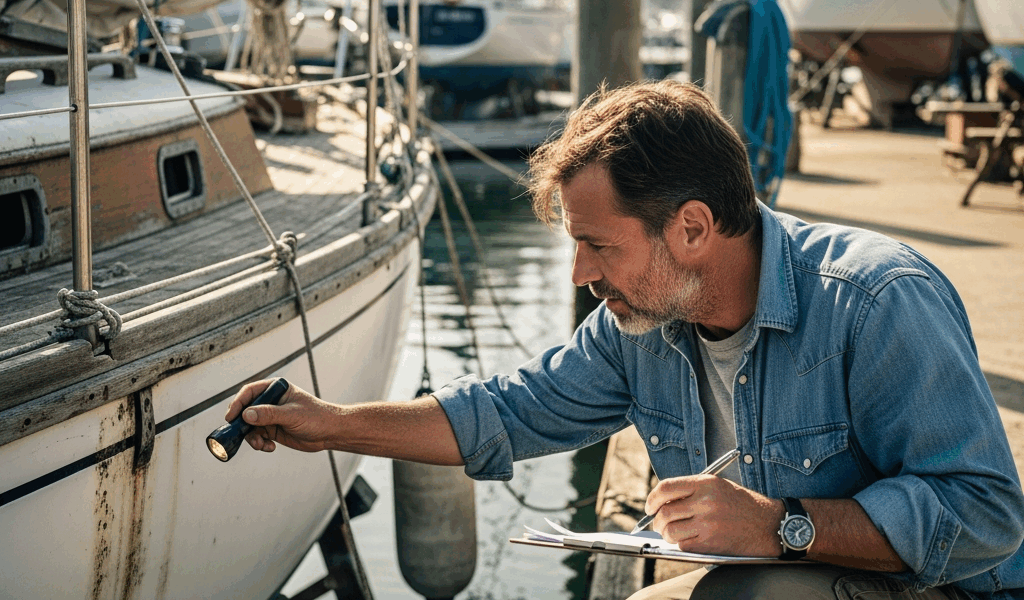
Get a survey before you commit to anything. A marine survey on a 30-foot vessel from a certified SAMS or NAMS surveyor typically costs $400 to $700 — and it gives you an honest accounting of structural, mechanical, and electrical condition. A boat sitting unattended for three or four years in saltwater has almost certainly suffered osmotic blistering below the waterline, corrosion in every electrical connection, UV degradation throughout the running rigging, and probably compromised chainplates if it’s a sailboat. Replacing chainplates on a 35-foot sloop averages $800 to $2,000 in parts and labor. A full rewire on a 30-foot boat runs $3,000 to $6,000 at a competent yard.
The vessel that looked like a steal at zero dollars can easily require $15,000 to $30,000 in work before it’s safely back in the water. That’s not a reason to walk away from every opportunity — good deals genuinely exist, and working through the proper legal process is worth it when the underlying boat has solid bones. It’s just a reason to go in with open eyes and a calculator instead of just enthusiasm.
The legal process exists to protect everyone involved — including you. Follow it, document everything, get a survey, and if there’s any doubt about title complexity, spend the $200 on an hour with a maritime attorney before you spend anything else.



Stay in the loop
Get the latest passage maker mag updates delivered to your inbox.