“`html
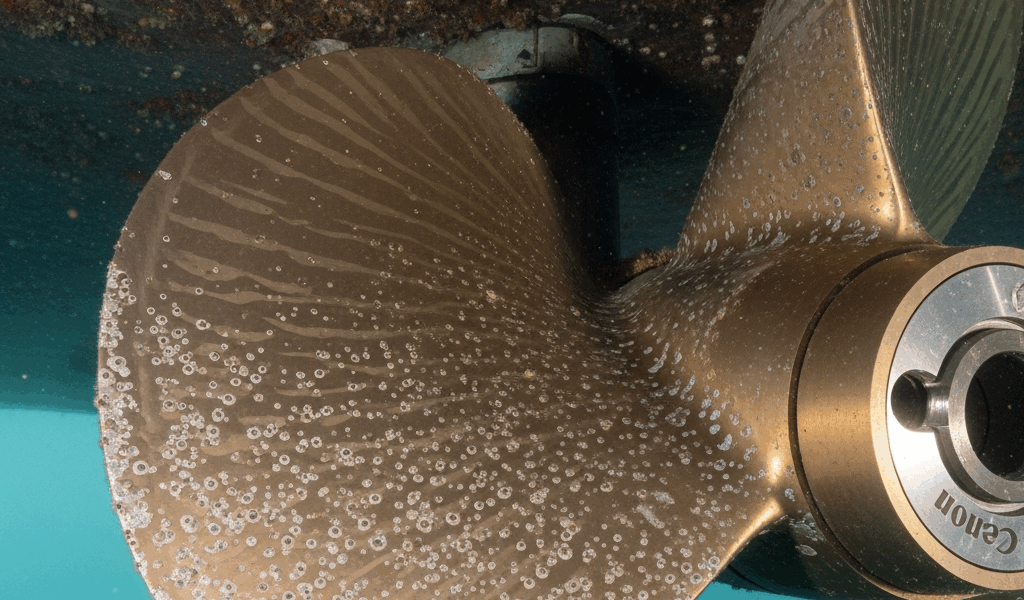
What Cavitation Looks Like on Your Trawler Prop
I spent three weeks last summer chasing down a noise I couldn’t pin down. My 42-foot Grand Banks was humming—literally buzzing—at 1600 RPM, and I figured I’d picked up some floating debris tangled somewhere underneath. Pulled into a marina in Batavia, New York, hired a diver, and learned I was watching cavitation damage unfold in real time on my prop.
Cavitation happens when water pressure drops rapidly around your spinning propeller blade, creating vacuum bubbles. These bubbles collapse violently back onto the blade surface, hammering tiny pits into the metal. On a trawler running sustained high RPM through locks, shallow channels, and tight passages — at least if you want to maintain any kind of schedule — this becomes a genuine problem.
The erosion pattern looks nothing like prop strike damage. Cavitation creates a porous, spongy texture across the blade face—almost like someone took a fine-tooth file to it systematically. The damage clusters near the blade’s leading edge and pressure side, where water pressure drops lowest. Prop strike, by contrast, dents or bends metal in a localized area. You’ll see sharp erosion lines, pitting that looks almost crystalline under the right angle, and sometimes complete loss of blade edge definition. Completely different animal.
Great Loop cruisers are especially vulnerable. Why? Lock transits demand sustained RPM. You’re pushing through narrow chambers at consistent power. Add shallow-water running—common in many inland waterways—and your prop never gets the clean, deep water it needs to operate efficiently. Shallow water compresses pressure zones around the blade. The blade works harder than it should. Cavitation accelerates exponentially.
A healthy propeller blade edge is sharp and clean. Cavitation-damaged blades look rough, almost corroded, with visible pitting that spreads like a rash. On Tohatsu, Yamaha, and Mercury props—common across trawler fleets—damage usually starts where the blade curves into water first. The leading edge. Then it spreads across the working surface like nobody’s paying attention.
Early Warning Signs Every Passage-Maker Should Know
Probably should have opened with this section, honestly. The buzzing noise I mentioned? Classic early-stage cavitation. Not the grinding sound of a transmission problem. Not the thumping of bearing wear. A high-frequency buzz that gets louder as RPM climbs—persistent and annoying once you notice it.
After 200-plus hours at your cruise RPM—say 1600 RPM over three months on the Great Loop—cavitation starts sending messages. Listen for a vibration change that feels different from normal engine harmonic. Your boat develops a hum that travels through the helm, the cabin, the entire hull structure. It’s not constant. It gets worse at certain RPM ranges and improves slightly in deeper water or at lower throttle settings.
Speed loss is the second warning sign. Your 42-footer usually makes 8 knots at 1600 RPM. Suddenly it’s 7.5 knots. Same fuel burn, maybe even higher, but you’re moving slower through the water. Your fuel efficiency drops noticeably—you’re pushing the same power into cavitation energy rather than actual water movement.
Exhaust anomalies come next. White or light-gray smoke during cruise mode, not during startup. Your temperatures climb. Shaft bearings work harder compensating for prop imbalance caused by cavitation erosion. The prop is no longer balanced. It’s digging unevenly into water.
Distinguish this from other problems: Bearing wear produces a grinding sensation that travels through the shaft and gets worse under load. Prop strike creates immediate, obvious vibration—you feel it right away, not gradually over weeks. Cavitation whispers first, then nags, then demands attention.
After my haul-out in Batavia, the diver showed me photos on his underwater camera. The damage was maybe 18 months old, I estimated—slow erosion that I’d attributed to engine wear and normal degradation. The blade pressure side had maybe 40 pits per square inch in the worst zones, each the size of a ballpoint pen tip. Not catastrophic yet. But definitely worsening.
How to Inspect Your Prop Before Damage Gets Expensive
You don’t need a full haul-out for early detection. Bring snorkel gear. Seriously. Most Great Loop marinas sit in water shallow enough that you can get underneath your boat in 8-12 feet with basic equipment—mask, snorkel, fins.
Here’s my step-by-step inspection checklist:
- Shut down the engine. Confirm it’s off. Put the key in your pocket where you can feel it.
- Descend alongside the prop and look at the blade leading edge. Run your hand along it if you can (carefully—it’s sharp). A healthy edge feels crisp and clean. Cavitation damage feels rough, pitted, almost corroded under your fingertips.
- Examine the pressure side of each blade—the side facing the water behind you when moving forward. Look for discoloration (darker pitting), porous texture, or erosion patterns spreading from the leading edge toward the hub.
- Check blade symmetry. All three blades should look identical. If one blade is visibly more pitted than others, you may have asymmetric cavitation—often tied to hull fouling on one side or prop misalignment.
- Inspect the anti-cavitation plate—the flat section between the hub and blade. Pitting here is a late-stage indicator. Early damage stays on the blade itself.
When to haul out? If you see moderate pitting—more than a few dozen pits per square inch—spreading across 30 percent or more of the blade, get the boat out of the water. Cavitation accelerates. Pitting spreads exponentially once it starts gaining momentum. A prop worth $1,200 to repair becomes a $3,500 replacement if you wait another season thinking it’ll stabilize.
Great Loop hauling logistics matter here. Plan your haul-out during a full-moon tide cycle if possible—eastern rivers have generous tide windows then. Batavia, Rome (New York), and Georgetown (South Carolina) all have facilities familiar with trawler-sized boats and cavity prop damage. Call ahead. Get pricing. A haul-out, inspection, and blade repair typically runs $800–$1,400 depending on damage severity and your location along the waterway.
Prevention Strategies for Extended Cruising
RPM management is your first defense. Most trawlers have an optimal cruise range—usually 1400–1650 RPM depending on hull design and displacement. Running sustained above that creates unnecessary stress on the prop and blade structure. I adjusted my cruise RPM down to 1500 after my Batavia experience. Fuel burn dropped 8 percent, speed stayed acceptable at 7.8 knots, and vibration disappeared entirely within the first week.
Propeller pitch tuning matters more than cruisers realize. A prop pitched too aggressively for your hull and engine loads the blade harder than necessary. Water can’t flow cleanly across it. Pressure drops form more readily. If you’re running a 14-inch pitch on a boat designed for 12-inch, you’re asking for cavitation to develop. Work with a prop specialist before your next haul-out. Cost is usually $150–$300 for consultation and pitch analysis, potentially saving thousands in damage down the road.
Anti-cavitation plate design varies by manufacturer. Some prop hubs have deeper plates that create water circulation zones—these reduce cavitation risk dramatically. Aftermarket blades designed specifically for shallow-water and lock transit operation exist. Tohatsu and Yamaha both offer cavitation-resistant designs for recreational trawlers running Great Loop distances. They cost maybe $400 more than standard blades but extend service life 3–4 years in heavy-use applications.
Hull fouling accelerates cavitation dramatically. Every 300 hours, bottom-paint your trawler if you’re doing extended cruising. Algae and biological film buildup changes water flow around the hull. Your prop encounters disturbed water, pressure drops form faster than normal. I’ve watched cruisers add 400+ RPM just to maintain speed as hull fouling accumulated over months. Added RPM equals added cavitation stress on the blades.
Fuel quality affects engine stability, which affects prop load. Poor-quality diesel from unreliable suppliers in some inland waterways causes inconsistent fuel burn, vibration spikes, and load fluctuations. Buy fuel from major marine suppliers—Pilot Flying J, marina docks, established fuel docks. Your injectors stay cleaner. Engine RPM stays stable. Your prop works in steady-state conditions, not fluctuating ones.
Repair or Replace When Cavitation Damage Is Found
Cost comparison: A blade repair—filling pits with epoxy sealant, then re-machining the blade profile back to spec—runs $400–$700 per blade. Full propeller replacement with a new casting, 18–24 knots of waiting, runs $2,500–$4,200 depending on your prop size and material.
The skipper’s dilemma is real. You’re in Vicksburg, Mississippi. Your prop is cavitating noticeably. The next haul-out facility is 300 river miles away. Do you push through, accepting accelerating damage? Or do you sit tight and wait for a nearby haul-out date?
Push through only if damage is very minor—fewer than 20 pits, concentrated on one small zone. Cavitation accelerates exponentially. Three weeks at higher-than-comfortable RPM can double your damage severity. Two weeks later, you’re facing full replacement instead of repair.
Find specialists familiar with marine propellers. Not all machine shops understand prop work. You want someone certified in marine blade repair, ideally someone who’s worked on trawler props specifically. They understand salt-water metallurgy, blade balance requirements, and pitch tolerances that automotive machinists don’t know anything about.
Downtime for blade repair is typically 3–5 days. Full replacement requires 7–10 days, assuming the propeller is in stock somewhere nearby. Ship your prop to a facility in advance if you’re doing a haul-out. Have the new one waiting on a shelf.
After my own repair in Batavia, I changed my operational approach entirely. Slower sustained cruise. Hull maintenance every 250 hours instead of 400. RPM management discipline. Haven’t seen cavitation damage since. The buzzing is gone. My fuel burn dropped noticeably. My boat runs quieter at the helm.
That’s what recognition and prevention actually feel like.
“`


Stay in the loop
Get the latest passage maker mag updates delivered to your inbox.