Why Great Loop Cruisers Face Unique Fuel Tank Risk
Planning a Great Loop passage means committing to 18-36 months of continuous cruising through some of North America’s most extreme seasonal climates. As someone who’s spent two years researching passage-maker fuel systems while monitoring cruising forums obsessively, I can tell you that fuel tank corrosion on extended voyages looks nothing like what seasonal boaters encounter. The difference matters enormously.
Seasonal cruisers winterize their boats. Great Loop participants live in them. That distinction changes everything about fuel degradation.
Your fuel tank experiences temperature swings of 80+ degrees Fahrenheit when you’re anchored in the Gulf of Mexico in July, then frozen tributaries of the Tennessee River in January. Diesel fuel sitting idle for weeks or months — say, during a boat haul-out or while waiting out winter weather in the lower Mississippi — oxidizes differently than fuel in active rotation. The Gulf’s ambient humidity means condensation forms inside tanks on cool mornings. Northern lake regions create the same moisture problem through seasonal temperature cycling. Over 24-36 months, this isn’t seasonal boating maintenance. It’s industrial-scale corrosion prevention.
Probably should have opened with this section, honestly: modern diesel contains biodiesel blends (typically 5-20% FAME — fatty acid methyl ester). In warm climates, those blends accelerate microbial growth inside your tank. You’ll encounter bacteria, fungi, and acetobacter species that feed on diesel and produce corrosive acids as metabolic waste. A seasonal boater changes fuel every November. A Great Loop cruiser might run the same tank contents through June. That’s a 7-8 month incubation window for tank microbes.
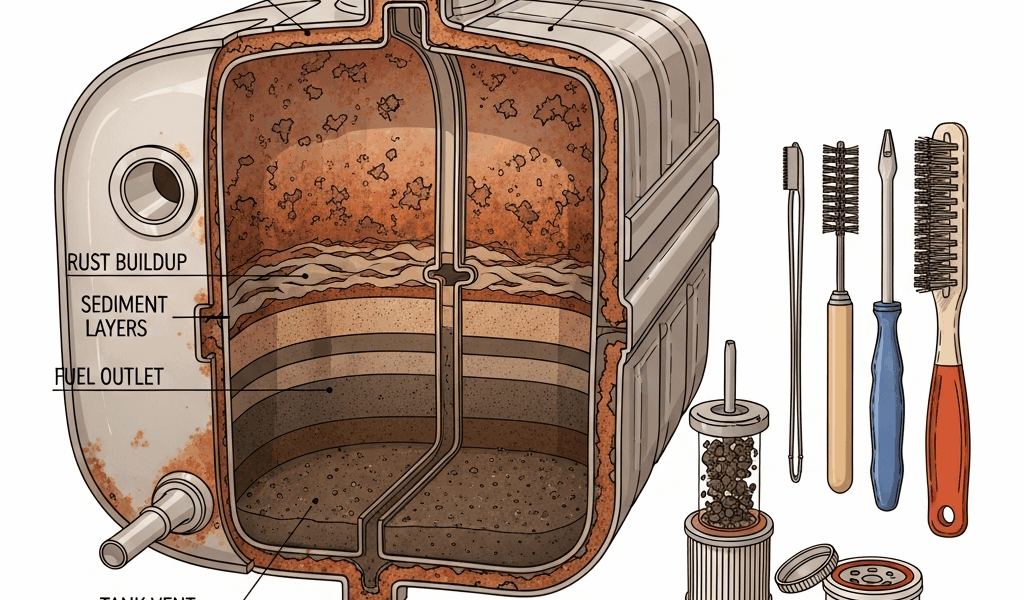
Steel tanks rust from water contact; aluminum tanks pit and corrode through electrolytic action when moisture combines with dissimilar metals in fuel system components. Composite tanks avoid some corrosion but face polymer degradation in sustained heat exposure across the Gulf region’s 95-degree summers.
Early Warning Signs of Tank Corrosion and Contamination
Dark fuel color is your first diagnostic clue. Healthy diesel ranges from pale amber to light brown. If your fuel looks like weak iced tea or darker, oxidation has already advanced significantly. You’ve got days, maybe weeks, before injector fouling becomes obvious.
Sluggish engine starts — especially after your boat’s been anchored for 3-4 weeks — suggest microbial growth or oxidized fuel components blocking fuel lines. Cold starts become progressively worse as contamination worsens. By the time you’re cranking for 10-15 seconds before ignition, your tank is seriously compromised.
Fuel filter clogs in increasingly short intervals are textbook passage-maker trouble. Most cruisers run primary filters rated 30 microns and secondary filters at 10 or 2 microns. When you’re changing primary filters every 100 engine hours instead of every 400-500 hours, water and particulate have reached critical levels in your tank. The filter is doing its job — protecting your injectors from destruction — but it’s a symptom of a larger problem upstream.
Water in your fuel bowl is unmistakable. Drain your primary fuel filter canister into a clear glass jar. If water separates at the bottom — even a tablespoon in 5 gallons — you have tank water ingress. This happens through inadequate tank venting in humidity swings, failed tank inspection ports, or simple condensation accumulation over months of idle anchoring.
Visible rust particles in your fuel strainer screen mean steel tank corrosion has progressed to the point where flakes are circulating. Your fuel system is now actively grinding metal into your injectors. This requires immediate intervention.
Tank Treatment vs Fuel Polishing vs Full Replacement
Three intervention levels exist. Each has distinct cost, downtime, and effectiveness profiles for different voyage timelines.
Chemical Treatment — The Budget Option
Products like Fuzzy’s Tank Cleaner ($35-50 per 32-ounce bottle) or PRI-D diesel conditioner cost under $150 to treat a typical 300-400 gallon cruising trawler fuel tank. You pour the treatment into your fuel fill, run the boat for several hours to circulate it through the system, and monitor fuel clarity over two weeks. Light oxidation and early microbial growth respond well. Established rust or significant water accumulation won’t budge with chemical treatment alone.
Downtime is minimal — one day. Cost is trivial. Best use case: preventive treatment during your Great Loop passage, every 6-8 months starting in month two, before serious problems emerge.
Fuel Polishing — The Middle Ground
Professional fuel polishing services run $800-2,000 per treatment depending on tank size and local labor rates. A polishing unit filters your fuel through a cartridge system designed to remove water and particulate down to 3 microns while you keep the boat running — or the system hooks into your existing fuel system for circulation while anchored. Most Great Loop service yards (those that service cruising boats specifically, not charter fleets) offer polishing in the $1,200-1,500 range for a 300-gallon tank.
Downtime is 4-8 hours typically. Fuel circulation continues, so you’re not left without propulsion. Effectiveness is genuinely impressive for moderate contamination. Established rust particles, microbial mats, and free water all get removed. Your fuel color improves noticeably. Injectors respond better. This is your real workhorse option if you catch problems in month 4-6 of your passage.
Tank Replacement — The Nuclear Option
Full tank replacement at a marine yard runs $4,000-8,000 in labor plus $1,500-3,500 for the tank itself, depending on materials and complexity. Haul-out time is 3-5 days minimum. You’re looking at total project cost of $6,000-12,000 and a week of no-boating status. Some yards — notably those specializing in Great Loop cruiser service in the Tennessee River region and Gulf Coast — have tank replacement down to 3-day timelines, but you’re still out of commission during peak cruising season.
Replacement becomes necessary when corrosion perforation is visible (small leaks), rust contamination is severe and persistent, or your tank materials are incompatible with extended warm-weather exposure. Some older aluminum tanks become liabilities in Gulf summer heat.
Monthly and Annual Fuel System Maintenance on Extended Cruises
Prevention beats treatment at every scale. Here’s the rhythm that works for 24-36 month passages.
Monthly Protocol
Run fuel through a clear glass observation jar every 4-6 weeks. Watch for color darkening, water separation, or sediment. This takes 3 minutes and catches problems early. I learned this lesson the hard way — skipped visual checks for two months in the lower Mississippi, missed developing water intrusion, and paid $1,800 for polishing that might have cost $400 in biocide treatment caught at month 2.
Change your primary fuel filter element every 200 engine hours instead of the manufacturer’s 400-hour recommendation. Great Loop passages involve more engine running than you’d think — river lock transits, tidal currents, docking in current, generator runtime. But you’re also doing extended anchoring. Shorter filter intervals catch contamination progression before it reaches your secondary filters and injectors.
Seasonal Adjustments
Add biocide to your tanks every 6-8 weeks starting in month two — or immediately if you’re entering the Gulf region or any warm climate where microbial growth accelerates. Products like Biobor JF ($80-120 per quart) dose at roughly 1 ounce per 100 gallons and require circulation through the fuel system over 30 minutes to be effective. Tank climate matters. If you’re transiting the Gulf in July with ambient temperatures pushing 95 degrees and high humidity, you’re running maximum biofuel degradation conditions. Dose every 6 weeks. Northern passages can extend to 8-week intervals.
Inspect tank venting every 30 days. Fuel tanks vent through small-diameter lines (typically 3/8-inch hose or tubes) to prevent pressure buildup. These vents block with debris, water, or biological growth. Blocked vents create vacuum conditions that draw moisture-laden air directly into the tank headspace. Check that your vent lines are clear, terminate above the waterline with proper drip loops, and aren’t routed through bilge areas where humidity accumulates.
Test fuel water content formally every 6 months using Karl Fischer titration testing kits ($50-120 for a lab-grade kit, or $30-40 if you use field testers like the Aqua-Glo moisture indicator). Professional fuel testing through marine labs costs $75-150 per sample but gives you ppm precision instead of visual approximation. Over a 3-year passage, budget $400-600 for formal testing intervals — it’s cheap insurance.
Fuel Tank Selection for New Trawler Buyers Planning Long Passages
If you’re building or buying a trawler specifically for Great Loop cruising, fuel tank material selection is foundational to your long-term corrosion strategy.
Steel Tanks
Traditional mild steel tanks are inexpensive ($1,200-1,800 for a 300-gallon unit) and easily customized to fit tight engine room spaces. They require interior epoxy coating and exterior protection. Over 24-36 months in mixed climates, steel tanks need aggressive corrosion management — regular biocide treatments, water removal, and frequent inspections. Steel tanks in the fuel-polishing lifecycle are totally manageable. Neglected steel tanks become $8,000+ replacement projects.
Aluminum Tanks
Aluminum tanks resist rust but are susceptible to electrolytic corrosion (pitting) when dissimilar metals contact diesel fuel in the presence of moisture. A properly isolated aluminum tank with sacrificial zincs and electrical bonding works beautifully for Great Loop passages. Cost runs $2,200-3,200 for 300-gallon capacity. Aluminum’s real advantage: if corrosion starts, it’s typically slow and manifests as thin pitting rather than catastrophic rust-through. Many experienced Great Loop cruisers actively prefer aluminum tanks for this longevity profile.
Composite/Plastic Tanks
Modern thermoplastic tanks (often polyethylene-based) eliminate corrosion entirely and cost $1,600-2,400. They excel in cold climates and high-moisture conditions. The trade-off: they degrade under sustained high heat (90+ degree ambient temperatures over months), and some fuel additives interact negatively with certain plastics. For Gulf passages, composite tanks are riskier than aluminum or steel with proper coatings.
Tank baffles matter. Tanks with internal baffles promote fuel circulation and reduce sediment settling, cutting microbial growth opportunities. Sediment traps — small sumps at the tank’s lowest point — let you drain accumulated water and sludge without removing fuel. These features cost $200-400 extra during tank selection but save you thousands in maintenance over 3 years.
Tank inspection access is non-negotiable. You need a cleanout plate or inspection port large enough to physically inspect interior surfaces or enable professional cleaning service access. Some economical tanks come without proper inspection ports. Avoid them. Maintenance blindness leads to catastrophic problems mid-passage.


Stay in the loop
Get the latest passage maker mag updates delivered to your inbox.