Why Stabilizers Matter on Long Passages
Six weeks aboard a 42-foot Grand Banks — first the Chesapeake, then the Gulf of Mexico — taught me something the brochures don’t emphasize. Stabilizer systems aren’t luxury upgrades. They’re survival equipment for your crew’s endurance.
When you’re dealing with 4-6 foot beam seas and a 20-degree roll every eight seconds, discomfort becomes exhaustion. And exhaustion leads to poor navigation, missed weather windows, and actual safety problems. I watched a skipper miss an entire weather window because his crew was too wrecked to properly analyze the forecast.
The Great Loop pulls trawler owners into 1000+ nautical mile passages where conditions don’t cooperate. Chesapeake chop in November. Yucatan Channel swell fighting opposing wind. The Tennessee-Tombigbee during tow traffic when you can’t even alter course. Over a 300-hour Gulf crossing, a five-degree reduction in roll angle compounds into crew recovery, better watchkeeping, and honestly — the difference between enjoying your retirement and white-knuckling through it.
Probably should have opened with this, but here’s the real problem: you don’t make the stabilizer decision until you’ve already spent money on other systems. By then, your budget’s already committed elsewhere.
Active Fin Stabilizers vs Gyroscopic Systems
Two major active technologies exist for 35-60 foot trawlers, and they work on completely opposite principles.
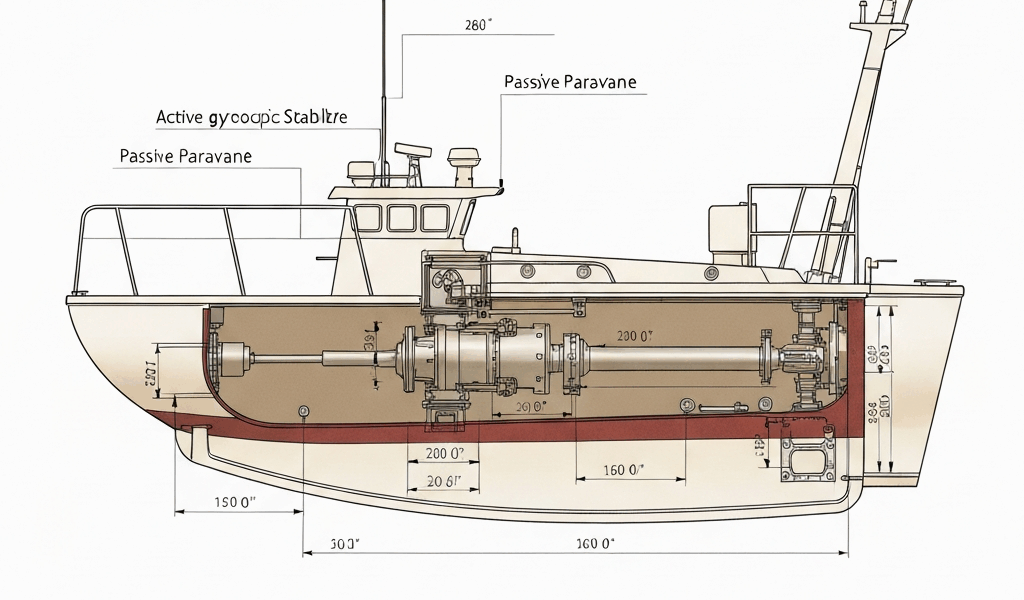
Fin stabilizers deploy retractable fins through the hull that generate lift opposing roll motion. The SeaKeeper gyroscope uses angular momentum — a weighted rotor spinning at 10,000+ RPM creates counter-force without water penetration. Naiad and Humphree represent the fin category for trawlers.
Here’s what actually matters in the real world:
- SeaKeeper 3 (typical trawler size): $65,000-$85,000 installed. Continuous power draw 4-6 kW. Achieves 60-80% roll reduction in beam seas. Single through-hull for cooling water. No moving parts below the waterline. Lifespan 20+ years with oil changes every 500 hours ($800-$1200 annually).
- Naiad 250 (comparable class): $55,000-$75,000 installed. Full deployment draws 8-12 kW. Delivers 50-75% roll reduction depending on conditions and speed. Two through-hulls (one per fin). Hydraulic systems need annual service ($1500-$2000 yearly). Fin casings can suffer impact damage in tight anchorages.
- Humphree active fins: $40,000-$60,000 for smaller trawlers (under 45 feet). Power draw 3-5 kW. Roll reduction 40-65%. Speed-sensitive — effectiveness drops significantly below 6 knots. Simpler installation than Naiad but requires dedicated electrical architecture.
The fuel penalty exists, but it’s smaller than people think. A gyroscope spinning continuously draws consistent power regardless of sea state. Fin systems only draw power during active stabilizing, so they’re more efficient in changing conditions. Running a 48-foot trawler at 8 knots for 300 hours? A 5 kW gyroscope costs roughly $150 in fuel across the entire transit. A fin system might run $80-120. Nobody’s picking systems based on that difference.
Generator sizing? That changes everything. Your boat currently runs a 15 kW genset comfortably. Add a 6 kW stabilizer system and you’re forced to jump to 20-25 kW. That new genset costs $8,000-$15,000 more — plus higher fuel burn and maintenance. Suddenly the “cheaper” fin system becomes expensive because your electrical backbone can’t support it without upgrades.
Installation complexity matters more than anyone admits. The SeaKeeper needs one through-hull for cooling intake, mountable almost anywhere convenient. Gyroscopes respond within 3-4 seconds of motion. Fin systems demand hull penetrations at specific locations with hydraulic lines routed throughout the interior. A 1995 Grand Banks might not have accessible wall space for new pressure lines without major reconstruction.
Passive Paravane and Flopper Stopper Systems
Most of us — the budget-conscious ones — still choose passive systems. You’re looking at $3,000-$8,000 depending on quality. Zero power draw. Zero through-hulls. Zero installation headaches.
Paravanes are weighted vanes towed astern on outriggers that deploy into roll moments, creating drag to counter the motion. Flopper Stoppers use similar physics with side-mounted devices. A quality set (Sea Hawk or Shewmon brand) reduces roll 30-50% in moderate-to-heavy seas. Genuinely effective in beam conditions.
But the actual workflow is tedious. Deployment takes 10-15 minutes before rough water. Retrieval takes another 15 when approaching land or anchoring. In the Gulf, you’re doing this weekly in at least 10-knot wind. I’ve watched skippers catch outrigger lines in their props during hasty retrievals in fog. It happens.
Real limitation: paravanes don’t work below 5 knots. Useless in rivers, narrow channels, or crowded anchorages. Following seas or quartering wind? Forget it. A crew on the Tenn-Tom might deploy them for six total hours across the entire route.
Most Great Loop skippers accept some roll to avoid active system complexity. They manage fatigue through watch rotation, strategic route planning, and accepting that passages get uncomfortable. It’s not ideal, but it’s realistic.
Installation Complexity for Trawlers Underway
This is where choices become concrete.
Retrofitting fin stabilizers on a 1995 Nordhavn 46 means haul-out ($3,000-$5,000 for marine railway time). New through-hulls need hull reinforcement — marine architect sign-off potentially required, adding $1,500-$2,500. Hydraulic line routing assumes accessible engine room space. Nordhavns have tight engine rooms. Every inch of new piping becomes a logistics puzzle.
SeaKeeper on that same 46: haul-out still required (same cost). The cooling intake through-hull is small — 1.25 inches typically. Most boats accommodate this in the keel area without reinforcement. Electrical integration stays straightforward if you’ve already got decent 120V AC circuits and genset capacity. No routing nightmares.
I watched a Grand Banks 42 owner spend four months and $18,000 on a Naiad 250 because his hull construction demanded extensive reinforcement around the fin casings. Same owner could have installed a SeaKeeper in two weeks with identical haul-out time for $8,000 less total. His mistake was not getting marine surveyor input before committing.
Retrofitting old boats means guessing at interior construction. New wiring or piping access is unpredictable. Budget for surprises — always.
Fuel Consumption and Generator Load Impact
A SeaKeeper 3 runs roughly 4-6 kW sustained. That’s equivalent to a household dishwasher running continuously. Over 300 hours at 8 knots, assuming 8 hours daily genset runtime, you’re adding about 32 kWh to power demand. At $0.15 per kWh for marine diesel generation, that’s roughly $150 in fuel and wear.
But here’s the catch: if your genset isn’t sized for simultaneous AC load (air conditioning, water heater, stabilizer together), you either oversize the generator or live without comfort systems. Upsizing from 15 kW to 20 kW typically costs $10,000-$15,000 additional. Nobody disables their AC voluntarily.
Math changes dramatically if you’ve already got substantial genset capacity. A boat running a 25 kW unit — oversized for future expansion — absorbs a 5 kW stabilizer with minimal impact. That same stabilizer on a 12 kW system becomes a limiting constraint.
Great Loop Skipper Recommendations
I’ve talked with a dozen passage makers about their stabilizer choices, and patterns emerge immediately.
Coastal Gulf transits: SeaKeeper or Naiad systems. Roll reduction in open water justifies the cost and complexity. Skippers running Miami-Panama or Florida-Louisiana regularly see 40-60 days of coastal voyaging annually. Active stabilization pays itself in crew health and safety margins.
Great Loop inland routes: Paravanes or nothing. Inland rivers generate chop but rarely sustained beam seas. Passive systems deploy occasionally; most of the time deployment is overkill anyway. Cost discipline wins here.
Mixed cruising (coastal plus inland): This is the actual difficult choice. A 48-foot trawler spending six months on the Loop and two months heading to the Bahamas faces a real dilemma. One Nordhavn 48 owner chose a mid-range Humphree system specifically because it worked reasonably well at varying speeds and didn’t force genset upsizing. His trade-off: 55% roll reduction instead of 70%, but $20,000 less total cost and no generator stress.
A Grand Banks 46 I know chose paravanes and accepts the roll. Her owner runs offshore infrequently and prioritizes simplicity. She was honest about it: “Some roll doesn’t sink boats. Complexity and cost do.”
The right choice depends entirely on your actual cruising pattern, existing electrical infrastructure, and what you can tolerate — complexity-wise and cost-wise. Get clarity on that before committing any budget.

Stay in the loop
Get the latest passage maker mag updates delivered to your inbox.