Why Trawler Holding Tanks Fail on Long Passages
Holding tank failures on extended cruises aren’t random — they’re predictable consequences of how we actually live and move through the water. I’ve spent enough time aboard trawlers to understand the difference. The tanks themselves? They’re engineered for intermittent use on weekenders. But liveaboards and Great Loop passages demand something entirely different, and most tank systems just aren’t built for it.
Constant motion breaks down the bacterial colonies that normally establish equilibrium in a stationary tank. Then there’s temperature — especially those freeze-thaw cycles in northern Great Loop sections around Ohio and Pennsylvania. I’ve watched these swings stress seams and create condensation that accelerates corrosion from the inside. Here’s what gets most owners: keeping tanks at 50% capacity for weeks is actually worse than running full. Half-full tanks allow waste to coat the interior surface, and that coating hardens into a bacterial biofilm — feels like concrete when you finally try to clean it.
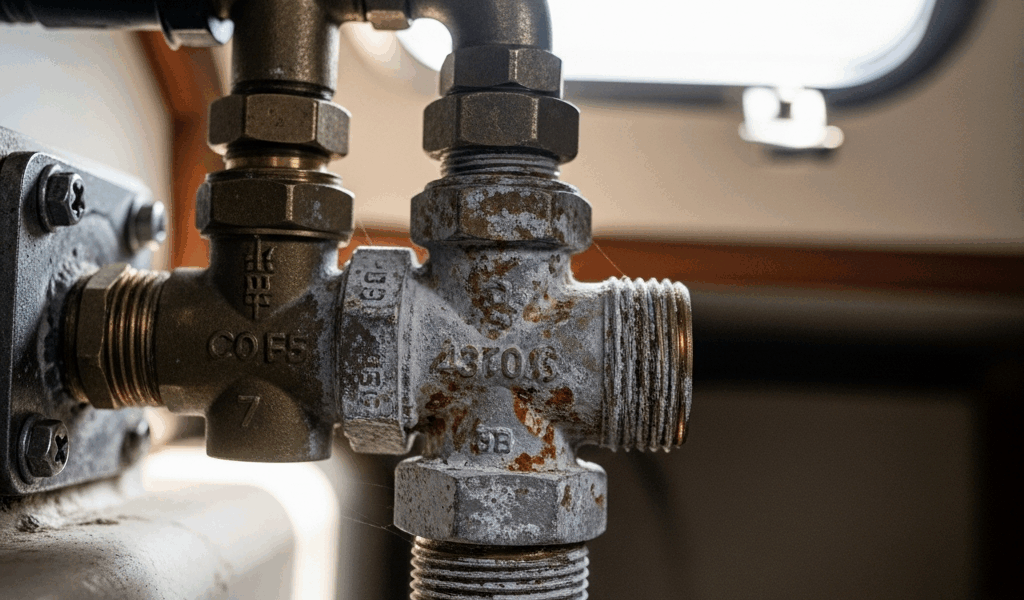
Saltwater intrusion happens more often than people admit, honestly. A corroded through-hull fitting, a failed discharge hose clamp, or even capillary action through a wooden mounting block — any of these introduces salt that kills beneficial bacteria and accelerates tank degradation. Add in seasonal temperature swings — a tank exposed to 90°F summer heat followed by 20°F winter nights — and you’re looking at expansion cycles that no polyethylene or fiberglass tank was designed to handle over decades.
Methane gas buildup is the silent killer nobody talks about. When anaerobic bacteria dominate (oxygen-starved tanks), they produce methane and hydrogen sulfide. These gases corrode metal fittings, warp plastic tanks, and create the kind of smell that makes other cruisers actively avoid your boat at the fuel dock.
Diagnosing Tank Problems Before They Strand You
Persistent odors despite sensor readings showing tank at 20% capacity? That’s your first red flag. The sensor reads volume, not condition — it can’t tell you the tank’s lined with sludge.
Run the flush test. Fill a 5-gallon bucket at the galley sink, add food coloring, pour it in, and watch the drain. If water backs up, if it takes more than 10 seconds to disappear, your system has a clog or a failing pump. Listen for gurgling sounds when the pump runs — that’s air being drawn into the line, which happens when sludge buildup creates low spots that trap waste.
Slow discharge is classic sludge. After weeks of cruising, solid waste settles into a concrete-like mass at the tank bottom, and your discharge pump can’t move it. The pump cavitates — it runs but pushes nothing. You’ll notice the discharge line won’t fill even though the pump’s running.
Frozen discharge lines announce themselves with zero flow and a pump that sounds normal but produces nothing. If you’re running the Great Loop north of Kentucky in winter, this will happen. The discharge line — usually ½-inch hose running through an engine room or along an exterior wall — freezes solid at 28°F. Antifreeze in the tank helps, but it doesn’t always reach the line itself, especially if that line runs outside the insulated cabin.
A methane gas problem shows up as a chemical smell that gets worse after the tank’s been sitting for 12 hours. Probably should have opened with this section, honestly. Gas problems are more dangerous than odors. If you smell rotten eggs or sulfur inside the cabin when no one’s used the head in hours, you’ve got anaerobic fermentation happening. That’s your cue to treat immediately.
To confirm diagnosis, turn off the tank pump breaker and observe for 30 minutes. If water levels in the tank rise (indicating backflow), your discharge pump or through-hull check valve has failed. If levels stay steady but smell intensifies, you’re dealing with bacterial overgrowth and need biocide treatment.
Step-by-Step Tank Cleaning and Biocide Treatment
Start with a fresh-water flush — and this is important. Use city water or dock water, never your boat’s fresh-water tank. Set a deck washdown hose to low pressure (20 PSI maximum) and spray directly into the tank through the inspection port or deck plate. High-pressure water destroys beneficial bacteria colonies and can crack older tanks. Low pressure gently breaks loose sludge without damage.
Run the discharge pump continuously during the flush. This pushes loosened sludge out the through-hull while fresh water replaces it. Expect this to take 15–20 minutes. The water coming out will be black initially, then gray, then clear. When it runs clear, you’re done.
Next, introduce biocide treatment. Odor Away (sold in marine catalogs for roughly $22 per quart) kills anaerobic bacteria without poisoning your system’s beneficial bacteria. Dosage is typically 1 quart per 40 gallons of tank capacity. Raritan Fresh Flush works similarly and costs about $18 per treatment for a 30-gallon tank. I prefer Odor Away because it includes enzyme supplements that break down solid waste — not just mask odors.
Fill the tank to 75% capacity with fresh water, add biocide at the recommended dose, then run the system normally for 24 hours. Use the head, pump the shower drain through the tank if your system allows it. Movement distributes the biocide throughout. After 24 hours, flush again with fresh water at low pressure.
Critical warning: Never mix chemical treatments. Bleach-based products combined with enzyme treatments create gas. I made this mistake on a 2017 Maine cruise and learned it the hard way — the tank vent line literally exploded, blowing out a deck fitting and coating my cabin sole with waste. Don’t make my mistake.
For liveaboards cruising extended passages, treat your tank every 30 days during the season. During winter layup or short seasonal use, treat every 60 days. If you’re doing the Great Loop (4–6 months continuous), treat every 3 weeks once you’re in northern sections where cold slows bacterial activity.
Unfreezing and Protecting Discharge Lines in Cold Water
If your discharge line is already frozen, you have three options: heat tape, hot water, or antifreeze circulation.
Heat tape ($30–$60 for 25 feet) wraps around the discharge hose and connects to a thermostat — set it to activate at 35°F. This prevents freeze-up before it starts. Installation takes 2 hours if you can access the line. Most trawlers have it routed through the engine room or laundry space, making it accessible. Wrap the line with 2 inches of closed-cell foam insulation afterward. The combination works for temperatures down to 10°F without drawing excessive battery power.
Emergency thawing uses hot water bags (literally hot-water bottles) placed against the frozen section for 30–45 minutes. Don’t use a heat gun on plastic hose — it melts the material. A hair dryer on high works in a pinch for 15–20 minutes of gentle warming. The goal is gradual melting, not thermal shock.
Winterization fluid is your best long-term solution. Pour non-toxic RV antifreeze (brands like Sierra and Camco, roughly $8–$12 per gallon) into the tank before temperatures drop. Use 2–3 gallons for a 40-gallon system. This lowers the freezing point of any moisture in the line and prevents ice formation even in below-zero temperatures. Pump it through the system once to distribute it, then leave the tank as-is. When spring arrives, flush with fresh water and treat with biocide to clear residual antifreeze.
Before you enter cold-water regions (Ohio northward on the Great Loop, typically November–March), inspect your discharge line for splits or soft spots. A compromised line will freeze more easily and burst when thawed. A new 50-foot spool of marine-grade discharge hose costs about $80–$120, and replacing it takes 2–3 hours if the routing is simple. It’s cheaper than a major leak mid-winter.
When to Replace vs. Repair Your Tank System
Tank lifespan depends on material and use. A polyethylene tank in continuous liveaboard service lasts 15–20 years. Fiberglass tanks last 20–30 years. Steel tanks corrode from the inside and fail unpredictably after 12–15 years.
If your tank is cracked (visible damage, confirmed by repeated water loss), replacement is the only option. A new 40-gallon polyethylene holding tank costs $400–$600. Fiberglass tanks run $600–$900. Installation labor adds $800–$1,500 depending on through-hull fittings and plumbing complexity. That’s a $1,200–$2,400 job.
A failing sensor (shows full when empty, or vice versa) costs $150–$300 to replace and takes 1 hour. That’s the easiest repair — do it yourself if you’re comfortable with wiring, or pay a marine electrician.
A corroded discharge pump ($200–$400) or faulty through-hull check valve ($75–$150) should be repaired, not replaced. The tank itself is fine. You’re just fixing the plumbing.
For long-term peace of mind, install a tank monitoring system. Holding tank sensors that display volume, temperature, and water quality run $300–$600 installed. They alert you to problems before they become emergencies. The difference between discovering a tank problem in open water versus discovering it at a fuel dock is thousands of dollars and serious risk.
Holding Tank Maintenance Schedule for Cruisers
Quarterly treatment (every 3 months during cruising season): Flush at low pressure, add biocide, run for 24 hours, flush again. Budget 2 hours and $25 in supplies.
Seasonal transition (spring and fall): Replace any antifreeze used for winterization. Check discharge line for damage. Inspect through-hull fitting and hose clamps. Tighten any loose clamps and apply dielectric grease to prevent corrosion.
Pumpout frequency for extended cruising: Every 5–7 days if you’re a family of two using a marine head normally. If you’re a solo cruiser or couple, you can stretch to 10–14 days if you treat the tank every 3 weeks. Never let a tank run beyond 75% capacity for more than 2 weeks — that’s when sludge buildup accelerates.
Winterization (before temperatures drop below 40°F): Add non-toxic antifreeze, pump it through the system once, inspect discharge line insulation, verify heat tape is functional if installed, and test the thermostat.
Spring prep (before resuming cruising): Drain and flush antifreeze, treat with biocide, pump-out at first opportunity, run the system with fresh water for 24 hours, flush one final time.
Keep a maintenance log. Write down treatment dates, biocide type and quantity, pumpout dates, and any issues. I learned this the hard way — my insurance company required documentation when I filed a claim for a tank-related bilge contamination. Three years of handwritten notes in a spiral notebook saved me $8,000.
Follow this schedule, and holding tank problems become manageable maintenance, not emergency repairs that strand you in a Pennsylvania marina in February.


Stay in the loop
Get the latest passage maker mag updates delivered to your inbox.