Why Standard Generator Sizing Rules Fall Apart at Sea
The “one kilowatt per ten feet of boat length” rule haunted me for three years. I bought a Nordhavn 43 in 2019 and followed that math—4.3 kW seemed reasonable for a trawler. Then I tried to run the water maker while the heating oil burner cycled and the battery charger pulled current. The generator stalled. Mid-passage in the North Atlantic, I was hand-washing dishes and rationing hot water like it was 1987.
That rule exists for shore-power assumptions. Marinas provide 50 amps at 240 volts. Your boat sits at a dock. Peak loads happen for minutes, not hours. But when you’re living aboard for months at sea — everything changes. Completely.
Passage makers face a brutal choice: undersized generators that brown out when multiple loads run simultaneously, or oversized units that burn fuel inefficiently and struggle in rough seas. A 6 kW genset running a 15 kW simultaneous load will shut down. A 20 kW genset running 8 kW of actual demand idles at partial load, where diesel engines carbon up and waste fuel.
The real problem is that shore-power sizing ignores simultaneous demand. You need a methodology built around what actually runs together when you’re a thousand miles from land.
The Load Audit: Mapping Your Actual Power Draw
Probably should have opened with this section, honestly. Before you buy anything, inventory every AC appliance and its real power consumption.
I made a spreadsheet. Item, running watts, duty cycle, likelihood of simultaneous use. Here’s what matters:
- Water maker: A typical Spectra or Katadyn draws 15–18 amps at 240V (3.6–4.3 kW). Three-hour cycle per day if you’re conservative, longer in rough weather when you’re making passages and want fresh water stored.
- Oil heating burner: Webasto or Espar units draw 10–12 amps at startup (2.4–2.9 kW), cycling every 30 minutes in winter. Small draw, but it overlaps with everything else.
- Refrigeration: 8–12 amps running (1.9–2.9 kW), compressor cycles every 45 minutes. Minimal issue on its own.
- Battery charger (inverter-charger): This is the killer load. A Victron Multiplus 48/5000 pulling 30 amps at 240V (7.2 kW) while charging house batteries and running inverter mode simultaneously.
- Induction cooktop or microwave: 4–6 kW each, but usually manual—you don’t run these while other loads peak.
- Electric element heating: 6–8 kW if you have it. Don’t. Use diesel heating instead.
I pulled actual data from three common offshore trawlers:
| Nordhavn 43 | Amps @ 240V | Watts |
|---|---|---|
| Water maker (Spectra) | 15A | 3,600W |
| Webasto heater | 10A | 2,400W |
| Victron charger (combined) | 30A | 7,200W |
| Refrigeration compressor | 8A | 1,920W |
| Total simultaneous demand | 63A | 15,120W |
The Kadey-Krogen 42 and Selene 53 look similar—water maker plus charger is always the spike. Most passage makers don’t run heater, water maker, and charger all at once intentionally, but rough seas and battery management force the overlap.
Walk through your own boat systematically. Check nameplate data. Don’t guess.
Calculating Simultaneous Load and Peak Demand
Total load and realistic simultaneous load are different animals. You have 15 kW of total installed equipment. You’ll never need all of it running together.
But you need to know what will run together. This depends on your cruising pattern.
Calm-anchorage scenario: You’re on anchor, batteries are low, you want hot water. Water maker runs 3 hours (4.3 kW). Charger tops batteries (7.2 kW). Heater cycles (2.4 kW average). Fridge compressor (1.9 kW intermittent). Simultaneous peak is roughly 13–14 kW for 30 seconds when the water maker and charger both have motor inrush, then 11–12 kW sustained.
Winter passage scenario: Running offshore, seas building. Heater wants to cycle every 15 minutes because cold cabin temperature drops faster. Water maker hasn’t run in four days — you’re conserving fuel. Battery charger is just topping a partial deficit. Real simultaneous demand is 4–5 kW, modest and manageable.
Now add headroom. Motors draw 150–200% of running amperage for the first one to two seconds during startup. Voltage sag under load is real—your bus voltage may drop 5–10% when a large load starts. A 7.2 kW charger drawing 30 amps at 240V (nominal) might spike to 50–55 amps for two seconds, or 12 kW at the generator terminals.
Industry practice: add 20–25% headroom above your calculated peak simultaneous load.
If your worst-case simultaneous scenario is 14 kW, size for 17–18 kW. If it’s 18 kW, size for 22 kW.
Matching Generator Type and Fuel Efficiency to Passage Making
Marine diesel generators dominate for continuous cruising. Onan (now part of Cummins), Westerbeke, and Northern Lights are the standards. Gas generators are lighter and cheaper upfront but guzzle fuel when running 2–4 hours per day for months.
Diesel wins on efficiency. A Westerbeke 13.5 DBEC (diesel, 13.5 kW) burns roughly 3.3 gallons per hour at 80% load. A comparable gas generator burns 4.5–5 gallons per hour. On a six-month passage with 180 days of routine generator use, that’s a 400-gallon difference.
Sound levels matter less offshore but matter at anchor. Diesel units run 75–82 dB at 25 feet. Gas units are quieter (72–78 dB) but the fuel economy trade-off kills them.
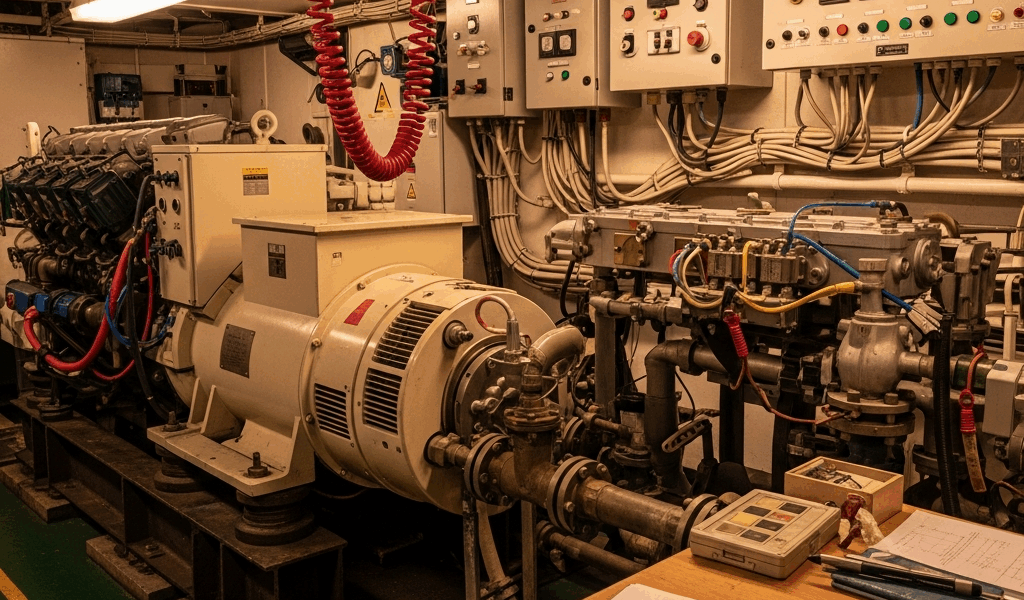
Installation space is real. A 15 kW diesel genset occupies roughly 72 inches long, 30 inches wide, 36 inches tall with sound enclosure. You need access for maintenance, exhaust routing, and cooling airflow.
Here’s the efficiency insight: a correctly sized diesel generator runs at 70–80% of its rated load. That’s the sweet spot for fuel consumption per kilowatt-hour. An oversized genset running at 40–50% load burns nearly as much fuel per hour while producing half the power. Carbon builds up. Injectors coke. You’re wasting money.
If your calculated peak is 17 kW, buy a 15 kW genset. It will run at 85–90% load during peak simultaneous use, which is acceptable short-term. During normal 8–10 kW cruising loads, it sits at 55–65% load — not ideal but manageable. You’re not buying a 20 or 25 kW genset for a 17 kW peak.
Redundancy and Realistic Backup Plans
Generators fail. Mine’s been bulletproof, but I’ve seen fuel contamination shut down three other boats mid-ocean.
Should you carry a small portable genset? A 4 kW Honda or Yamaha weighs 100–130 pounds and costs $3,000–$4,500. You can’t run the water maker on it, but you can charge batteries, run the fridge, and use the microwave. I know passage makers who carry one as insurance. Honest trade-off: you lose storage space and weight that could be fuel, but you sleep better.
Battery-only passages are possible if your house bank is 800–1,000 amp-hours and you’re disciplined about conservation. You’d reduce load to 2–3 kW and stretch generator runtime to every other day. Works in mild weather. Fails in winter when heating demand is real.
Inverter-chargers provide partial backup. If your generator dies, you can invert 3–5 kW from batteries for essential loads—fridge, navigation, lights—while you troubleshoot or motor-sail to the next port. It’s not replacement-level redundancy, but it buys time.
Many experienced passage makers run smaller primary generators (8–10 kW) and accept trade-offs. You don’t run water maker and charger simultaneously. You batch tasks. It requires planning and discipline, but it reduces fuel consumption and engine hours. Only you know your cruising priorities.
Size your generator for your actual simultaneous load plus 20–25% margin, match it to a fuel-efficient diesel unit, and plan a realistic backup. That’s how you avoid sitting dead in the water at sea.



Stay in the loop
Get the latest passage maker mag updates delivered to your inbox.