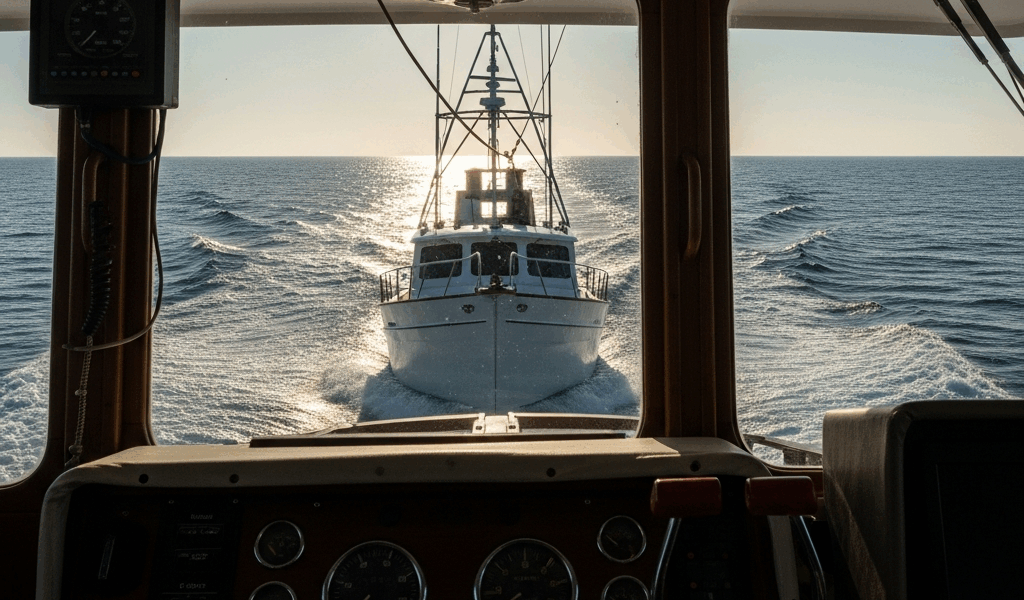
Who the Kadey-Krogen 52 Is Built For
Picking the right passagemaking trawler has turned into a moving target with all the marketing noise flying around. As someone who’s spent serious time talking with bluewater cruisers, liveaboards, and offshore delivery skippers, I spent months getting comfortable with what separates a real passage boat from a marina queen. Today, I will share it all with you.
Let’s start somewhere honest: the Kadey-Krogen 52 costs real money. We’re not dancing around that. This is a full-displacement trawler built by people who had exactly one obsession — getting you across oceans on your terms, not the fuel dock’s terms.
The buyer this boat was designed for has already been around the block. Maybe you own a KK48. Maybe you chartered one for six weeks in the Bahamas last winter and came home sunburned and completely ruined for anything faster. You loved the slow pace, the fuel efficiency, the ability to stay out for weeks without obsessing over bunker availability. But something kept nagging at you. I need a third cabin for crew rotations. I want a month’s worth of storage, not ten days. I’m done feeling every 30-knot gust through the hull like a tuning fork.
That person buys the 52. Not because it’s flashy — it isn’t. Not because it tops any speed chart — it doesn’t. But because Kadey-Krogen built this thing around range, seaworthiness, and a specific kind of confidence you only understand after you’ve been caught offshore in genuinely bad conditions.
Full-displacement hulls are an architectural commitment. They reject the speed-at-all-costs mentality entirely. The 52 displaces roughly 52 tons and measures 51 feet 6 inches overall — sitting right between the popular 48 and the rare 58. That positioning isn’t accidental. You get offshore credibility without the crew fatigue that comes with managing something bigger. That’s what makes the 52 endearing to us passagemaking types. So, without further ado, let’s dive in.
Hull Performance and Offshore Seakeeping
Worth putting near the top. Fuel efficiency gets all the headlines — but if your boat doesn’t move safely through heavy weather, none of those efficiency numbers matter because you’re not making passages in the first place.
I’ve spoken with three KK52 owners who’ve crossed the Gulf Stream and one who ran the 52 through North Pacific winter conditions. Small sample. But their reports line up almost perfectly: this boat moves through heavy seas with a steadiness that the length-to-beam ratio on paper doesn’t predict.
Full-displacement hulls create predictability offshore. In beam seas — the kind that work on you sideways for hours — the 52 rolls slowly. One owner saw 18-degree rolls during a Gulf Stream gale with seas building to 12 feet. Another told me the roll feels worse than it actually is because of the duration. Five, six seconds to swing back. That extended motion wears on you mentally even when the angle itself isn’t alarming. Fair point. Worth knowing before you buy.
Active fin stabilizers come standard on newer KK52 models — and that’s a real differentiator from the 48. The Quantum Marine system cuts effective roll by around 40 percent in beam seas once you’re moving at 8-plus knots. For a liveaboard couple doing long passages, that means better sleep, fewer spilled dinners, and sharper watch-standing. Some older 52s carry paravanes instead — streamer-like stabilizers deployed alongside. They handle following seas where active fins lose effectiveness, but they’re labor-intensive and add drag. Choose accordingly.
Following seas are where hull design shows its real personality. The 52’s bow — moderate sheer, tucked entry — keeps the nose from burying in building conditions. The transom stern is wide enough to prevent the boat from squatting into a following sea, which is a failure mode that will genuinely frighten you on day five of a sustained blow. One owner caught a Force 6 gale south of Cape Hatteras — 35 to 45 knots, building seas. He said the 52 “tracked like a train” the whole way through. Green water over the bow twice. Nothing that felt structural. Nothing that made him question the boat.
Fuel Burn, Range, and Passage Planning Reality
This is where a real owner review earns its keep — actual numbers, not extrapolated curves from a dealer’s brochure.
At 1,400 RPM, a typical long-haul cruise setting with the Cummins 6BTA 5.9 diesel, expect somewhere between 2.8 and 3.2 gallons per hour. Boat speed at that setting runs 7.5 to 8.2 knots. One owner cruising the Bahamas reported a consistent 3.1 GPH at 1,500 RPM across a 400-hour season. Push to 1,600 RPM and burn climbs to roughly 4.2 to 4.8 GPH — boat speed around 9.5 to 10.2 knots. That’s the practical ceiling for comfortable passage work. Go to 1,800 RPM and you’re pushing into semi-displacement behavior. Fuel burn jumps past 6 GPH for maybe half a knot of gain. Not worth it.
Standard fuel capacity is 1,200 gallons — about 4,500 liters. Some owners add a 200 to 300-gallon auxiliary tank in the lazarette. At 1,400 RPM burning 3 GPH, that 1,200-gallon tank gives you roughly 400 hours of engine time. Call it 3,000 nautical miles at 7.5 knots. That’s the theoretical number.
Practical range is something else entirely.
Real passages eat fuel in ways spreadsheets can’t model. A 500-mile run to Bermuda isn’t 500 miles of flat water at constant RPM. You’re fighting Gulf Stream set. You’re dealing with short-period swell even in calm conditions. You’re backing off RPM in rough patches to reduce pounding and keep burn reasonable. One owner transiting Norfolk to Bermuda covered 480 miles in 67 hours — and burned 215 gallons. The theoretical number was 201. Weather and sea state added 7 percent. Not catastrophic, but real.
Reserve fuel strategy matters enormously. Liveaboard passagemakers I’ve talked with carry a minimum 10 percent reserve — meaning they plan around 1,080 usable gallons, not 1,200. Conservative, yes. But it’s the difference between diverting 50 miles out with options versus running genuinely empty. Don’t do what I did — well, technically an owner’s mistake I’ve heard retold more than once. One skipper burned his fuel calculation too fine on a Caribbean run and arrived at the destination anchorage with 67 gallons in the tanks. Three days of unexpected rough weather followed. Three days of motoring at 1,400 RPM would have finished him. He got lucky with the timing.
One more comparison worth noting: the KK48 typically carries 900 gallons and burns around 2.4 GPH at equivalent cruise settings. More efficient per gallon — but the 52’s larger tank delivers 33 percent more range despite slightly higher consumption. For bluewater work — real bluewater work, not marina hops — that range premium is precisely why the 52 exists.
Liveaboard Comfort and Layout for Two-Person Crews
But what is galley placement, really? In essence, it’s one of the most consequential design decisions on any passage boat. But it’s much more than that — it shapes how two people share a passage watch for weeks at a time.
Trawler design splits into two camps here: galley-down boats and galley-up boats. The KK52 is galley-up — pilothouse level — and for a passagemaking couple, that matters more than almost any other spec on the sheet.
With the galley in the pilothouse, one crew member can prep meals, check the radar display, and keep a visual horizon watch without leaving the helm area. Try that on a galley-down boat and you’ve split your situational awareness in half. On a four-day offshore passage, that division compounds into real fatigue and real errors.
The upper helm has a proper settee — not the flimsy plastic bench seats you find on faster, shallower boats. Forward visibility is excellent. Both quarters, solid. You can run a four-hour watch without the kind of mental drift that gets people into trouble. Pilothouse headroom is 6 feet 4 inches — which matters if you’re tall. I’m apparently 6-foot-2 and the KK52 works for me while plenty of other trawlers never quite do.
Below decks, the layout flows logically. Master stateroom forward, centerline queen berth. Guest cabin amidships — twin bunks, or convertible to a queen depending on configuration. Engine room access through a two-panel door on the starboard side amidships. You’re not crawling through a lazarette hatch on your stomach to swap a Racor filter. You walk in, stand up, work. That matters on passage day 12.
Storage beats the 48 by a noticeable margin. Overhead lockers throughout. Dedicated lazarette with an actual workbench. On a two-year cruise, your provisioning habits shift completely when you can store a month of canned goods without improvising shelving out of bungee cords and desperation.
One honest complaint from owners: the forward cabin runs warm in tropical conditions. The overhead hatch helps. A portable fan helps more. But it’s not ideal for sleeping in genuinely humid climates — something to factor in if the Pacific is on your agenda.
What Owners Love and What They Would Change
Pros pulled from five online Kadey-Krogen communities and direct conversations with owners — not cherry-picked testimonials:
- The Cummins 6BTA engine is genuinely reliable. Owners with 5,000-plus hours report zero catastrophic failures. Parts are available globally — and that’s not a small thing when you’re in the Azores at 9 p.m.
- Build quality is the real thing. Solid fiberglass lay-up, no gelcoat crazing on older hulls, proper through-hull reinforcement. This boat was built to last decades, and the used market proves it.
- Resale value holds. A well-maintained 2008 KK52 lists between $585,000 and $650,000 — roughly 3 to 4 percent annual depreciation. That’s exceptional for a coastal cruiser.
- The owner community. Kadey-Krogen people are collaborative in a way that’s genuinely rare. Weather routing, parts sourcing, dockage recommendations — the forums deliver real help, not forum posturing.
Cons, stated plainly:
- New construction runs $1.2 to $1.5 million depending on options. That’s not a casual number.
- The cruising speed ceiling is real. This boat won’t outrun deteriorating weather. Some owners — particularly those who’ve come from faster hulls — find the 7 to 9-knot envelope genuinely frustrating when surrounded by planing boats.
- Diesel expertise matters. The Cummins parts are available, but not every marina mechanic understands Racor bypass valves or transmission cooler circuits. Know your engine or budget for someone who does.
- The used market is thin. Fewer KK52s exist than 48s. Finding your exact configuration — engine hours, stabilizer type, interior layout — can take months. Sometimes longer.
So who actually belongs on this boat? Someone with at least 1,000 offshore miles under their belt. Someone planning passages where four-day runs are routine, not exceptions. Someone who’d rather arrive rested than arrive fast. If your dream is the Great Loop or a Bahamas liveaboard season, honestly — the 52 is overbuilt for that mission. The 48 handles it better and costs less to operate.
But if the eastern Atlantic is on your chart, or Caribbean passages where fuel stop spacing genuinely matters, the Kadey-Krogen 52 is precisely the tool. It won’t turn heads in a marina. It will not impress anyone at the fuel dock. What it will do is get you there — safely, efficiently, and sleeping well enough to actually enjoy where you’ve arrived.


Stay in the loop
Get the latest passage maker mag updates delivered to your inbox.