“`html
Why Raw Water Pumps Fail on Trawlers
As someone who’s spent six seasons cruising the Great Loop and two passages to the Bahamas, I learned everything there is to know about raw water pump failure the hard way. Today, I will share it all with you.
Salt and brackish water are brutal on these systems — impellers made from bronze or synthetic materials wear down gradually, accelerated by the 2,000-plus annual cruising hours typical of passage makers. Every minute your pump runs, tiny salt crystals and debris are abrading the impeller blades. On a Great Loop cruise, you’re not dealing with pure saltwater; you’re contending with river sediment, algae blooms, zebra mussels (depending on your route), and accumulated gunk that clogs strainers faster than you’d expect.
Temperature cycling stresses the whole system. During a 200-mile overnight passage, your engine runs continuously at steady RPM for 18–24 hours straight. That constant thermal load, combined with the corrosive environment, degrades impeller material. I watched a Nordhavn 43’s pump fail in 2019 because the previous owner had skipped impeller replacement for 800 cruising hours. The cost difference? Preventive maintenance runs $400; emergency mid-passage repairs cost $4,000 and your peace of mind.
The cooler load on long passages demands peak efficiency from your pump. Unlike day-cruising boats, trawlers running 24/7 cooling cycles push raw water systems to their limits. A failing pump doesn’t just reduce cooling flow — it triggers cascading problems. Overheating damages your oil, stresses seals, and can warp cylinder heads. That’s what makes this system so unforgiving for us passage makers.
Six Warning Signs Before Total Failure
Rising engine temperature is the loudest alarm. Normal cruising temps sit around 160–180°F. If you’re seeing 190°F or climbing during normal throttle, something’s restricting flow. Check your gauge twice; digital displays don’t lie like old mechanical ones.
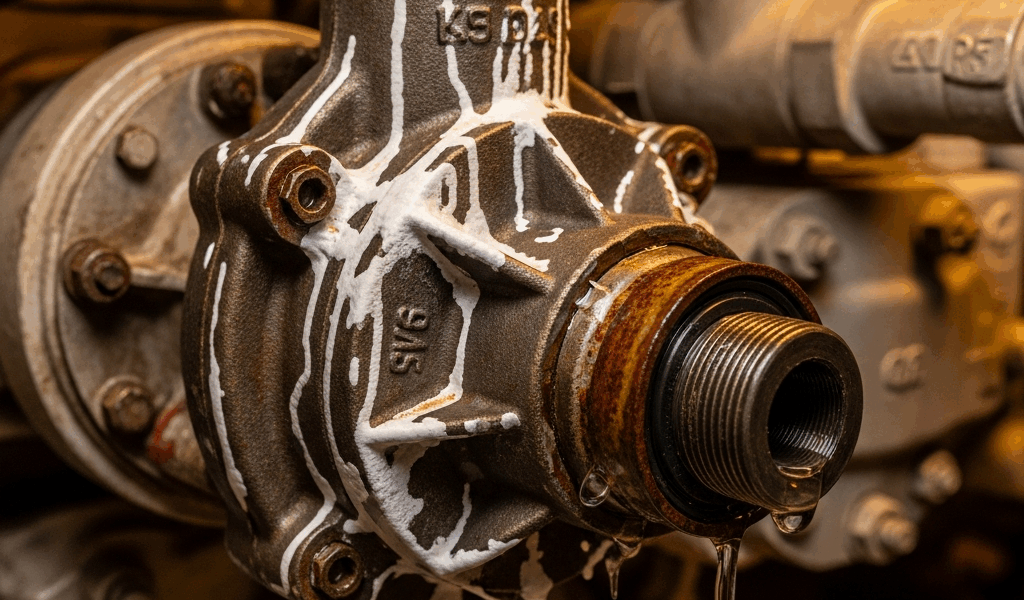
Weeping seals around the pump body signal internal wear. You’ll notice a small drip near the mounting bolts or along the pump shaft. I caught this on our 1997 Grand Banks when a few drops of coolant appeared on the bilge pan — cost me $600 to replace it before full failure. This isn’t catastrophic yet, but it means the impeller is probably worn unevenly.
Cavitation noise sounds like marbles rattling inside the pump housing. It’s a high-pitched grinding or chirping audible above engine noise. Cavitation happens when the impeller can’t maintain consistent pressure, creating vapor bubbles that collapse violently. This destroys the impeller in hours if you don’t address it.
Reduced cooling flow is harder to spot underway. Flow should feel strong when you crack the raw water strainer — a steady, firm discharge. Weak flow suggests either a clogged intake through-hull, blockage in the strainer, or pump wear. Test this by opening the strainer cap at idle; water should emerge with purpose.
Discolored coolant — milky, rusty, or greenish — means corrosion products are circulating. Fresh coolant should be bright pink or bright green, depending on type. Discoloration suggests the pump seal is failing and raw water is contaminating your closed cooling loop.
Vibration at idle that wasn’t there before indicates impeller imbalance. You’ll feel it through the engine itself, not just hear it. This compounds quickly; bad impellers generate vibration that loosens everything around them.
Diagnosing Raw Water Pump Problems at Sea
Start with what you can observe without stopping the engine. Check coolant level in the expansion tank (never open the cap on a hot engine). A dropping level over 24 hours suggests a leak, possibly at the pump.
Listen for cavitation. Run at idle, then slowly increase throttle while someone stands near the pump area. Cavitation gets louder as RPM climbs; a healthy pump is nearly silent above engine noise.
Feel the raw water discharge hose below the strainer. It should be hot and firm with pressure. If it’s lukewarm or soft, flow is compromised. Now test the strainer itself: close the seacock briefly, then open the strainer bowl. Water should discharge vigorously. If it dribbles, you’ve got intake clogging or a failing pump.
Monitor engine temperature every 30 minutes on passage. Create a simple log — time, RPM, water temp, ambient air temp. A pattern emerges quickly. If temps climb 5–10°F per hour despite steady throttle, the pump is losing efficiency.
Use this flowchart mindset: Rising temps plus strong strainer flow equals pump failure. Rising temps plus weak strainer flow plus seacock open means intake blockage or strainer clog (the easier fix). Rising temps plus weak flow plus closed seacock signals through-hull blockage (stop immediately and investigate).
When to reduce RPM: If temps hit 195°F and you’re 40 miles from safe harbor, throttle back to 1,200 RPM. This cuts cooling demand and buys you time. When to head to a facility: If you’re seeing cavitation noise plus rising temps, aim for the nearest marina. A total pump failure at sea is dangerous; you’ll overheat in 30–45 minutes of full-throttle operation.
Emergency Bypass and Temporary Solutions
Manual raw water circulation is your last-resort triage. If your pump is visibly failing and you’re more than 50 miles from help, you can manually pump raw water through the system using a portable bilge pump or manual pump connected to the strainer discharge. It’s slow. It’s exhausting. But it keeps your engine below critical temperature for another 12 hours.
Coolant concentration adjustments buy you a few degrees of headroom. If your coolant is a 50/50 mix, you can temporarily increase the water ratio to 60/40 — more water means better heat transfer, though less freeze protection. This is temporary only; pure water will start corroding your block within days.
Reduced-speed cruising is the pragmatic choice for most situations. Dropping from 7.5 knots to 5.5 knots cuts engine load nearly in half. Your fuel efficiency improves, and your pump — even a tired one — can manage reduced cooling demand. I’ve run at 1,200–1,400 RPM for entire passages when I suspected pump wear, arriving slower but intact.
Be honest with yourself about limits. These solutions are triage, not fixes. You’re managing a failing system until you reach a facility. A temporary bypass won’t save you in heavy seas or if ambient water temperature spikes. If you’re running these workarounds for more than 48 hours, abort the passage and head to the nearest yard with a haul-out capability.
Replacement and Preventive Maintenance Schedule
Popular Great Loop trawlers have standardized pump options. Nordhavn models typically use Westerbeke or Onan-supplied pumps; Kadey-Krogen uses similar setups, as do Grand Banks. Most fit a 1-inch diameter bronze or synthetic impeller. Replacement cost runs $350–$850 depending on brand and whether you’re doing labor yourself.
Impeller replacement intervals: every 500 cruising hours for passage makers, every 1,000 hours for part-time cruisers. I’ve been religious about this — replacing a $120 impeller beats replacing a $3,500 pump. Mark your engine hours in a waterproof log and set phone reminders.
Strainer cleaning frequency depends on water condition. Clear coastal water? Monthly. Great Loop or river systems? Every 50 operating hours during peak season. Zebra mussels or heavy algae blooms? Check it every week. A clogged strainer masquerades as pump failure.
Carry a spare impeller kit for any offshore passage longer than 300 miles. Include gaskets, bolts, and the specialized wrench your pump requires — Sherwood, Jabsco, and others all differ. A spare raw water pump body is impractical; a spare impeller costs $120 and takes 45 minutes to swap.
Inspect hose clamps, hoses, and the pump mounting bolts quarterly. Vibration loosens everything. Use stainless steel clamps only — galvanized rusts through in salt environments. Replace hoses every three years, regardless of condition; the inside degrades before the outside shows wear.
Keep your strainer bowl, gasket, and impeller spares in a labeled marine-grade plastic container near your engine room. Label it clearly. When a pump fails at 2 AM in fog, you’ll thank yourself.
“`

Stay in the loop
Get the latest passage maker mag updates delivered to your inbox.