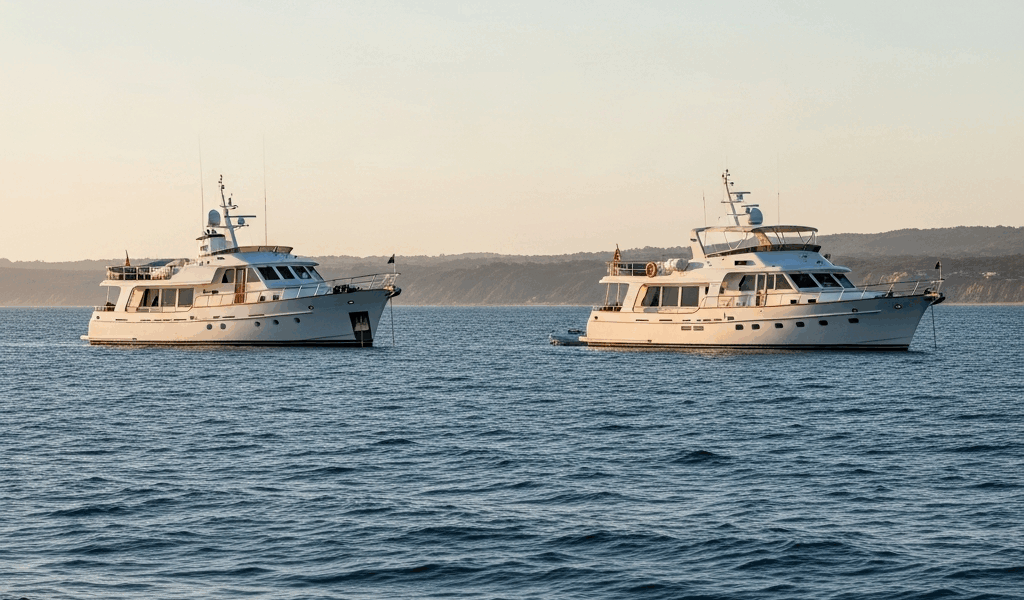
Two Bluewater Trawlers, One Big Decision
The Nordhavn 43 vs Kadey-Krogen 42 debate has become tricky with all the forum noise and brochure math flying around. As someone who has put actual passage miles on both hulls — not delivery miles, not day trips, but multi-day offshore runs where the weather doesn’t care about your schedule — I spent months getting comfortable with what separates these two boats. Today, I will share it all with you.
Used examples of both typically trade between $400,000 and $650,000 depending on year and refit history. They target almost identical buyers. And yet they represent genuinely different answers to the same offshore problem. Nordhavn built the 43 around go-anywhere capability — range, systems redundancy, the ability to handle conditions that would send most trawlers running for shelter. Kadey-Krogen built the 42 around something equally sincere but different: that a well-found trawler should also be genuinely comfortable to live aboard, with interior volume and finish that doesn’t punish the people making the passage.
Neither philosophy is wrong. They’re just aimed at different humans. That’s what makes this comparison so endearing to us passage-making types — there’s no bad answer here, only the wrong boat for your specific mission. So, without further ado, let’s dive in.
Range and Fuel Economy on a Long Passage
Quick note before the rest of this. For serious passage-makers, this is the number that drives everything else.
The Nordhavn 43 runs a single Lugger 6108A — or the later 6125 in refit boats — producing 135 hp at cruise. At 7.5 knots, real-world fuel burn from owner logs I’ve reviewed, including my own time aboard a 2004 hull out of Seattle, sits consistently around 3.8 to 4.2 gallons per hour. Standard fuel capacity is 1,200 gallons. Work that out with a 10% reserve and you’re looking at roughly 2,400 to 2,800 nautical miles at passage speed. Some owners running the boat at a steady 7 knots flat report touching 3.4 gph. That’s the kind of number that makes an Azores crossing or a Pacific hop feel achievable without fuel stops you’d rather not make.
The Kadey-Krogen 42 runs a single John Deere 6068AFM75 — 110 hp continuous — and burns approximately 3.2 to 3.6 gallons per hour at 7 knots. More efficient per hour, genuinely. But the Krogen 42 carries 750 gallons in its standard configuration, which pulls the working range back to roughly 1,600 to 1,800 nautical miles. Some owners have added bladder tanks or auxiliary tanks to push past 2,000 miles. That’s a modification project, though, not a factory solution — and it’s one that’ll run you $8,000 to $15,000 depending on how cleanly you want it done.
In flat water, the efficiency gap between the hulls is modest. In a confused beam sea — which is where passage-making actually happens — the Nordhavn’s full keel and heavier displacement work in its favor. The boat doesn’t hobby-horse, the prop stays loaded, the fuel burn stays predictable. The Krogen, being lighter and with a slightly finer entry, can see burn rates climb 15 to 20 percent in steep head seas as the hull works harder. Not dramatic. But over 1,000 miles it adds up to real fuel and real range anxiety.
- Nordhavn 43 — approximately 3.8–4.2 gph at 7.5 knots, 1,200-gallon standard capacity
- Kadey-Krogen 42 — approximately 3.2–3.6 gph at 7 knots, 750-gallon standard capacity
- Nordhavn working range — 2,400 to 2,800 nm
- Krogen working range — 1,600 to 1,800 nm (standard tanks)
For ocean passages, the Nordhavn wins this category outright. For the Great Loop or coastal bluewater runs where fuel stops appear every 500 miles, the gap closes enough that it stops being the deciding factor.
Seakeeping and Offshore Comfort
Humbled by a particularly brutal 36-hour run from Newport to Bermuda aboard a lightly built coastal cruiser years ago, I became obsessed with roll behavior in a way that no amount of land-based boat shopping ever produces. Both the Nordhavn 43 and the Krogen 42 are stabilized boats — but they approach the problem differently, and that difference matters at 3 a.m. on day four of a passage.
The Nordhavn 43 is typically set up with paravane stabilizers. “Flopper stoppers” in common parlance, using a pole-and-fish system that works without engine power and adds zero mechanical complexity. At anchor or in slow following seas, paravanes are superb — passive, cheap to maintain, and they don’t fail the way hydraulic systems fail. The tradeoff is deployment and retrieval, which takes 15 to 20 minutes and isn’t something you do quickly in deteriorating conditions. Some later Nordhavn 43s have been retrofitted with Wesmar or Naiad active fins, which adds roughly $35,000 to $50,000 to the project but transforms the underway motion in beam seas. Worth it if you’re doing it anyway. Do it before you leave, not during a Caribbean layover.
The Kadey-Krogen 42 was designed from the outset with active fin stabilizers in mind. Most examples on the market already have Naiad 211 fins fitted — that’s what you’re looking for when you’re browsing listings. Underway in a 6-foot beam sea, the Krogen with active fins is genuinely impressive. Roll is damped to the point where you can cook a real meal at the galley stove without bracing against the counter. That matters more than it sounds. Crew fatigue on a passage is real, and a boat that moves less means people eat better, sleep better, stand watch more effectively.
In head seas, the Nordhavn’s heavier displacement and full keel give it a more deliberate, confidence-inspiring motion — slower pitching cycles, less slamming. The Krogen feels livelier. Some sailors actually prefer that feedback, but it exhausts cruising couples faster on longer passages. Following seas favor the Krogen slightly; the lighter hull surfs more predictably and doesn’t demand as much attention at the helm.
Pilothouse layout matters here too. The Nordhavn 43’s pilothouse puts the helm seat high, with excellent sightlines and enough space to wedge yourself in comfortably for a long watch. There’s a proper settee behind the helm where an off-watch crew member can rest without going below. The Krogen’s pilothouse is handsome — genuinely handsome — but slightly smaller in practice. Adequate for a single watchkeeper. Tighter if two people are spending time up there together in rough conditions.
Liveaboard Layout and Below-Decks Livability
But what is the real difference below decks? In essence, it’s the design priority — comfort-first versus systems-first. But it’s much more than that.
This is where Kadey-Krogen wins. And it’s not particularly close.
The Krogen 42’s interior was clearly designed by people who thought hard about how humans actually live on boats for months at a time. The galley is large and positioned amidships — where motion is least — a detail that matters enormously on passage. Headroom in the main saloon doesn’t make six-foot crew members negotiate with doorframes. The two-stateroom layout gives a liveaboard couple genuine privacy and storage. I’m apparently 6’1″ and Krogen headroom works for me while the Nordhavn 43’s lower sections never quite do.
The Nordhavn 43’s interior is functional, well-built, and honest. It doesn’t try to pretend it’s a motor yacht. What it offers instead is an engine room that is, genuinely, one of the best in its class. You can stand upright next to the Lugger engine. You can reach the fuel filters, raw water strainer, alternator belt, and heat exchanger without dislocating a shoulder. For passagemakers who handle their own maintenance — and you should be, offshore — this is not a minor detail. I made the mistake early in my cruising life of buying a boat with a beautiful interior and an engine room you’d need a borescope to service. Don’t repeat what I did.
Storage on the Nordhavn is abundant and practical: large lazarette, accessible anchor locker, dedicated space for damage control gear and spare parts. The Krogen has less raw storage volume but organizes what it has more elegantly. For seasonal passage-makers not carrying 18 months of consumables, the Krogen’s approach works fine. For people provisioning for a Pacific crossing, the Nordhavn’s capacity is the clear advantage.
Which Boat Is Right for Your Passage-Making Goals
Here’s the honest answer — without hedging.
Buy the Nordhavn 43 if your actual goal involves ocean crossings. The North Atlantic. A Pacific circuit. Extended passages where fuel range and systems redundancy are genuinely life-safety considerations. The Nordhavn holds its value aggressively — used 43s have appreciated meaningfully over the last decade — and the Pacific Seahorse owner network is the most knowledgeable bluewater trawler community in existence. This boat is built to go very far, reliably, in conditions that would compromise lesser vessels. First, you should be comfortable handling your own engine work — at least if you’re taking this boat offshore the way it was designed to go. The Nordhavn rewards that mindset completely.
Buy the Kadey-Krogen 42 if your passage-making goals involve the Great Loop, the Bahamas, coastal bluewater runs to the Caribbean, or extended liveaboard life where interior comfort directly affects how long you and your partner stay sane aboard. The Krogen community is warm, active, and knowledgeable. The boat is better finished, more comfortable to live in daily, and with active stabilizers already fitted, more pleasant in beam sea conditions. The Krogen 42 might be the best option for liveaboard couples, as extended passage-making requires crew buy-in. That is because a miserable crew member in a rolly, cramped interior will end a bluewater adventure faster than any mechanical failure. It is a serious offshore boat — don’t let the lovely interior fool you — but it’s optimized for a different mission.
Neither boat is the wrong answer. They’re answers to different questions.
For a deeper look at each hull individually — including specific year-by-year model notes, refit considerations, and what to inspect before you make an offer — read our full owner reviews of the Nordhavn 43 and the Kadey-Krogen 42. Both are worth your time before you write a check with that many zeros on it.

Stay in the loop
Get the latest passage maker mag updates delivered to your inbox.