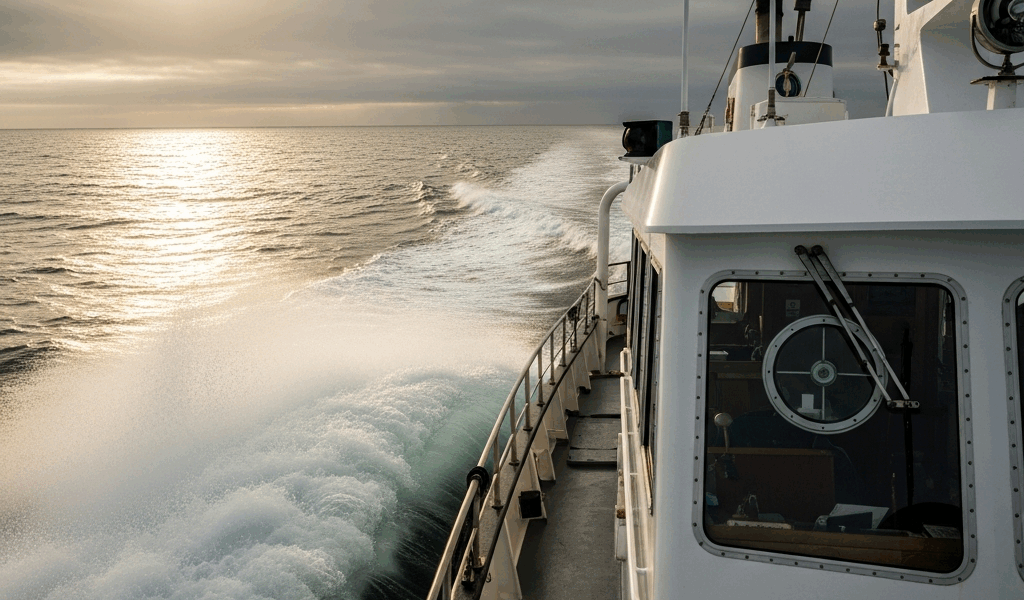
Who Buys the Kadey-Krogen 42 and Why
Trawler shopping has grown more complex with the marketing noise flying around. As someone who spent three years living aboard a KK42, I spent real time learning the ins and outs of who actually buys these boats — and more importantly, why. Today, I will share it all with you.
The buyer profile is specific. Almost suspiciously so. Late 50s, early 60s. Real cruising miles already logged. Enough money saved to do this properly. And absolutely zero patience left for the compromises a 35-footer demands after a week offshore. That’s the KK42 customer. I know because I am one.
I picked up my boat in 2021 — a 2008 hull with 2,100 original hours on the clock. That vintage is second-generation, the refined design Kadey-Krogen settled on after reworking the original 42 run that started around 2000. Full-displacement, single-screw, traditional long keel and skeg. It looks like something built to actually cross water. Because it was.
The typical mission? Great Loop passage at a civilized pace. Bahamas winters. Florida-to-Carolinas coastal runs. The occasional couple genuinely serious about pushing across the Gulf Stream. These aren’t daydream missions — these are people with charts already marked up and departure windows already picked out.
But what separates KK42 buyers from Nordhavn 40 buyers? In essence, it’s a values difference. But it’s much more than that. We tend to prioritize American-built construction and realistic parts sourcing over offshore prestige. We’ll give up a knot of top speed and a few hundred miles of theoretical range in exchange for a boat we can actually wrench on ourselves. That trade runs deeper than any comparison spreadsheet can capture. That’s what makes the KK42 endearing to us coastal cruisers.
Fuel Burn, Range, and Passage Performance
Real talk on this front. Manufacturer brochures are fiction dressed up as engineering documents. So, without further ado, let’s dive in.
My KK42 runs a Cummins 5.9L turbodiesel — 315 horsepower through a Twin Disc transmission. Kadey-Krogen’s advertised range sits at 2,200 nautical miles at “economical cruising speeds.” Technically accurate. Practically useless. That number assumes 5.5 knots, flat water, no current. Nobody actually cruises at 5.5 knots for ten hours unless they’re trying to prove something to someone who isn’t watching.
My real-world cruise speed is 7.2 knots. That’s where the boat settles in. At that pace, I’m burning exactly 4.1 gallons per hour. My fuel capacity is 800 gallons. Do the math and you get roughly 1,560 nautical miles of usable range. That’s not a complaint. It’s just honesty.
On a run from Key West to Tampa last February, I fought a two-knot current for seven hours straight and burned 4.8 GPH the whole way. The math worked. It wasn’t pretty. But it worked.
Here’s what genuinely surprised me — the efficiency curve at lower RPM. Drop to 1,600 RPM and the boat moves at 6.1 knots on 3.2 gallons per hour. Viable, if you have unlimited time and cooperative weather. At 1,800 RPM, she hits 7.2 knots on 4.1 GPH. That’s my sweet spot, and I stay there most days. Push to 2,000 RPM and you’re doing 8.3 knots — but drinking 5.2 GPH and listening to noise and vibration that honestly just isn’t worth an extra knot.
The full-displacement hull carries its sea-kindliness like a badge. I’ve run her through two nor’easters and one surprise squall off Cape Canaveral that came out of nowhere on what was supposed to be a clear afternoon. All three times, the bow climbed swell rather than punching through it. Predictable motion. You can walk galley to helm without a death grip on the handrail. That matters when you’re living aboard for months at a stretch — a beam sea that had me bracing hard on my old Mainship barely registers here.
Following seas are where the skeg earns its keep. The boat tracks straight. It doesn’t want to broach. That long keel costs two knots of top speed compared to a newer Nordhavn running a spade rudder, but it bought me actual sleep on overnight passages in conditions I’d have white-knuckled on a lighter hull.
One caveat worth noting: later KK42 models offered optional fin stabilizers. Mine didn’t come with them. I’ve never missed them — I cruise protected waters most of the year, and the conditions where active stabilizers genuinely justify their weight and power draw haven’t been my reality.
Liveaboard Layout and Practical Comfort
Quick callout up front. Because the interior is where this boat either fits your life or it absolutely doesn’t.
Technically sleeps six if you count the convertible saloon dinette. I don’t count it. Converting that thing requires an hour of fussing that nobody wants to do at 10pm when they’re tired after a passage day. Realistically: master stateroom with a proper queen berth, a guest cabin that’s small but genuinely functional, and a crew cabin that’s basically a bunk. For two people with occasional visiting family aboard for a few days, that’s sufficient.
The saloon works. Large L-shaped settee around a real dinette. Galley is galley-sized — not cramped, not cavernous — with a three-burner stove and convection oven. Actual counter space. My wife cooks real meals nearly every evening aboard, which she could not do on the 37-footer we had before. On smaller trawlers the galley is theater. Here it’s functional. There’s a difference.
The head situation requires plain talk: one full head amidships, separate shower, nicer than the tight wet-head arrangements on 35-foot boats but not as convenient as newer designs with two split heads. Two people aboard — zero friction. Four people — you negotiate schedules. That’s just the reality.
Tankage dictates liveaboard life more than any other single factor. My boat carries 800 gallons of fuel, 250 gallons of fresh water, and 150 gallons of holding. The water runs five days on normal usage between dock stops — less in July when everyone showers twice. Holding tank needs pump-out roughly every six to eight days depending on crew size. These aren’t complaints, they’re operational facts you plan around.
Storage is where the KK42 genuinely earns its liveaboard reputation. Actual lockers, not cubbies with bungee cords. Hanging locker space that fits real clothing. Lazarette below deck with room for multiple spare water jugs, two cases of oil, dock lines, project supplies, and a generator that I probably should have installed two years earlier. I’ve done ninety-day stretches aboard without feeling like I’m running out of places to put things.
The freezer runs sixteen cubic feet. I’m apparently a chest-freezer person — that format works for me while the upright configuration on my friend’s Nordhavn 40 never quite did. I stock it from a grocery run ashore and don’t think about protein sources again for three weeks. The refrigerator matches that same sensibility. Kadey-Krogen actually designed around real appliances instead of shoehorning yacht-sized units into whatever space remained.
Mechanical Access, Maintenance, and Known Issues
Frustrated by engine room inaccessibility on two previous boats, I spent an embarrassing amount of time during my KK42 survey just standing in the engine room not doing anything — just standing there, appreciating the space.
It’s a room. An actual room. You stand upright. The Cummins 5.9 sits on substantial beds with genuine clearance on all four sides. Raw water strainer, fuel filters, oil filter, transmission dipstick, coolant overflow — accessible without contortion, without mirrors on sticks, without cursing at whoever designed the thing. A raw water pump replacement cost me one afternoon with hand tools I already owned. Same job on my previous boat required a boatyard, a crane, and half my sanity.
The Twin Disc transmission is probably the single most reliable piece of equipment on this boat. That’s not marketing copy — that’s what every KK42 owner I’ve met over three years of cruising reports without prompting. Mine had 2,100 hours on original fluid when I bought it. Probably sitting at 3,200 hours now. Still shifts like new.
Raw water cooling demands consistent attention — skip your maintenance intervals or cruise through fouled marina water for a few weeks and mineral deposits accumulate in passages that cost thousands to properly clean. I run fresh water through the entire cooling circuit twice annually. Thirty minutes. Prevents a repair bill that would ruin a cruising season.
The stuffing box needs packing adjustment roughly every hundred hours under power. Quarter turn on the adjusting nut, increase pressure until seepage drops to five drops per minute, leave it alone. Sounds archaic. It works. I’ve never had one fail in 1,100 hours of my ownership.
One known issue specific to early 2000s KK42 hulls: electrical gremlins in the original distribution panels. Several owners report intermittent breaker trips with no obvious cause. Mine developed an intermittent short in the galley circuits that took me three weeks to properly isolate — genuinely maddening. A replacement Blue Sea Systems panel, installed in early 2022, resolved everything completely. Budget for this if you’re buying a pre-2010 hull. Avoid the path I took of assuming the existing panel is fine just because it hasn’t failed yet.
Thru-hull valves are standard bronze from the original installation, serviceable but nothing exotic. The prop shaft runs a three-blade Martec feathering prop that I’ve honestly never needed to deploy under sail — the fuel capacity makes that a theoretical feature rather than a practical one for how I cruise.
Kadey-Krogen 42 vs Nordhavn 40 and 43 — Which to Choose
This is the comparison you came here for. So let me be direct about it.
The Nordhavn 40 and 43 are superior offshore vessels. Full stop. The naval architecture is more refined. Range extends further. The resale market is deeper and prices hold better over time. If your genuine mission involves trans-oceanic passages or regular Gulf Stream crossings, the Nordhavn wins that argument — the offshore reputation is real and the used market prices reflect genuine confidence in the platform.
But the KK42 wins on three specific fronts: build quality optimized for actual coastal cruising, American support infrastructure, and purchase value. A comparable used KK42 runs $100,000 to $150,000 less than a similarly-aged Nordhavn 40. That capital stays in your cruising kitty rather than your asset column. Parts availability across the U.S. is superior — Kadey-Krogen built boats domestically with a real dealer network, and the Cummins 5.9 is serviced by shops in every coastal city without specialized technicians flown in from somewhere.
While you won’t need offshore range credentials for most coastal cruising, you will need a handful of things the KK42 delivers well: accessible mechanics, predictable sea behavior, and enough range to get somewhere interesting without a fuel barge on speed dial. The Nordhavn might be the best option if transoceanic passage-making is genuinely your plan, as that mission requires offshore-rated systems and hull design. That is because blue-water crossings punish compromises that coastal conditions simply never expose.
Here’s the honest framework. Choose the Nordhavn if offshore range is a real requirement and the premium pricing fits your budget. Choose the Kadey-Krogen if you cruise protected waters the majority of the time, take satisfaction in maintaining your own boat, and want genuine passage-making capability without the trophy price attached to it.
I chose correctly for my actual life. Your correct choice depends entirely on the waters you’ll realistically cruise and how you feel about turning your own wrenches. Both boats will get you where you’re going. The question is which one lets you afford the journey in the first place.

Stay in the loop
Get the latest passage maker mag updates delivered to your inbox.