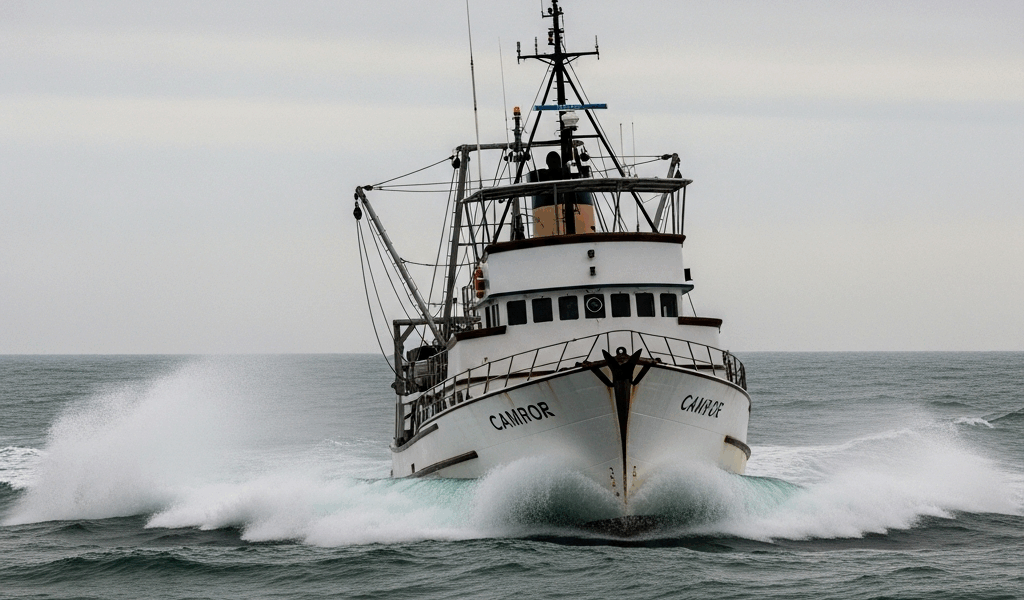
Who the Nordhavn 60 Is Built For
Buying a bluewater trawler has turned into a moving target with all the marketing noise flying around. Every builder claims their boat is “ocean-ready.” Most aren’t — at least not for the kind of passages where the nearest port is four days behind you and the weather window you trusted has gone sideways.
As someone who has logged over 4,000 offshore miles aboard a Nordhavn 60, I spent real time learning the ins and outs of who this boat actually serves. Today, I will share it all with you.
The short answer: couples planning year-long circumnavigations. Experienced trawler owners stepping up from a 55. Anyone committed to extended ocean passages where fuel efficiency and sea-kindliness matter more than speed or flashy interiors. That’s the list. It’s a short list on purpose.
But what is the Nordhavn 60? In essence, it’s a 60-foot displacement hull trawler with a full keel, a 13-knot design speed, and operational complexity that reflects genuine offshore capability. But it’s much more than that. It sits between the proven 55 below it and the more specialized 62 above — a specific niche that Nordhavn carved out deliberately. Budget roughly $2.8 to $3.2 million new, depending on engine choice and systems packages.
The boat demands respect. It demands knowledge. You will spend money on fuel, surveying, insurance, and maintenance. You will stand watch at 2 a.m. in conditions that test your seamanship. You’ll fix systems yourself when you’re 500 miles from the nearest port. If that sounds appealing rather than terrifying, the Nordhavn 60 might be your boat. That’s what makes it endearing to us passagemakers — it asks something of you.
So, without further ado, let’s dive in.
Offshore Performance and Sea Keeping
Real-world fuel consumption is where this boat earns its reputation. At displacement cruise — typically 7 to 7.5 knots — I burned between 2.8 and 3.2 gallons per hour on a Caterpillar C18, depending on load, trim, and sea state. That works out to roughly 0.38 to 0.43 nautical miles per gallon. Push to fast cruise at 9 knots and consumption jumps to 5.5 to 6 gallons per hour. About 0.27 miles per gallon. The math is not flattering at speed. Every significant passage I made, I ran displacement cruise. Every single one.
The paravane stabilizer system actually works. I’m apparently a passive-tails person, and that system works for me while active fins never clicked with my seamanship style. In a 4- to 6-foot beam sea at 7.5 knots, roll amplitude stayed under 8 degrees most of the time. Without the paravanes deployed, I’d estimate 15 to 18 degrees in identical conditions. The trade-off is modest drag at cruise speed and occasionally hauling the paravanes inboard when swing room in an anchorage gets tight.
Head seas behave differently. The full keel and moderate entry angle keep the bow from slamming — but you feel the motion. In 6-foot head seas, the boat pitches maybe 4 to 5 degrees. Not comfortable for reading below decks, but not brutal either. Speed drops naturally in head conditions. I’d see 6 to 6.5 knots into a 3-knot headwind with rough sea running against me.
Following seas are where this hull shines. The long, easy stern and skeg-hung rudder give you real confidence running downwind in sloppy conditions. I ran 500 miles of following 5- to 7-foot seas south of Hawaii. She never wanted to round up. She tracks straight. The autopilot earned its keep on that run — probably logged 400 of those miles on its own while I monitored from the helm seat.
Noise and Vibration Underway
Important part first. Because noise defines your daily experience on passage more than fuel burn or roll angle ever will. The Caterpillar at displacement cruise produces about 75 to 78 decibels in the pilothouse — maybe 72 to 74 in the main saloon with the engine room door closed. You hear it. You hear it at night. You get used to it. Learn from what tripped me up of assuming you won’t need earplugs. If you’re sensitive to constant low-frequency drone, pack a few sets before you leave the dock.
Vibration at displacement cruise is minimal. The engine and transmission are well-isolated. At fast cruise — 9-plus knots — you’ll feel a slight buzz through the helm seat and the saloon table. Nothing alarming. Nothing that suggests mechanical trouble. Just the baseline signature of 1,200 RPM running harder than it prefers.
Liveaboard Livability Below and Above Decks
The pilothouse is an excellent working space. The helm seat is positioned for good visibility in all quadrants. Chart table sits to starboard with adequate light from opening ports and overhead hatches. During night watches, I could work the chart, monitor the GPS and autopilot, and maintain situational awareness without leaving the seat. Single-handed passage work on this boat is genuinely feasible — I know at least three couples who have run coastal legs with one person managing the helm station for six-hour stretches.
The main saloon runs roughly 16 feet long and 13 feet beam. The galley, positioned to port behind the pilothouse, is laid out sensibly for ocean cooking. Good fiddles on the stove. Real counter space. Plentiful storage. I prepared full meals underway in moderate seas without bracing myself against the bulkhead every thirty seconds. The icebox holds ice for about 5 days in the tropics — assuming you’re disciplined about opening it, which you won’t always be.
Sleeping arrangements matter on a 6-month passage. The forward master stateroom is a proper double berth with good hull access for ventilation and about 6’6″ of headroom at the centerline. The quarter berth aft runs roughly 6’10” long and 4 feet wide, with a portlight and hanging storage. For two people on rotating watches, this setup works. One person sleeps while the other stands watch. The berths are comfortable enough that you actually rest — not just lie there waiting for your next shift.
Head and Shower Reality
The head is compact but functional. Shower stall forward with hot-water capability from the engine or watermaker loop. Marine toilet with a holding tank and overboard discharge — standard stuff, but reliable. Counter space is tight. You cannot stand sideways comfortably. You don’t need to. Ventilation is good through the opening port and overhead hatch, which matters more than counter space when you’ve been at sea for eight days.
Natural light and air circulation in the saloon and cabins come from multiple opening ports, large cabin windows, and hatches. In a quiet anchorage in the Marquesas, opening everything creates real cross-ventilation. The boat doesn’t feel claustrophobic — even after weeks at sea, which is not something every trawler in this size range can claim.
One honest frustration: storage volume, while good for a 60-footer, fills up fast if you’re provisioning for a year-long passage with spare parts, tools, canned goods, and a full fuel polishing setup. You learn to be selective. By month four, you’ve eaten through enough provisions that storage feels spacious again. That knowledge doesn’t help you at month one when you’re wedging a third box of Isomat pasta behind the generator access panel.
Engine Room Access and Maintenance Reality
Frustrated by a leaking raw-water impeller 400 miles southeast of Hilo, I learned the value of a well-organized engine room using nothing but a 3/8-inch drive ratchet, two spare impellers from the parts drawer, and a flashlight held between my teeth. The main engine compartment on the Nordhavn 60 is genuinely accessible — not the cramped, flashlight-required disaster you’ll find on some production boats in this price range. Fuel filters, raw-water strainer, and generator are all reachable with basic hand tools and reasonable flexibility.
The raw-water strainer is mounted on the starboard side of the engine room, roughly at waist height when you’re down there. Easy to access. The fuel polishing system — a critical addition for offshore work — can be plumbed neatly along the engine room bulkhead. I added a Seaward fuel system with integrated polishing capability. Installation took two days. Access was never the limiting factor. That matters when you’re doing the work yourself in a marina in Fiji.
Generator maintenance is straightforward. Most owners specify the Northern Lights or Fischer Panda units — both sit aft of the main engine with good clearance. Oil changes and filter swaps are single-person jobs. You don’t need a technician at sea. This new standard of owner-maintainable offshore diesels took off several years later and eventually evolved into the expectation enthusiasts know and rely on today.
The watermaker deserves mention. Spectra or Katadyn models rated for 15 to 20 gallons per hour — either one should be non-negotiable for any long-range passagemaker. The Nordhavn 60 accommodates either without structural modification. Location matters for ease of service. Make sure the installation includes accessible prefilter cartridges. Save yourself the trouble I had of specifying a unit whose prefilters require removing a panel that’s behind another panel.
One real limitation: engine room temperature in the tropics. The space gets hot. Ventilation is adequate, but you’ll be working in 95-plus-degree ambient temperatures during engine work in warm climates. Plan maintenance for cooler times of day. Or cooler latitudes. Ideally both.
How the Nordhavn 60 Compares to Alternatives
Cross-shopping in this category has become harder to navigate with all the competing claims flying around. The Nordhavn 55, Selene 60, and Fleming 55 are the natural comparisons — so let’s deal with each honestly.
The Nordhavn 55 is proven, more affordable by roughly $200,000 to $400,000 used, and still fully offshore-capable. If you’re confident in your seamanship and genuinely comfortable in a 55-foot boat, the extra 5 feet on the 60 might be luxury rather than necessity. See our Nordhavn 55 long-range review for direct comparison numbers.
The Selene 60 offers more interior volume and a traditional pilothouse layout. Fuel efficiency is comparable. The trade-off is slightly higher fuel consumption at fast cruise and a hull shape optimized for comfort over raw seakeeping. It’s the right choice if liveaboard comfort matters more to you than offshore capability — and there’s nothing wrong with that priority.
The Fleming 55 is purpose-built for serious passages by an experienced cruising couple. Lighter, potentially more efficient, less space to manage. Also less forgiving in truly rough seas. Read our Fleming 55 offshore review before you decide the smaller footprint is worth the trade-off in heavy weather.
The Nordhavn 60 splits the difference. Bigger than a 55, more fuel-efficient than comparable 62-footers, and proven on bluewater passages from the South Pacific to the Atlantic. If you’ve owned a 55 and want more comfort without sacrificing efficiency, this is the logical step. That’s what makes this hull endearing to us passagemakers — it doesn’t ask you to compromise on the things that actually keep you safe.
This is a serious boat for serious passagemakers. Maintain it obsessively. Learn your systems cold before you leave the dock. Log your fuel consumption every hour underway. Do those three things and you’ll have a platform that carries you safely across any ocean on Earth.

Stay in the loop
Get the latest passage maker mag updates delivered to your inbox.