Nordhavn 55 vs Selene 53 for Bluewater Passagemaking
Who These Boats Are Built For
The Nordhavn 55 vs Selene 53 comparison has gotten complicated with all the forum noise and spec-sheet worship flying around. I’ve watched serious passagemakers wrestle with this exact decision for years — and it almost never gets answered straight. You either get brand loyalty arguments or a table of numbers that tells you nothing useful about spending somewhere between $800,000 and $1.4 million. Today, I will share it all with you.
You’ve already owned a trawler. Maybe a Krogen 42, a Grand Banks 42, or a smaller Nordhavn. You’ve done real offshore legs — Cape Hatteras to Bermuda, the Bahamas ICW run, maybe Puget Sound to Southeast Alaska. You know what a following sea feels like at 2 a.m. when you’re solo on watch. And you know that “range under ideal conditions” is a marketing number, not a planning number. Don’t make my mistake of treating those two things as interchangeable.
The buyers circling these two boats are typically in their 50s or 60s — retired or winding down — and planning genuinely consequential passages. A Pacific crossing via Hawaii or the Coconut Milk Run. The Atlantic circuit through the Azores. An extended Great Loop run with real offshore exposure in the Gulf Stream and around the Carolina Capes. These aren’t coastal cruisers with an anchor light and a borrowed chart plotter. Both the N55 and the Selene 53 are built to cross oceans. The question is which one crosses them better for your specific situation — and the answer actually differs depending on how you intend to use the boat.
Hull Design and Seakeeping in Open Water
Probably should have opened with this section, honestly. Everything else — range, layout, resale value — is secondary if the boat makes you miserable in a beam sea for eight consecutive days.
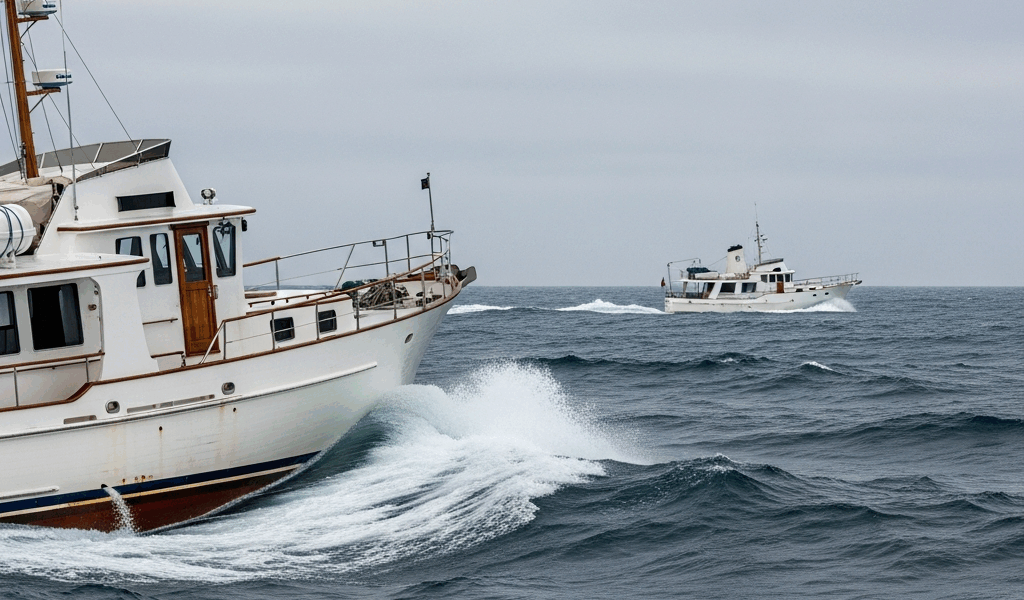
The Nordhavn 55 runs a full displacement hull. Traditional round-bilge design, deep forefoot, canoe stern — geometry Nordhavn has been refining since the N46. It sits lower in the water relative to its beam and displaces around 75,000 lbs loaded. That hull wants to move at 7.5 to 8 knots. Push it to 9 and you’re fighting physics. But what is the real advantage here? In essence, it’s what that hull does in a confused sea — damping roll and pitch in a way that feels almost passive, like the boat is absorbing the ocean rather than arguing with it. But it’s much more than that. Nordhavn equipped the N55 with paravane stabilizer hardware as standard, and the geometry works because the hull was designed around that system from scratch. Active fin stabilizers are available. Many experienced N55 owners stick with paravanes offshore and save the fins for anchorages.
The Selene 53 runs a semi-displacement hull. It can exceed theoretical hull speed — reaching 10 to 11 knots at full throttle — but its optimal passagemaking speed sits around 8 to 9 knots. The hull is Taiwanese-built by Ta Shing, and construction quality is legitimately excellent. Where things diverge is behavior in a quartering sea. Semi-displacement hulls get squirrelly when waves are pushing from astern and slightly to the quarter — they surf a little, the autopilot works harder, and at 2 a.m. that extra helmsman demand is real. Selene installs active fin stabilizers as standard and has gyro compatibility for the Seakeeper units. The fins work well underway but give less benefit than paravanes when you slow down or heave-to.
In a sustained beam sea — which is exactly what you’ll encounter on a Pacific high-pressure deviation or a North Atlantic gale routing maneuver — the N55’s full displacement hull is measurably more comfortable. That’s what makes full displacement endearing to us bluewater passagemakers. It’s not a marketing claim. It’s the consistent finding of owners who have run both hull types across long passages. So, without further ado, let’s dive in on the numbers.
Fuel Capacity, Burn Rate, and Real-World Range
Published numbers first. Then why they don’t quite tell the story.
- Nordhavn 55: 2,100 U.S. gallon fuel capacity, published range of approximately 2,800 nautical miles at 7.5 knots — single John Deere 6068 or Lugger L6108A pushing around 5.5 to 6.5 GPH at cruise RPM.
- Selene 53: 1,800 U.S. gallons, published range around 2,400 nautical miles at 8.5 knots — Cummins QSB 6.7 or Volvo D9 at cruise burning approximately 5 to 7 GPH depending on loading and sea state.
Now stress-test both numbers. A 15% fuel reserve — which any bluewater skipper treats as a hard floor, not a suggestion — drops the N55’s usable fuel to about 1,785 gallons. At 6.5 GPH cruise, that’s roughly 274 hours of run time. Call it 2,050 nautical miles at 7.5 knots. The Selene 53 with the same 15% reserve gives you roughly 1,530 usable gallons, about 218 to 250 hours at cruise burn — somewhere between 1,750 and 1,900 nautical miles.
That gap matters concretely. San Diego to the Marquesas is approximately 2,900 nautical miles. Neither boat makes it nonstop without additional fuel bladders or a stop at Hilo, Hawaii. But the N55’s extra capacity gives you a meaningfully wider routing window and a less stressful fuel state arriving at landfall. That’s not a trivial difference when you’re three weeks offshore.
As someone who once ran the Yucatan Channel into a 20-knot north on a smaller trawler, I learned everything there is to know about arriving with less margin than any experienced captain should tolerate. Owner-reported data from the Nordhavn Owners Association and Selene owner forums confirms both boats burn 15 to 25% more than published figures in head seas — bashing into 15-knot trade winds. I’ve seen N55 owners report 8 GPH on an upwind delivery from Florida to Bermuda. Plan for real conditions. Not brochure conditions.
Liveaboard Layout and Offshore Ergonomics
Marina liveaboard comfort and offshore ergonomics are almost opposites. A wide-open salon with beautiful teak soles looks spectacular tied to a dock and becomes a hazard in a seaway.
The Nordhavn 55 pilothouse is purpose-designed for watch-keeping. Helm seat mounted high with good sightlines, chart table to port within arm’s reach, overhead grab rail system throughout the interior that’s functional rather than decorative. Sea berths on the N55 — experienced owners skip the forward guest stateroom for passages and use the settee berth or rig a lee cloth aft. The master stateroom sits aft and low, which is generally correct for a passagemaker, though some find the athwartships berth orientation awkward in a beam roll. I’m apparently an athwartships sleeper and the N55’s layout works for me while forward cabins never do on a long passage.
The Selene 53’s interior is notably more spacious and elegant — Ta Shing builds a genuinely beautiful boat, full stop. But that spaciousness works against you offshore. The galley is well-equipped — Force 10 range as standard — but requires aftermarket fiddle rails and net rigging underway that many owners add post-purchase. Pilothouse visibility on the Selene 53 is excellent. The helm ergonomics are slightly less optimized for solo watch-keeping than the Nordhavn, partly because the design accommodates a wider range of users, including coastal and charter configurations.
Owner forum consensus — specifically Selene Owners Forum and Trawler Forum threads going back to 2015 — flags two recurring complaints on the Selene 53: limited handholds on the exterior side decks in a seaway, and a companionway step arrangement that requires real attention in rough weather. The N55’s exterior layout has been refined through decades of offshore owner feedback. It shows in the detail work. Small details that you notice only when conditions deteriorate at 0300.
Which One Should You Buy
First, you should define your primary mission — at least if you want to spend $800,000 to $1.4 million without regret eighteen months later.
The Nordhavn 55 might be the best option if genuine bluewater passagemaking is your goal, as ocean crossing requires range margin and heavy-weather stability above everything else. That is because the N55’s full displacement hull, superior fuel capacity, and paravane-optimized design give it a real edge across long ocean passages. Parts and builder support from Pacific Asian Enterprises in Dana Point, California are strong. The owner community — Nordhavn Owners Association — is organized and technically deep. Resale values hold well. Budget $950,000 to $1.4 million for a well-equipped used example.
The Selene 53 is the better call if you want a more versatile boat — one that performs well on coastal passages and extended Great Loop runs with offshore legs, offers a more comfortable and spacious interior for extended liveaboard use in port, and still has genuine bluewater capability. Well-maintained used examples trade between $650,000 and $950,000. The semi-displacement hull makes it a more capable and fuel-efficient cruiser in the 8 to 10-knot range when seas are manageable. Running the Caribbean circuit or the Pacific Northwest rather than mid-ocean crossings? That flexibility matters more than the hull-speed ceiling you’ll rarely approach anyway.
Parts availability for both boats is reasonable in the U.S. and major Pacific and European cruising hubs. The Selene 53’s Cummins or Volvo engines are arguably more universally serviceable in remote ports than some Lugger configurations — and that is a real consideration sitting at anchor in the Marquesas or the Azores at 11 p.m. with a fuel injector problem.
The honest summary: the Nordhavn 55 is the better ocean-crossing boat. The Selene 53 is the better all-around cruising boat with offshore capability. Crossing oceans on a schedule and arriving in condition to handle landfall? Buy the Nordhavn. Living aboard and exploring extensively with occasional offshore passages? The Selene earns its price delta every month you’re in port.


Stay in the loop
Get the latest passage maker mag updates delivered to your inbox.