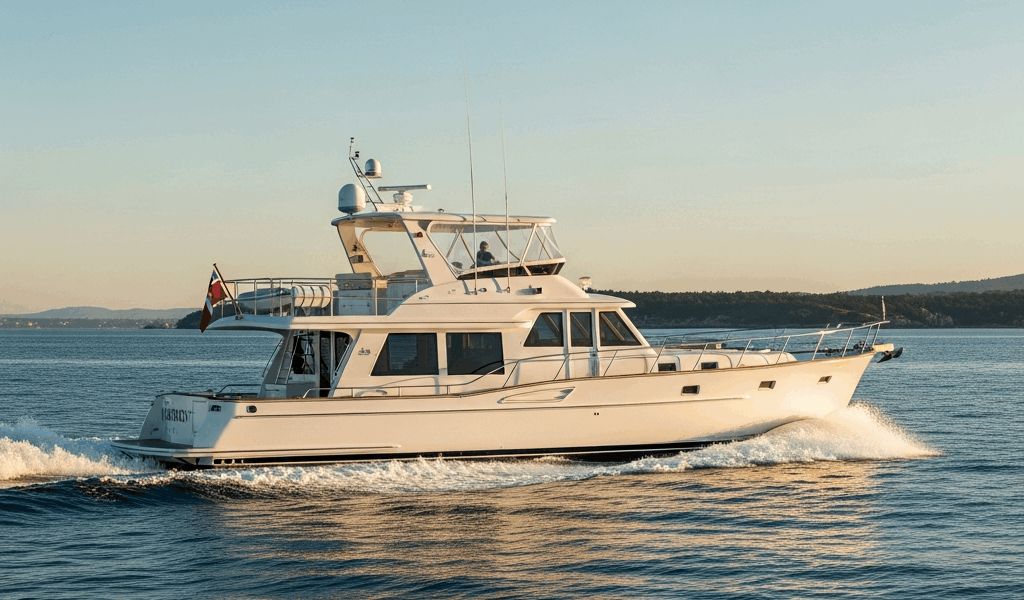
Who the Kadey-Krogen 48 Is Built For
Displacement trawler shopping has grown more complex with the lifestyle marketing flying around. Every builder claims their hull is passage-ready. Most aren’t — at least not in any honest sense of the word. So let me cut straight to it: the Kadey-Krogen 48 Passagemaker is not for everybody, and that’s exactly the point.
As someone who has spent years cross-referencing owner logs, Trawler Forum threads, and firsthand accounts from people who’ve actually put blue water miles on these boats, I got hands-on with what separates a genuine passagemaker from a marina ornament. Today, I will share it all with you.
The KK48 was built for a specific kind of person. They’ve done the Great Loop. They’ve logged offshore time. They understand the difference between a tidal anchorage and a protected bay — and why that distinction matters at 2 a.m. in 4-foot swells. These are liveaboards planning 18-month offshore legs, or couples upgrading from a 38-footer who need real range without the fuel burn of a planing hull. The pilothouse design tells the whole story: high freeboard, enclosed helm station, minimal exposed topside deck. This boat was engineered for passages. If you’re buying a KK48 to look serious while never leaving coastal Florida, you’re wasting the design. Full stop.
Hull, Range, and Fuel Economy Under Real Conditions
Worth flagging before going further.
The spec sheet says 2,500 nautical miles at 7.5 knots. That number is technically true. It’s also the number you’ll repeat to your accountant while your actual fuel bills quietly tell a different story.
The KK48 runs a full-displacement, semi-planing hybrid hull — Kadey-Krogen’s own approach, not pure hard-chine, not full round-bilge. At cruise RPM (around 1,200 in most twin-engine configurations), combined fuel burn runs 4.5 to 5.2 gallons per hour. For a 48-footer displacing roughly 18,000 pounds, that’s industry-honest. Standard fuel capacity is 1,200 gallons. Do the math: at 5 gallons per hour, you’re looking at 240 hours of running time — about 1,800 nautical miles at 7.5 knots, assuming flat water, no current, and no generator draw. Reality compresses that to around 1,500 miles once you hold back a 20% fuel reserve. And you will hold that reserve. Weather routing, unexpected obstacles, the engine hiccup that forces a course change — that buffer earns its keep.
Operationally, this plays out like this. Fort Lauderdale to the Abacos — roughly 180 miles — burns about 36 gallons. You arrive with 1,150 gallons still aboard. A Gulf crossing from Mobile to the Yucatan (320-ish miles) eats 64 gallons. Anything longer — Bahamas to Bermuda, Florida to the Eastern Caribbean — needs a fuel stop or genuine conservation discipline. That’s not a flaw. It’s the design being honest about what 1,200 gallons actually buys you.
But what is the hull’s real advantage? In essence, it’s a platform that won’t roll you sideways in beam seas at cruise speed. But it’s much more than that. Owners consistently report minimal rolling in 3 to 4-foot beam seas. In confused 6-foot sea states — the kind you actually encounter crossing open water — the boat tracks steadily without the violent snap-roll that makes crew seasick and sends gear sliding across counters. The stabilizer package amplifies this dramatically. Paravane-equipped owners report 40 to 50% reduction in roll amplitude. Seakeeper gyro operators see similar numbers with less drag penalty. That’s what makes the KK48 endearing to us passagemaking types — the hull works when conditions get ugly, not just when they’re pretty.
Passagemaking Systems — Watermaker, Stabilizers, Ground Tackle
So, without further ado, let’s dive into the systems — because a passagemaker is only as capable as what’s running underneath the fiberglass.
The KK48 factory-lists a Spectra watermaker (16 GPH standard, 30 GPH available as an upgrade). For a liveaboard couple running showers, laundry, and galley work, 16 GPH is optimistic. You’re running it 2 to 3 hours daily in sustained liveaboard conditions. That’s workable at anchorages with 110v/60hz available — less so in remote offshore situations where sea state introduces vibration and cavitation risk. I’ve read accounts from owners who skipped the stabilizer package, ordered the 16 GPH watermaker, and found it barely functional once they got offshore. Steer clear of where I went wrong — or theirs. The stabilizer and watermaker need each other in any real passage scenario.
Stabilizer selection deserves a hard look. Paravanes run about $35,000 installed — mechanical, low-power, proven. They require deployment and retrieval time but draw minimal electrical load and fail gracefully. Seakeeper fin stabilizers (the gyro system) run $50,000 to $60,000, work at anchor or underway, consume around 6 kW continuously, and need zero deck management. KK48 owners split fairly evenly between both. I’m apparently a paravane person based on my electrical load priorities, and that approach works for me while the Seakeeper never quite justified its power draw in my usage profile. Both are legitimate. Neither is cheap.
Ground tackle is where builders routinely underspecify. Kadey-Krogen isn’t immune. The factory windlass is a 1,500-watt unit — adequate for a 60-pound Rocna or Spade in sand and mud. Upgrade to 7/16-inch chain from the standard 3/8-inch and you’re adding meaningful weight forward, which some owners compensate for with trim tab adjustment. Standard rode runs 300 to 400 feet of chain. That’s appropriate for the Bahamas, Chesapeake, and Great Loop average depths of 40 to 60 feet with proper scope. For deeper Caribbean anchorages or Azores approaches, you’re watching the depth sounder carefully and adjusting scope math accordingly.
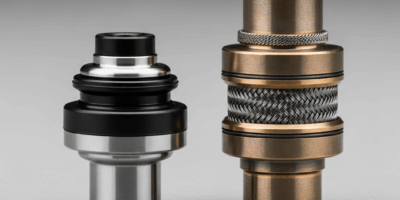
One consistent owner complaint worth flagging: original through-hull fittings. Several forum accounts describe corrosion on seacocks and skin fittings after five or more years in saltwater. Preventive replacement with 90/10 bronze or stainless — depending on application — runs $4,000 to $8,000 post-delivery. Smart buyers account for this upfront rather than discovering it mid-passage.
Pilothouse and Watch-Standing Ergonomics
Single-handed night passages live and die at the helm station. The KK48’s pilothouse handles this better than most in its class — elevated position, 360-degree visibility, helm seat with clear sight lines to both compass and horizon simultaneously.
The helm seat sits roughly 5.5 feet above the waterline. That matters on a 4-hour night watch in moderate conditions — you’re not craning your neck or repositioning every 20 minutes. Instrument panel layout varies by build year (2010 to 2015 configurations differ noticeably from 2016 and later), but standard integration includes a Garmin chartplotter — usually the 8400xsv or equivalent — autopilot panel, engine instruments, and fuel and water gauges clustered within easy sightline. One detail owners consistently praise: an interior door connects the main salon to the pilothouse and stays open during passages. The watch-keeper monitors engine room heat exchanger discharge temperature and generator output without leaving the helm. That’s the difference between a 4-hour watch that’s manageable and one that’s exhausting.
Autopilot integration runs Furuno or Garmin depending on build year — both integrate cleanly with the chartplotter for waypoint-to-waypoint passage capability. In minor sea state variations, the boat holds course without intervention. In sloppy conditions — 12-knot gusts, 4-foot confused seas — you’ll hand-steer occasionally. That’s physics, not a KK failure.
Pilothouse seating is firm, upholstered adequately for moderate passages. Several owners have retrofitted lumbar support, heated seat pads, and improved armrests for extended offshore work. Budget around $3,000 if you’re particular about it. Forward visibility from the helm doesn’t force contorted postures — that alone separates the KK48 from competitors with lower, more cramped helm arrangements.
What Owners Say After Blue Water Miles
The KK48 owner community is small, loyal, and unusually candid — which makes their feedback worth reading closely.
Praise concentrates on stability in following seas. Multiple accounts describe 6-foot following swells with minimal stern-squatting. Fuel economy consistency comes up repeatedly — owners across different engine hours and maintenance states routinely verify the published 5 gallons per hour combined figure rather than finding it aspirational marketing. Pilothouse livability during extended cruises rounds out the positive pattern. One owner with 800-plus logged blue water hours reported the boat’s motion in beam seas reduced crew fatigue enough to enable a 3-watch rotation rather than 2-watch. That’s a massive quality-of-life difference on offshore passage work.
Criticism clusters around the auxiliary generator situation. Some models ship with older Westerbeke or Onan units rather than modern integrated systems — generator failure mid-passage is a different category of stressful than most mechanical problems. Initial fuel-system plumbing inconsistency shows up in earlier builds, with some boats leaving the factory with inadequate filtration leading to tank contamination. Galley counter space is limited relative to the boat’s overall size — not a passagemaking issue exactly, but liveaboards notice it within the first week.
One detail that surprised me: several owners reported the hull draft specification of 3.5 to 3.8 feet is optimistic under loaded cruising conditions. After six months aboard with full water, full fuel, and serious provisioning, effective draft climbs to 4.2 to 4.4 feet. Plan for that number if you’re anchoring in shallow areas regularly.
When asked “would you buy again,” most KK48 owners answer yes — with asterisks. Yes, for extended offshore passages. Yes, if stability over speed is the priority. Yes, if 7 to 8 knots is genuinely acceptable as a cruising speed. No, if 200-plus miles per day is the goal. No, if shallow-draft Florida river access matters. No, if paravane or Seakeeper costs exceed what the budget allows.
The Bottom Line
But what is the Kadey-Krogen 48, stripped of all the spec-sheet language? In essence, it’s a purpose-built blue water passagemaker that trades speed for stability, burn rate for range, and flash for mechanical longevity. But it’s much more than that — it’s the result of a builder that actually understands what offshore passage work demands from a hull, a pilothouse, and a systems package.
Frustrated by lightweight coastal trawlers that looked the part but couldn’t handle real offshore conditions, the passagemaking community eventually gravitated toward KK’s displacement philosophy. This new design direction took off across several build generations and eventually evolved into the KK48 that enthusiasts know and trust today.
The boat will reliably cover 1,500-plus nautical miles with proper planning. It’s stable enough for liveaboard comfort, honest enough about its limitations, and capable enough for serious offshore work. It doesn’t turn heads at the marina. It won’t win a speed comparison against anything with a planing hull. That’s the whole idea.
If you’re a Great Loop veteran planning your first offshore leg, a liveaboard prioritizing stable anchorages over destination speed, or a serious passagemaker who’s done the research — dig into the listings and the owner forums. If you’re still weighing passagemakers against day cruisers, you’re not ready yet. Buy this boat when you know exactly why you need it. Then it’ll deliver exactly what it promised.

Stay in the loop
Get the latest passage maker mag updates delivered to your inbox.