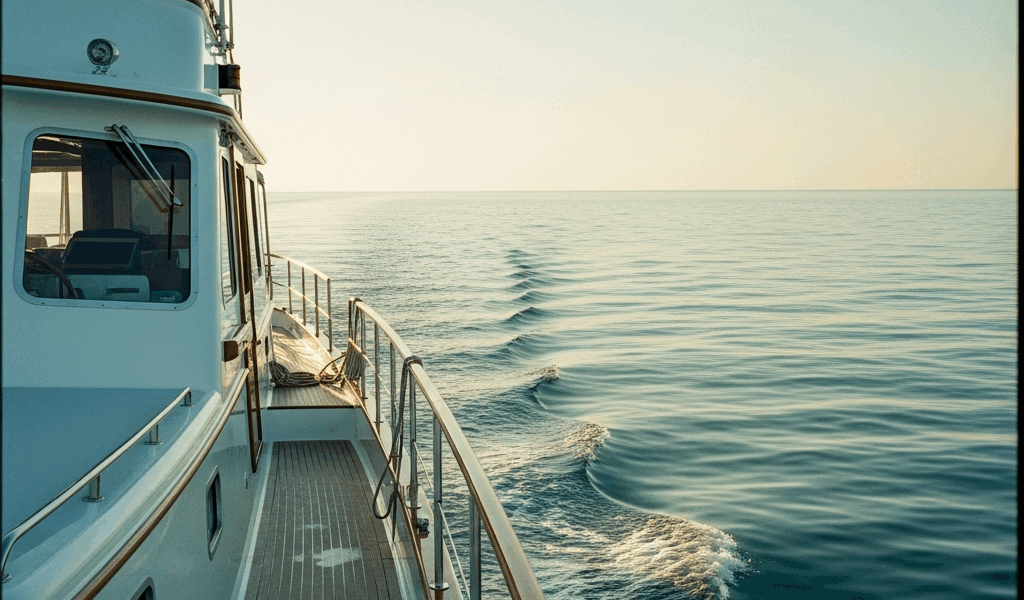
Who the Nordhavn 43 Is Really Built For
Buying a passagemaker has gotten messy with all the marketing noise flying around. As someone who spent three years researching offshore trawlers before finally stepping aboard a Nordhavn 43 in Anacortes, I dug into the practical details of this specific, uncompromising niche. Today, I will share it all with you.
But what is the Nordhavn 43? In essence, it’s a long-range displacement trawler engineered for couples doing transatlantic or transpacific passages. But it’s much more than that. It’s a deliberate rejection of the weekend-cruiser mentality — a boat built for people treating fuel economy as seriously as they treat comfort. If your cruising ambitions peak at the Bahamas in February and home by April, you’re genuinely overshooting this vessel. Avoid the path I took of assuming size equals suitability.
The 43 sits between the 40 and 47 in Nordhavn’s lineup. That matters more than specs suggest. The 40 feels cramped below decks once you’re three weeks offshore. The 47 costs substantially more — and overkills fuel efficiency gains for most passages a 43 handles without complaint. The 43 splits the difference at roughly 43,000 pounds displacement, 43 feet on deck, accepting that serious passagemaking requires trade-offs. Most owners I’ve spoken with landed here after eliminating smaller boats for range anxiety and rejecting larger ones as unnecessary capital drain. The target buyer is an experienced coastal cruiser ready to go bluewater. Not a beginner drawn by a glossy brochure.
Fuel Burn and Real-World Range at Passage Speed
Quick callout up front. Fuel efficiency is the entire reason passagemakers exist as a category.
At displacement speed — the sweet spot for offshore work — most 43s burn between 2.5 and 3.0 gallons per hour. Hull condition matters. Sea state matters. Whether you’re running trim tabs or paravane stabilizers matters enormously. We’re talking 6.5 to 7.5 knots true over the ground in typical offshore conditions, burning fuel at rates that make 2,000-plus nautical mile passages genuinely feasible. At 3.0 GPH, this boat consumes less fuel than many 30-foot coastal cruisers running at plane. That’s the engineering that justifies the price tag.
Fuel capacity runs 1,000 to 1,100 gallons depending on tank configuration. Running the math at 2.8 GPH and 7 knots true: you’re covering roughly 196 nautical miles per day on 67 gallons. True range lands around 2,900 nautical miles before reserve. I’ve heard owner reports of 3,200-mile legs — conditions favored them, and the skipper held strict RPM discipline at 1,000 to 1,100 revolutions on single-engine installations.
What manufacturer brochures quietly gloss over: stabilizer choice reshapes your range profile. Paravane stabilizers — the towed-fin variety — reduce fuel burn by 8 to 12 percent compared to passive tanks. They eliminate continuous trim corrections and reduce pitch-induced yaw. Several owners I’ve corresponded with reported that upgrading from passive to active paravanes added 250 to 350 nautical miles of effective range. The tradeoff is deployment time and managing outriggers in heavy weather. That’s what makes the paravane question endearing to us trawler obsessives — there’s no universally right answer, just your specific trade-off calculation.
Pilothouse and Below-Decks Livability on Long Passages
So, without further ado, let’s dive into what actually living aboard this boat looks like at sea.
The pilothouse is deliberately spartan — full 360-degree sightlines, minimal obstruction, enough clearance at the side windows to spot squalls and shipping traffic without moving your head. Helm seat placement accepts a quality two-axis autopilot. Most owners upgrade to a Simrad NSS evo3 or comparable integrated system. Instrument placement favors the working skipper: GPS, chartplotter, and engine gauges cluster within arm’s reach. VHF sits to starboard, SSB to port if equipped. Functional. Not lavish.
Below decks is where compromise becomes apparent. Master stateroom aft sleeps two comfortably in a full athwartships bunk — 6’2″ headroom at centerline, tapering to 5’10” at the outer edges. You cannot stand upright at the foot of the bed. For a liveaboard couple spending months offshore, acceptable. For three or four people, genuinely austere. The saloon table folds down into a sea berth — rare on a 43-foot boat and legitimately useful when wave action makes the forward cabin untenable at 0200.
Galley ergonomics deserve scrutiny. The U-shape layout works underway if you’re methodical about securing pots and timing meal prep around the boat’s motion. Refrigeration runs on a 12-volt system paired with a holding plate — adequate for tropical cruising if you limit ice-making cycles. I’m apparently particular about galley setups and the stock configuration works for me while gimbaled alternatives never quite fit the cabinetry geometry. Several owners retrofitted gimbaled cookstove systems anyway, though it requires disassembling cabinetry that wasn’t designed to come apart easily.
Storage is distributed and somewhat unintuitive. Under-sole lockers, hanging lockers in the master, and numerous small cabinets give you total volume for a six-month provisioning cycle — if you’re organized. No Nordhavn 43 owner I know treats this as a floating condo. Common modifications include a proper sea berth insert for the forward cabin, added chart table workspace in the pilothouse, and custom joinery replacing original cabinetry to optimize offshore stowage.
Engine Room Access and Mechanical Serviceability
Sandwiched between the master stateroom and the lazarette, the engine room is compact but thoughtfully arranged. Most 43s came with either a single Lugger 4107 at 110 hp or a Cummins 6BTA at 260 hp — depending on build year. Access is through a hinged athwartships hatch lifting from the cabin sole. Wide enough to lower yourself in. Headroom adequate if you accept crouching and the occasional side-lying position. This is not a spacious engine room. It’s a working space designed for owner-level troubleshooting, full stop.
Raw water strainer placement is genuinely excellent — mounted on a through-hull accessible from the cabin sole, not buried behind the engine block. Oil dipstick, coolant overflow, and transmission fluid sight glass are all reachable without removing panels. Multiple owners confirmed that routine maintenance tasks — oil changes, fuel filter swaps, zinc replacement — can be handled at sea by a competent mechanic without running back to a yard. That matters at 800 miles offshore.
Common pain points worth knowing before you write a check. Transmission cooling lines run through the engine room on some early 43s, and corrosion in those fittings has forced several unplanned haul-outs. Generator access requires removing engine room floorboards — a 45-minute job that becomes genuinely tedious when you’re troubleshooting in four-foot swells. One owner I corresponded with reported that the water heater heat exchanger location makes winterization awkward. The drain valve sits at an unhelpful angle, and fully flushing the system requires creative use of couplers and shop-made shims.
These are not dealbreakers. They’re the details that separate a boat you understand deeply from one that surprises you at 3 a.m. in the Gulf Stream. Big difference.
Is the Nordhavn 43 Worth the Price for Bluewater Passagemakers
The honest answer depends on what you’re comparing against — and whether you’ve actually crossed blue water or are committing on faith.
Used Nordhavn 43s sit between $185,000 and $320,000 depending on build year, engine hours, and whether stabilizers and SSB radio are already aboard. Expensive for a 43-foot boat. But it’s the price for proven offshore design, a hull form optimized for fuel efficiency, and access to a tight owner community that has actually crossed oceans in these vessels. That last part isn’t marketing. It’s a genuine asset.
Frustrated by vague pre-purchase guidance, several experienced buyers I spoke with built their own inspection checklists using specific failure patterns from owner forums. They arrived at surveys with targeted questions — osmotic blistering history on pre-2005 hulls, stabilizer davit corrosion, genset hours versus engine hours. A 43 showing 4,000-plus engine hours alongside 2,000-plus genset hours has been liveaboarded hard. Budget for a genset rebuild. This new approach to pre-purchase diligence took off several years ago in online communities and eventually evolved into the standard practice serious buyers know and rely on today.
The 43 edges out the 40 for serious ocean passages — reduced tankage and tighter below-decks on the 40 make long legs less comfortable. Step up to the 47 only if you’re planning crew berths or extended stays at anchor in one location. The additional cost and complexity don’t yield proportional passagemaking advantage for a couple running a single-engine boat efficiently.
While you won’t need a professional delivery crew to evaluate this boat, you will need a handful of resources: a qualified marine surveyor familiar with displacement trawlers, at minimum two hours with a current owner willing to walk the engine room honestly, and access to the Nordhavn Trawlers forums before you sign anything. The owner network — active on Facebook groups and dedicated forums — offers real technical support you won’t find with mass-market fiberglass builds. That network is worth money. Actual money, not metaphorical money.
The Nordhavn 43 might be the best option for serious extended offshore passages, as bluewater cruising requires genuine range and mechanical accessibility. That is because most competing trawlers in this size range compromise one or the other. If you’re comfortable with methodical travel at 7 knots and serious about offshore passages, this is the right boat. If you’re hedging your commitment or expecting cruise-ship comfort, it genuinely isn’t — and no amount of modifications will change that fundamental reality.


Stay in the loop
Get the latest passage maker mag updates delivered to your inbox.