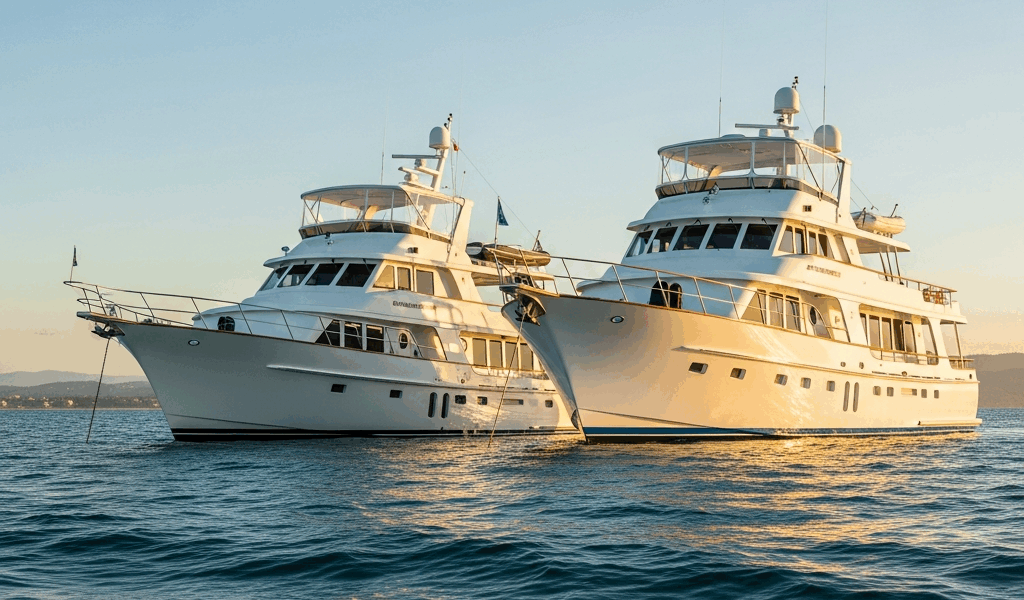
Nordhavn 40 vs Kadey-Krogen 42 for Blue Water Cruising
Two Trawler Icons With Very Different Philosophies
The Nordhavn 40 vs Kadey-Krogen 42 debate has grown more complex with the spec-sheet noise flying around. Displacement numbers, LOA, fuel capacity in tidy round figures. Nobody talks about how these boats actually feel at 0200 in a beam sea — or why one engine room will make you a better offshore sailor and the other will make you a more comfortable one. Those are genuinely different outcomes. They matter enormously depending on who you are.
As someone who has spent time aboard both hulls, I worked through the fundamentals of what separates these two boats philosophically. The Nordhavn 40 came via a delivery run from San Diego to Ensenada and back. The Krogen 42 through a week-long liveaboard charter out of Annapolis. Today, I will share it all with you.
The impression each boat leaves is almost comically distinct. The Nordhavn feels like a piece of equipment. The Krogen feels like a home. Neither is a criticism — but if you’re a couple trying to decide which one to stake your cruising life on for the next two to five years, that distinction is exactly where the decision lives. That’s what makes each of these boats endearing to the sailors who choose them.
Pacific Asian Enterprises built their reputation on ocean crossings. Their design philosophy starts with worst-case conditions and works backward toward comfort. Kadey-Krogen, out of Florida, came up through the Great Loop community and coastal cruising culture. Their boats are engineered around liveaboard quality for realistic North American routes. Neither builder is wrong. They’re answering different questions. But what is the core difference? In essence, it’s a gap in priorities between offshore capability and livability. But it’s much more than that.
Fuel Range and Passage-Making Capability
Worth putting near the top.
The Nordhavn 40 carries approximately 1,200 gallons of diesel — a figure that sounds almost absurd until you remember this boat was designed to cross oceans without a fuel dock. At a passage speed of 7 knots using its single Lugger L844D, or the more common John Deere 6068 in later hulls, fuel burn runs roughly 3.0 to 3.5 gallons per hour. Theoretical range lands somewhere between 2,400 and 2,800 nautical miles. Real-world range — factoring in current, headwinds, and the inevitable slog through short chop — comes in closer to 1,800 to 2,100 miles. Still extraordinary. A Nordhavn 40 crew can legitimately plan passages that most trawler owners simply cannot attempt without jerry cans strapped to the rail.
The Kadey-Krogen 42 carries around 700 to 750 gallons depending on hull year and configuration. At 7.5 knots behind a single Cummins 6BTA or Volvo TAMD, burn rate runs 3.0 to 3.8 GPH depending on conditions. Realistic range: 1,200 to 1,500 nautical miles. That covers the entire Great Loop with normal marina fuel stops. It handles an offshore Chesapeake-to-Bahamas passage with range to spare. What it doesn’t do is a Pacific crossing — or an unassisted run from the Pacific Northwest to Mexico and beyond — without very careful planning.
For a couple doing the Loop, the ICW, and Bahamas runs, the Krogen’s fuel capacity is genuinely sufficient. The Nordhavn’s extra 500 gallons comes at a cost — more displacement, a heavier hull — and you feel that weight on shorter passages where 1,800 miles of range was never relevant anyway. Know your actual routes before you decide this is a meaningful advantage. Don’t do what I did of treating range capability as prestige rather than utility.
Seakeeping, Stability, and Offshore Behavior
Hull form tells the story. The Nordhavn 40 runs a full keel with a pronounced forefoot — a design lineage that prioritizes directional stability and sea-kindly motion in open ocean swells. It tracks well under autopilot. The Furuno NavPilot 711C is a popular pairing, for what it’s worth. In long-period ocean swells it develops a slow, predictable roll that paravane stabilizers damp down effectively. Nordhavn designed the 40 specifically to accommodate paravanes, and many owners run them as the primary motion-damping system rather than active fins.
Paravanes require attention, though. Flopper stoppers streamed on their poles add windage, they’re a project to deploy and retrieve, and in following seas you’re managing the poles while also managing the boat. The upside is mechanical simplicity — no hydraulics required — and they work at anchor, which active fins don’t. Nordhavn owners who’ve crossed the Pacific generally swear by them for exactly that reason. This new approach to offshore stabilization took off several years after Nordhavn’s founding and eventually evolved into the paravane setup enthusiasts know and trust today.
The Krogen 42 uses a modified full keel with a flatter, more volume-forward hull form. It’s a beamier boat — 14 feet 2 inches versus the Nordhavn’s 14 feet 6 inches, though the Krogen’s interior beam feels significantly larger in practice. In a 4-to-6-foot beam sea, the Krogen exhibits more initial roll than the Nordhavn but recovers smoothly. Many owners install active Wesmar or Naiad fin stabilizers and report excellent motion comfort at passage speeds.
Humbled by a rough overnight run from Cape Hatteras northbound in a borrowed Krogen 42, I learned that even a well-stabilized trawler in beam seas with 2 knots of adverse current is a full-time physical job. The Krogen handled it without drama. But the question is whether your passage plan regularly puts you into those conditions. Honest answer for most Great Loop and coastal couples — it rarely does.
Liveaboard Systems, Maintenance, and Cost of Ownership
Engine room access on the Nordhavn 40 is exceptional by almost any trawler standard. The single-engine layout — large center hatch, full standing headroom over the Deere, organized plumbing runs — makes the boat genuinely maintainable by a competent owner-operator. Twin generators are standard on most hulls. Commonly a Northern Lights M944 as primary with a smaller backup unit. Most hulls also carry a CAT or Spectra watermaker in the 60 to 80 GPD range. The redundancy focus is real and it shows throughout the systems architecture.
The Krogen 42 prioritizes liveaboard quality over redundancy count. You’ll commonly find a single Onan 7.5 kW genset, a single watermaker — often a Sea Recovery or Village Marine unit — and very well-finished interiors with serious insulation and sound attenuation that the Nordhavn simply doesn’t match. The Krogen galley is a functional kitchen. The main saloon has standing headroom and natural light in a way that accumulates meaning over months, not days.
On the used market right now, a mid-2000s Nordhavn 40 in good condition trades between $550,000 and $750,000 depending on equipment and hours. The same vintage Kadey-Krogen 42 runs $380,000 to $520,000. That’s a meaningful gap. The Nordhavn commands a premium reflecting both builder reputation and genuine offshore systems investment. A well-equipped Krogen 42 can be outfitted with a backup generator and upgraded watermaker for well under $50,000 — narrowing the systems gap considerably while keeping the price gap intact.
I’m apparently a John Deere 6068 partisan and that engine works for me, while the Volvo TAMD configuration never felt as intuitive during maintenance. Doesn’t make the Volvo wrong. The Cummins 6BTA in many Krogens is equally well-supported worldwide. Neither boat will strand you somewhere obscure for lack of parts. Where Nordhavn owners tend to report higher ongoing costs is mechanical complexity — more through-hulls, more plumbing runs, more systems to maintain. The Krogen runs leaner. That actually lowers the long-term maintenance overhead for a couple doing their own work.
Which Boat Fits Which Cruiser
So, without further ado, let’s dive in on the actual decision framework.
The Nordhavn 40 might be the best option for passages over 1,200 miles, as blue water cruising requires genuine offshore range. That is because redundancy and capability at sea matter more than interior square footage when you’re 800 miles from the nearest marina. It is a serious offshore tool. It will take you places the Krogen cannot reach without substantial logistical planning. If your definition of success is crossing an ocean, the Nordhavn is not optional — at least if you’re being honest about the routes you’re planning.
The Kadey-Krogen 42 is the right boat if you’re a couple planning the Great Loop, extended coastal cruising, Bahamas seasons, and occasional offshore passages in the 500-to-800-mile range. More livable, more affordable, and — for the routes most North American cruising couples actually run — more than capable. The comfort advantage accumulates over months of living aboard in a way that matters to real people in real relationships. That’s what makes the Krogen endearing to us coastal cruisers.
First, you should be brutally honest about your actual cruising plan — at least if you want to avoid a very expensive mistake. The error I see most often is letting aspirational passage plans drive buyers toward a Nordhavn 40 when their actual cruising life will be the ICW and a Bahamas run or two. Buy the boat for the life you’ll actually live. Not the one you might live someday. If genuine offshore passages over 1,500 miles are on your calendar within the next three years, the Nordhavn earns every dollar of its premium. Go make an offer. If they’re not — call a Krogen broker this week and stop second-guessing yourself.


Stay in the loop
Get the latest passage maker mag updates delivered to your inbox.